wayground logo

Free Printable Worksheets

Font size

S
M
L
XL
Worksheets

atomic structure practice

Total questions: 91

Worksheet time: 3hrs 34mins

Name
Class
Date
1.

What is the name of the center part of an atom?

(a)  

2.

Which subatomic particles (pieces of an atom) are found in the nucleus?

a)

Proton

b)

Neutron

c)

Electron

3.

Which subatomic particle is NOT found in the nucleus?

a)

Proton

b)

Neutron

c)

Electron

4.
What is the number of protons that the element in this image contain?
a)
14
b)
7
c)
15
d)
18
5.
What does the 1.00794 stand for?
a)
Hydrogen
b)
atomic number
c)
atomic mass
d)
the mass #
6.
Elements are represented by chemical symbol.  Symbols are written with
a)
all lower case letters.
b)
all capital letters.
c)
always only one  letter.
d)
at least and ONLY one capital letter.
7.
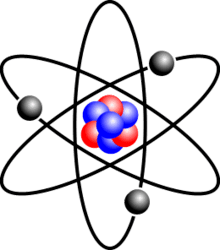
The subatomic particles in red are
a)
Electrons
b)
Neutrons
c)
Protons
8.
What is the biggest difference between an atom of cobalt (Co) and an atom of nickel (Ni), as shown in the periodic table entries?
a)
An atom of nickel has more protons.
b)
An atom of cobalt has more electrons.
c)
An atom of cobalt has a lower number of neutrons.
d)
An atom of nickel has a higher value for atomic mass.
9.

How many electrons does Oxygen have?

a)

16

b)

8

c)

15.99

d)

O

10.
True or False - Protons and Neutrons have about the same mass.
a)
True - They have about the same mass
b)
False - They do not have about the same mass
11.
a)
Protons + Electrons
b)
Atomic Number - Mass
c)
Mass - Atomic Number 
12.

An element has the mass number 12 and atomic number 6. The number of neutrons in it is:

a)

6

b)

10

c)

4

d)

8

13.

Which subatomic particle has a negative charge in the atom?

a)

proton

b)

neutron

c)

electron

d)

quark

14.

If an atom has 10 electrons, how many protons does it have?

a)

0

b)

1

c)

10

d)

5

15.

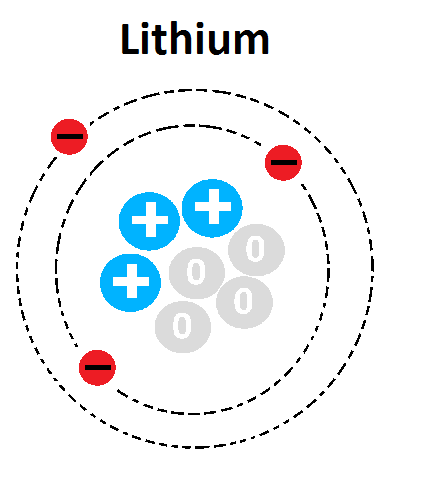
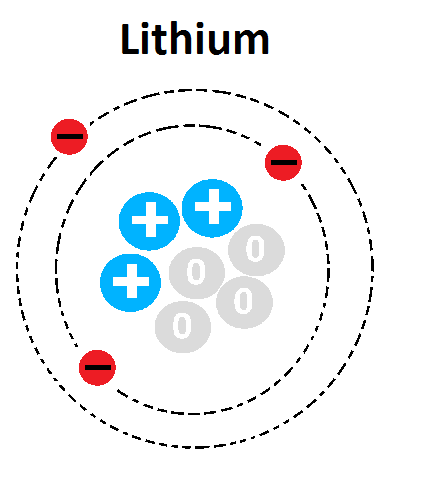
What is the mass number of this atom?

a)

1

b)

3

c)

4

d)

7

16.
What is the atomic number of this atom?
a)
1
b)
3
c)
4
d)
7
17.
What is the mass number defined as?
a)
the number of protons
b)
the number of protons and neutrons
c)
the number of neutrons
d)
the number of protons and electrons
18.
An element has the mass number 12 and atomic number  6. The number of neutrons in it is:
a)
6
b)
10
c)
4
d)
8
19.
What is the atomic number?
a)
the number of protons
b)
the number of protons and neutrons
c)
the number of neutrons
d)
the number of protons and electrons
20.
What is true about a neutral atom?
a)
The number of protons equal the number of neutrons
b)
The number of protons equal the number of electrons
c)
The number of neutrons equal the number of electrons
d)
The number of protons, neutrons, and electrons are all different
21.
The nucleus is ____________ charged whereas the electron cloud is ____________ charged. 
a)
negatively, positively
b)
negatively, negatively
c)
positively, positively
d)
positively, negatively
22.
The  mass of an atom is located  in the ___________ and the volume of an atom is made of the ____________
a)
electron cloud, nucleus
b)
electron cloud, energy levels
c)
nucleus, electron cloud
d)
nucleus, neutrons
23.

What does the 1.0079 stand for?

a)

atomic number

b)

hydrogen

c)

atomic mass

d)

mass number

24.
the central region of an atom where its neutrons and protons are is its 
a)
nucleus 
b)
electron cloud
c)
core 
d)
center 
25.
an atom with atomic number 6 would have how many protons 
a)
6
b)
12
c)
3
d)
cannot be determined 
26.
all matter is made of what 
a)
energy 
b)
atoms 
c)
electrons 
d)
compounds 
27.
Particles in an atom that are neutral and have no charge are 
a)
negatrons 
b)
electrons 
c)
neutrons 
d)
protons 
28.
The positive particles of an atom are 
a)
electrons 
b)
positrons 
c)
neutrons 
d)
protons 
29.
What is the atomic mass of Neon?
a)
10
b)
20.18
c)
10.18
d)
20.18
30.
How many protons are in Beryllium?
a)
4
b)
9
c)
5
d)
2
31.
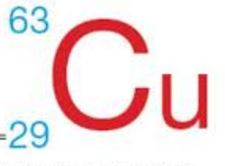
What is the atomic mass of Copper?
a)
63
b)
29
c)
34
d)
92
32.
How many neutrons are in a Gold atom?
a)
79
b)
196
c)
118
d)
275
33.
How many electrons does a Copper atom have?
a)
63
b)
29
c)
92
d)
34
34.
What is the atomic mass of Gold?
a)
79
b)
196.9665
c)
117
d)
275
35.
What is the atomic weight of Helium
a)
4
b)
2
c)
6
d)
1
36.
What is the atomic mass of Hydrogen?
a)
1
b)
2
c)
3
d)
0
37.
How many neutrons does a Hydrogen atom have?
a)
1
b)
2
c)
3
d)
0
38.
How many electrons does an Iodine atom have?
a)
53
b)
126
c)
73
d)
179
39.
How many electrons are in a gold atom?
a)
79
b)
196
c)
117
d)
275
40.
What is the atomic weight of Iron?
a)
26
b)
55.845
c)
56
d)
30
41.
How many electrons does an atom of Krypton have?
a)
36
b)
83.80
c)
47.80
d)
119.80
42.
What number is circled?
a)
Number of Neutrons
b)
Number of Protons
c)
Atomic Mass
d)
Number of Electrons
43.
How many neutrons does an Oxygen atom have?
a)
8
b)
16
c)
24
d)
7.999
44.
What is the number highlighted?
a)
Atomic number
b)
Atomic mass
c)
Number of protons
d)
Number of electons
45.
What is this number representing?
a)
Number of protons
b)
Number of Protons and Electrons
c)
Number of Protons and Neutrons
d)
Number of Electrons, Protons and Neutrons
46.
What does this number represent?
a)
Number of protons
b)
Number of neutrons
c)
Number of electrons
d)
Number of protons and neutrons
47.
What is the atomic mass of Sodium?
a)
11
b)
22.9898
c)
33.9898
d)
11.9898
48.

What is at the center of every atom?

a)

An electron

b)

A compound

c)

A molecule

d)

A nucleus

49.
Which two particles make up the nucleus of an atom?
a)
Protons and Electrons
b)
Protons and Neutrons
c)
Molecules and Compounds
d)
Neutrons and Electrons
50.
What is the role of an electron in an atom?
a)
Electrons live inside the nucleus and carry a neutral charge.
b)
Electrons circle the nucleus and have a positive charge.
c)
Electrons circle the nucleus and have a negative charge.
d)
Electrons live inside the nucleus and have a negative charge.
51.
Which of the following determines the type of element that an atom makes?
a)
The size of the nucleus.
b)
The number of protons.
c)
How much the atom weighs.
d)
The number of neutrons.
52.
A proton is a _____ charged particle.
a)
Negatively
b)
Positively
53.
An electron is a _____ charged particle.
a)
Positively
b)
Negatively
54.
What is an atomic number?
a)
The sum of protons and neutrons in an atom.
b)
The sum of protons and electrons in an atom.
c)
The number of protons in an atom of a specific element.
d)
The number of neutrons in a specific element.
55.

The number of neutrons equals...

a)

atomic number - mass number

b)

Protons - neutrons

c)

Electrons - protons

d)

mass number - atomic number

56.
The atoms of any given element ____ have the same number of protons.
a)
sometimes
b)
always
c)
never
57.
Where are protons located in the atom?
a)
orbitals
b)
nucleus
c)
rings
d)
positive
58.
Where are neutrons located in the atom?
a)
shells/orbitals
b)
rings
c)
center
d)
nucleus
59.
The number of protons plus neutrons.
a)
Mass number
b)
Mass Weight
c)
Atomic number
d)
Atomic weight
60.
The total number of Protons and Neutrons.
a)
Mass Number
b)
Atomic Number
c)
Matter
d)
Ion
61.
Number of protons in an atom.
a)
Atomic Number
b)
Mass Number
c)
Isotope
d)
Valence electrons
62.
Negatively charged Particle
Mass:  Almost Nothing
a)
Protons
b)
Neutrons
c)
Electrons
d)
Isotopes
63.
Neutral Charged Particle
Mass: 1 Amu
a)
Proton
b)
Neutron
c)
Electron
d)
Isotope
64.
Positively Charged Particle
Mass: 1 amu
a)
Proton
b)
Neuton
c)
Electron
d)
Isotope
65.
Although carbon's three isotopes are carbon-12, carbon-13, and carbon-14, its average atomic mass is 12.01 because
a)
Carbon-12 is the heaviest isotope
b)
Carbon-12 is the most useful to humans
c)
Carbon-12 is the most common isotope
66.
An ion forms when an atom gains or loses
a)
Protons
b)
Neutrons
c)
Electrons
67.
Isotopes are atoms that have different
a)
Mass numbers
b)
Element names
c)
Atomic Numbers
68.
A neutral atom would become an ion that has a charge of 2+ by 
a)
Losing two protons
b)
Losing two neutrons
c)
Losing two electrons
69.
Two atoms that have different numbers of protons are 
a)
Different ions
b)
Different isotopes
c)
Different elements
70.
If neutral copper atom (atomic number 29) becomes an ion that has a charge of 2+, how many electrons does the resulting ion have?
a)
27
b)
28
c)
29
d)
31
71.
Which phrase describes two atoms that are isotopes
a)
Same mass number, same atomic number
b)
Same mass number, different atomic number
c)
Different mass number, same atomic number
d)
Different mass number, different atomic number
72.
Two neutral atoms that have the same atomic number and different mass numbers are
a)
Ions
b)
Isotopes
c)
Alpha particles
d)
Different elements
73.
An ion that has a negative charge is formed when an atom 
a)
Loses neutrons
b)
Loses electrons
c)
Gains neutrons
d)
Gains electrons
74.
What information would allow you to determine whether two atoms are of the same or different elements
a)
The charge on each atom
b)
The number of neutrons each has
c)
The number of protons in their nuclei
d)
The location of the electrons in their electron clouds
75.
How are Protons and Neutrons similar
a)
Both are in the nucleus of the atom and they both have the relative mass of 1
b)
They both have alpha particles and have the relative mass of 2
c)
They both have 1 high-energy electron and different elements
76.
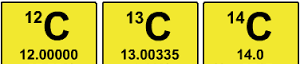
What do these isotopes of carbon all have in common?
a)
neutrons & mass number
b)
atomic number and neutrons
c)
atomic number and electrons
d)
protons, atomic number, and mass number
77.
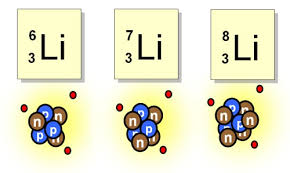
How many neutrons does the isotope of lithium have?
a)
8
b)
3
c)
4
d)
5
78.
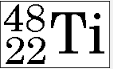
How many protons does this isotope of titanium have?
a)
48
b)
22
c)
26
d)
70
79.
In a correctly written symbol what would be located in the "A" position?
a)
number of neutrons
b)
atomic number
c)
number of electrons 
d)
mass number
80.
What quantities vary between isotopes of an element?
a)
protons, electrons, and atomic mass
b)
protons, electrons, and atomic number
c)
neutrons and electrons
d)
neutrons and atomic mass
81.
which atom has  4 neutrons?
a)
Li-6
b)
Li-7
c)
Li-8
d)
they have the same # of neutrons
82.
How many neutrons in C-14?
a)
6
b)
7
c)
14
d)
8
83.
How many neutrons does the isotope below have?     89 36Kr
a)
53
b)
36
c)
89
d)
125
84.
Isotopes are atoms of the same element with different #’s of __________ & therefore different __________.
a)
n0 ;  atomic #’s
b)
p+ ; atomic #’s
c)
e- ; atomic masses
d)
n0 ; atomic masses
85.
If X is the symbol for an element, which of the following two symbols represent    isotopes of the same element?     I. 7735X  II. 7733X  III. 8137X  IV. 8135 X
a)
I and II
b)
III and IV
c)
I and IV
d)
I and III
86.
How many neutrons does an atom of the isotope Neon-22 have?
a)
12
b)
10
c)
22
d)
20
87.
Four isotopes of lead include lead-204, lead-206, lead-207, and lead-208.  The average atomic mass of lead is 207.2.  Which isotope of lead is likely to be the most abundant.
a)
204
b)
206
c)
207
d)
208
88.
An atom is electrically neutral when
a)
protons and neutrons are the same
b)
protons and electrons are the same
c)
neutrons and electrons are the same
d)
neutrons balance the protons and electrons
89.
If the number of electrons in an atom changes you make a(n) __________________.
a)
ion
b)
isotope
c)
new element
d)
isomer
90.
How many electrons are in an atom that has an atomic number of 34, an atomic mass of 74 and a charge of -2?
a)
34
b)
36
c)
2
d)
40
91.
Ions are: 
a)
atoms with a positive or negative charge
b)
atoms with no charge
c)
atoms with ONLY a positive charge
d)
atoms with ONLY a negative charge