Wayground logo

Free Printable Worksheets

Font size

S
M
L
XL
Worksheets

Classification Review

Total questions: 44

Worksheet time: 1hrs 2mins

Name
Class
Date
1.
The diagram below represents a possible evolutionary pathways of certain organisms. Which species is most closely related to species L? 
a)
E
b)
F
c)
G
d)
I 
2.
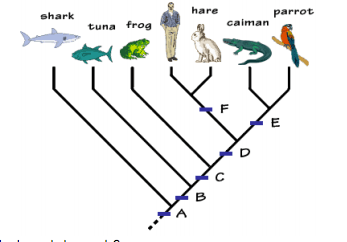
According to this cladogram, sharks are MOST closely related to which organism? 
a)
Amphibians
b)
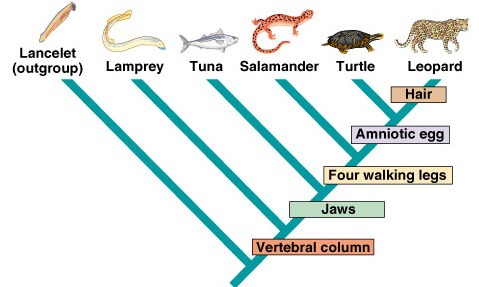
Ray finned fish
c)
Crocodiles
d)
Birds
3.
Cladograms are constructed by grouping organisms together based on their____________ characteristics.
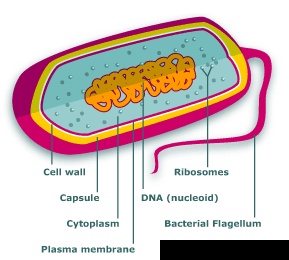
a)
shared
b)
different
c)
similar
d)
opposite
4.
What are the three domains?
a)
Green, Blue, Red
b)
Autotrophic, Heterotrophic, Both
c)
Archea, Eukarya, Bacteria
d)
Marine Organism, Land Organism, or Both
5.
Which kingdom contains members who are prokaryotic?
a)
Archaebacteria and Eubacteria
b)
Archaebacteria and Protista
c)
Eubacteria and Animalia
d)
Eubacteria  and Fungi
6.
Members of this kingdom have cell walls made of cellulose
a)
Eubacteria
b)
Protista
c)
Plantae
d)
Fungi
7.
Members of this kingdom never have a cell wall
a)
Animalia
b)
Plantae
c)
Archaebacteria
d)
Protista
8.
Cells that do not have a true nucleus are called....
a)
eukaryote
b)
prokaryote
c)
unicellular
d)
multicellular
9.
Cells that have a true nucleus are called....
a)
eukaryotes
b)
prokaryotes
c)
unicellular
d)
multicellular
10.
Organisms that are classified as autotrophic are able to-
a)
be seen with the human eye
b)
move
c)
reproduce
d)
make their own food
11.
Which domain contains organisms that are unicellular, prokaryotic, and can cause strep throat or e. coli infections?
a)
Eukarya
b)
Archaea
c)
Fungi
d)
Bacteria
12.
Organisms that CAN'T make their own food are... 
a)
Autotrophic
b)
Heterotrophic
c)
Unicellular
d)
Multicellular 
13.
What word means made up of many cells 
a)
Unicellular
b)
Mulitcellular
c)
Autotrophic
d)
Heterotrophic 
14.

The scientific name of a cherry blossom tree is Prunus yedoensis. What is its genus?

a)

Plantae

b)

Prunus

c)

Yedoensis

d)

Felis

15.

What is the correct order of Classification?

a)

Phylum, Kingdom, Class, Order, Family, Genus, Species

b)

Kingdom, Phylum, Order, Class, Family, Genus, Species

c)

Kingdom, Phylum, Class, Order, Family, Genus, Species

d)

Kingdom, Phylum, Class, Family, Genus, Species

16.

The scientific name for an organism comes from its _____.

a)

class and phylum

b)

family and species

c)

kingdom and phylum

d)

genus and species

17.

On this Cladogram, which animals have fur?

a)

Mouse, Chimp

b)

Pigeon, Mouse, Chimp

c)

Lizard, Pigeon, Mouse, Chimp

d)

Chimp

18.

What Level of Classification is missing from the RED section?

a)

Kingdom

b)

Order

c)

Genus

d)

Species

19.

What Level of Classification is missing from the ORANGE section?

a)

Genus

b)

Family

c)

Kingdom

d)

Species

20.

Using the cladogram below, which animals DON'T have lungs?

a)

Hagfish and Perch

b)

Salamander and Lizard

c)

Mouse and Chimp

d)

Pigeon

21.

The scientific name of an Platypus is Ornithorhynchus anatinus, what is the species?

a)

Ornithorhynchus

b)

anatinus

22.
Which of the following is the least closely related animal:
Gray Wolf: Canis lupus
Aardwolf: Proteles cristatus
Coyote: Canis latrans
a)
Coyote
b)
Aardwolf
c)
Gray Wolf
d)
Need more information on body characteristics
23.
Organisms that are unicellular, plant-like or animal-like or fungus-like, live in damp or wet places like ponds, rivers, or streams.
a)
Kingdom Fungi
b)
Kingdom Plantae
c)
Kingdom Animalia
d)
Kingdom Protista
24.
Organisms that are multicellular, photosynthetic autotrophs, reproduce sexually or asexually belong to this Kingdom:
a)
Animalia
b)
Fungi
c)
Monera
d)
Plantae
25.
Organisms that are eukaryotic, unicellular OR multicellular, decomposers or parasites belong to this Kingdom:
a)
Protista
b)
Fungi
c)
Plantae
d)
Archaebacteria
26.
A group of organisms that look alike and can reproduce among themselves is known as a:
a)
Genus
b)
Phylum
c)
Species
d)
Animal Family
27.
Which of the six kingdoms correspond to the domain Eukarya?
a)
the kingdoms Eubacteria and Archaebacteria only
b)
the kingdoms Eubacteria, Archaebacteria, Protista, and Fungi only
c)
the kingdoms Plantae and Animalia only
d)
the kingdoms Protista, Fungi, Plantae, and Animalia only
28.

On the cladogram, which organism is the closest relative of the parrot?

a)

Frog

b)

Hare

c)

Caiman

d)

Parrot

29.

Which is the newest trait?

a)

Amniotic egg

b)

Walking legs

c)

Jaws

d)

Hair

30.
According to this cladogram, birds are LEAST related to -
a)
Amphibians
b)
Sharks
c)
Ray Finned Fish
d)
Crocodiles
31.

What traits do the leopard and the turtle share? (Multiple choices)

a)

hair

b)

amniotic egg

c)

four walking legs

d)

jaws

32.

What separates a salamander from a turtle in this cladogram?

a)

four walking legs

b)

amniotic egg

c)

hair

d)

jaws

33.
Where is the T.rex and frog's common ancestor?
a)
Point A
b)
Point B
c)
Point C
d)
Point D
34.
A scientific name consists of 
a)
Genus and Order
b)
Genus and Domain
c)
Genus and species
d)
Kingdon and Phylum
35.

What is the main difference between prokaryotic and eukaryotic cells?

a)

Prokaryotic cells are found only in multicellular organisms

b)

Eukaryotic cells are found only in unicellular organisms

c)

Eukaryotic cells have a nucleus and prokaryotic cells do not

d)

Prokaryotic cells have DNA and eukaryotic cells do not
36.
Which type of cell?
a)
Prokaryote
b)
Eukaryote
37.
Which domain is capable of living in extreme environments like hot springs, geysers, or very salty waters?
a)
Bacteria
b)
Archaea
c)
Eukarya
38.
Which domain includes all animals and plants?
a)
Archaea
b)
Eukarya
c)
Bacteria
39.
How do scientists organize living things?
a)
by looks
b)
by shared characteristics
c)
by size
d)
by differences
40.
The method bacteria use to reproduce is
a)
asexual
b)
sexual
c)
artificial selection
d)
replication
41.

I have no cell walls

I am eukaryotic

I reproduce sexually

I am multicellular

What kingdom do I belong to?

a)

Plant

b)

Animal

c)

Protist

d)

Fungi

42.

Bacteria

a)

are always bad for you

b)

have a nucleus

c)

do not have DNA

d)

can be beneficial

43.

If the ocular lens has a magnification of 10x and the high power objective has a power of 40x, what is the total magnification of a microscope on high power?

a)

50x

b)

10x

c)

40x

d)

400x

44.

Daniel finds a sample of a multicellular, heterotrophic organism decomposing a fallen tree. What does he know about the cells of this organism?

a)

they do not have DNA

b)

they are the oldest form of life

c)

they have a nucleus

d)

they do not have a nucleus