
 Worksheets
9.2 - Cycles of Matter (Water, Carbon, Nitrogen)
Total questions: 42
Worksheet time: 27mins
What is precipitation?
Sweat from our bodies on hot days
Warm rain but not cold snow or sleet
Gas that we use in furnaces or ovens
Any form of water that falls from the sky

What is another name or synonym for the water cycle?
Geologic cycle
Hydrologic cycle
Geosphere
Carbon cycle

What is the energy source that drives the water cycle?
The moon T
The heat from our home in the winter all around the world
The sun
he heat generated solely from the core of the earth
The _________ exerts a major influence on weather and climate by absorbing energy from the sun, releasing it over time, and globally redistributing it through ocean currents.
Sun
Ocean
Continents
Desert

What are formed when water vapor condenses?
Clouds
Mountains
Transpiration
Valleys

The act of turning from a gas into a liquid. ________________________
Condensation
Evaporation
Transpiration
Precipitation

The act of turning from a liquid into a gas. ___________________
Transpiration
Condensation
Evaporation
Precipitation
The draining away of water from the surface of an area of land.
weathering
transpiration
run-off
precipitation

The process where plants absorb water through the roots and then give off water vapor through pores in their leaves. __________________________
Transpiration
Condensation
Evaporation
Precipitation
The amount of fresh water on Earth is _______%.
3
5
95
97
The amount of salt water on Earth is _____%.
3
5
95
97
Carbon Dioxide
Carbon Monoxide
How is the burning of fossil fuels related to global warming?
Carbon Cycle
Fuels are hot
Greenhouse effect
Photosynthesis
Which of the following removes carbon from the atmosphere?
Combustion
Cellular Respiration
Photosynthesis
Death
Organisms that die and did not decompose can be buried and eventually may become _____.
soil
nutrients
air
fossil fuels
Which process converts carbon, in the form of glucose, into carbon dioxide gas?
Condensation
Photosynthesis
Cellular Respiration
Transpiration
carbon dioxide is a gas produced by ________ and used by __________
plants and animals
carbon and photosynthesis
animals and plants
photosynthesis
animals and animals
Which is a true statement?
Animals depend on oxygen, plants depend on carbon dioxide
Plants produce carbon dioxide
Animals depend on carbon dioxide, plants depend on oxygen
Animals don't depend on plants for the air they need
Plants use ____________ to make their own food
Water
Sunlight
Carbon dioxide
All of these
Photosynthesis ____________ the amount of carbon dioxide in the atmosphere.
increases
decreases
keeps the same
Organism death ____________ the amount of carbon in the soil.
increases
decreases
keeps the same
What converts nitrogen gas into a usable form for plants and animals?
bacteria
rain
fungi
car exhaust
lightning
The process in which nitrogen circulates and is recycled is called
The nitrogen cycle
The carbon cycle
The water cycle
The phosphorus cycle
Organisms that need nitrogen to survive.
only plants
only animals
only bacteria
all living things
How is nitrogen "fixed" into a usable form for plants?
Through action of bacteria only
Through lightning only
Through action of bacteria and lightning
Through photosynthesis
How do animals get the nitrogen they need?
From the air they breathe
From the water they drink
From the food they eat
From the sun
Gas that makes up 78% of our atmosphere.
Oxygen
Nitrogen
Hydrogen
Carbon Dioxide
What is the process of combining nitrogen gas with other elements to make nitrogen into usable compounds?
nitrogen composition
nitrogen fixation
ammonia
denitrification
What is the formula for atmospheric nitrogen?
N
N2
NH3
NO3
What process occurs when dead plant and animal matter decomposes and nitrogen is released back into the atmosphere?
Assimilation
Fixation
Ammonification
Denitrification
Plants and animals cannot use nitrogen directly from the air.
True
False
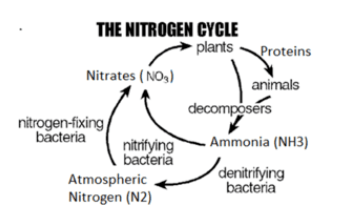
According to this diagram, plants use nitrogen to make _________________________
bacteria
animals
proteins
decomposers
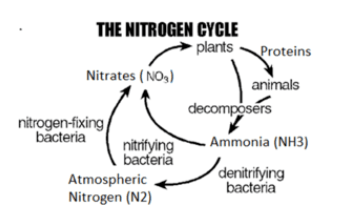
According to this diagram, plants absorb
nitrates
nitrogen fixing bacteria
animals
decomposers
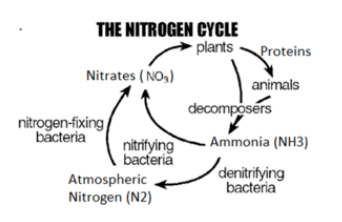
According to this diagram, animals get proteins from ________________________
decomposers
bacteria
plants
sunlight
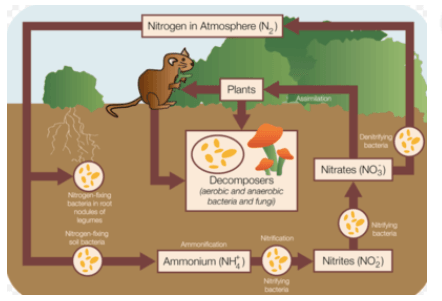
A correct path that nitrogen could take would be
air -> animals -> plants -> bacteria
animals -> air -> bacteria -> plants
bacteria -> air -> plants -> animals
air -> bacteria -> plants -> animals
Bacteria fix nitrogen from the atmosphere into a form plants can use.
True
False
Bacteria create a form of nitrogen that animals can use directly.
True
False
What do free living bacteria in the soil do?
Make nitrogen into glucose
Turn atmospheric nitrogen into nitrates
Make carbon dioxide for plants to go through photosynthesis
Help plants take in water
All plants have nitrogen fixing bacteria in their roots.
True
False
Examples of plants that can fix nitrogen are _______
clover
grass
trees
legumes
peanuts

