Worksheets
Unit 2 Plate Tectonics & Rock Cycling
Total questions: 60
Worksheet time: 1hrs 10mins

Weathering is defined as________
The transport of sediments
The breaking down of rocks into smaller pieces called sediment
The deposit of sediment
None of these


Erosion is defined as ________
The transport of sediment
The break down of rocks into sediment
The depositing of sediment
None of these
solid materials such as rock fragments, plant and animal remains, or minerals that are carried by water or by air and that settle on the bottom of a body of water or on the ground
fossil
ore
mineral
sediment
rock formed as pieces of older rocks and other loose materials get pressed or cemented together or as dissolved minerals reform and build up in layers.
metamorphic rock
rock cycle
sedimentary rock
igneous rock
rock formed as heat or pressure causes existing rock to change in structure, texture, or mineral composition
igneous rock
metamorphic rock
sediment
sedimentary rock
rock that forms as molten rock cools and becomes solid
metamorphic rock
sedimentary rock
ore
igneous rock
Molten rock beneath the earth's surface.
magma
lava
core
igneous rock
molten rock that reaches a planet’s surface through a volcano
metamorphic rock
lava
inner core
magma

Using the image, what is the process shown by #4?
Weathering and Erosion
Heat and Pressure
Cooling
Compacting and Cementing
Using the image, what rock type would be found at #2?
Metamorphic
Igneous
Sedimentary
Using the image, what is the process shown by #5?
Heat and Pressure
Melting
Weathering and Erosion
Compacting and Cementing

In the picture, what is the process shown by #7?
Weathering and Erosion
Heat and Pressure
Melting
Cooling
Compacting and Cementing

In the picture, what rock type would be found in #1?
Metamorphic
Sedimentary
Igneous

In the picture, what is the process shown by #6?
Melting
Heat and Pressure
Cooling
Weathering and Erosion

Using the picture, what is the process shown by #8?
Melting
Cooling
Compacting and Cementing
Heat and Pressure
Weathering and Erosion

In the picture, what rock type would be found at #3?
Sedimentary
Metamorphic
Igneous


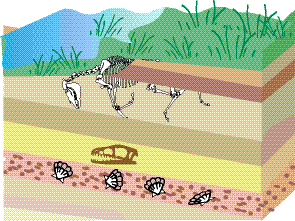
What is the best index fossil?
1
2
3
4
What is the best reason that fossil #4 is NOT a good index fossil?
It is not widespread
it is not short-lived (in numerous layers)
It is in half of the outcrops

Of these, which would make the best index fossil?
trilobite
bird
dinosaur
fish
plant


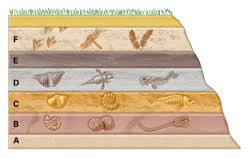


Which layer is youngest?
A
B
C
D

Letter E represents?
an intrusion
a volcanoe
a fault line
a pipe line
Choose the correct statement concerning A and D
A had to be formed in order for D to intrude
D and A formed at the same time
A was formed on top of D
D formed before A

What occurred most recently?
Layer A formed
D intruded through layer A
All rock layers shifted due to fault line
Left side of Layer A eroded

What is the order of these layers (OLDEST to YOUNGEST)
BADFEC
BACDEF
FDBACE
FBADEC

Which of the following is true about the Appalachian Mountains? Choose all that apply.
Old, eroded mountains
They are higher than the Rocky Mountains
They are the oldest mountain chain in North America
They are lower than the Rocky Mountains in elevation.
They contain the highest point in North America.

Which of the following is true about the Rocky Mountains? Choose all that apply.
Old, eroded mountains
They are younger than the Appalachian Mountains
They are taller than the Appalachian Mountains
They are lower than the Appalachian Mountains in elevation.
They are continuing to grow higher in elevation.

Why did Pangaea initially break up?
An asteroid impact followed by climate change
Convection currents in the mantle
The magnetic field
Pressure in the inner core

Which evidence did Wegener make use of to develop the theory of continental drift?
There is no evidence of glaciers anywhere in South America.
Similar fossils were found on different continents.
The climate of Siberia has always been the same.
The Rocky Mountains are taller than the Appalachian Mountains.
The theory of continental drift was widely unaccepted until scientists started using ________ to map the ocean floor.
Maps
Submarines
SONAR (Sound Navigation and Ranging)
Volcanoes

Which of the following is true concerning plates?
Plates are composed of continents only
Plates stopped moving 4.5 billion years ago
Plates can be composed of continent and ocean floor
All plates are moving and separating away from each other

Lystrosaurus was a slow-moving, plant-eating reptile that lived over 250 million years ago. Fossils of Lystrosaurus have been found in the brown areas shown below. How is this explained by the existence of Pangaea?
Lystrosaurus swam across the oceans from one continent to another.
Lystrosaurus drifted on rafts of vegetation from one continent to another.
and bridges once crossed oceans to connect Africa, Antarctica, and India.
Africa, Antarctica, and India used to be joined together into a single landmass.
Broken pieces of the ____________ are now known as tectonic plates.
crust
lithosphere
asthenosphere
core
What is the name of the layer that contains the uppermost mantle and crust
Lithosphere
Atmosphere
Asthnosphere
Mesosphere

Convection occurs because:
Molten rock comes close to the Earth’s core it heats up, becomes less dense and rises, and rock near the Earth’s crust cools down, becomes more dense, and sinks causing the cycle of convection
Small earthquakes occur within the Earth’s crust causing rocks to shake and change temperature
Oceanic crust is being destroyed at deep ocean trenches
Convection does not occur within the Earth

Seafloor spreading...
creates new oceanic crust
destroys or recycles crust
creates new continental crust
creates old crust
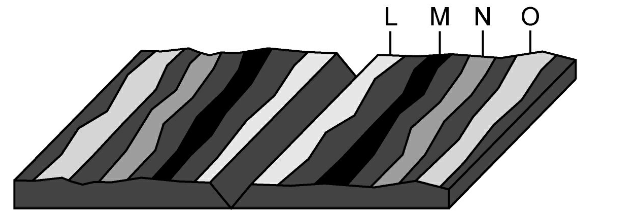
Rock at the mid ocean ridges...
is the oldest rock on the earth.
is older than continental rock.
is younger than continental rock.
The OLDEST seafloor is located
closest to the mid-ocean ridge.
farthest from the mid-ocean ridge.
east of Hawaii
west of California