
 Worksheets
Bonding and Intermolecular Forces Review
Total questions: 50
Worksheet time: 34mins
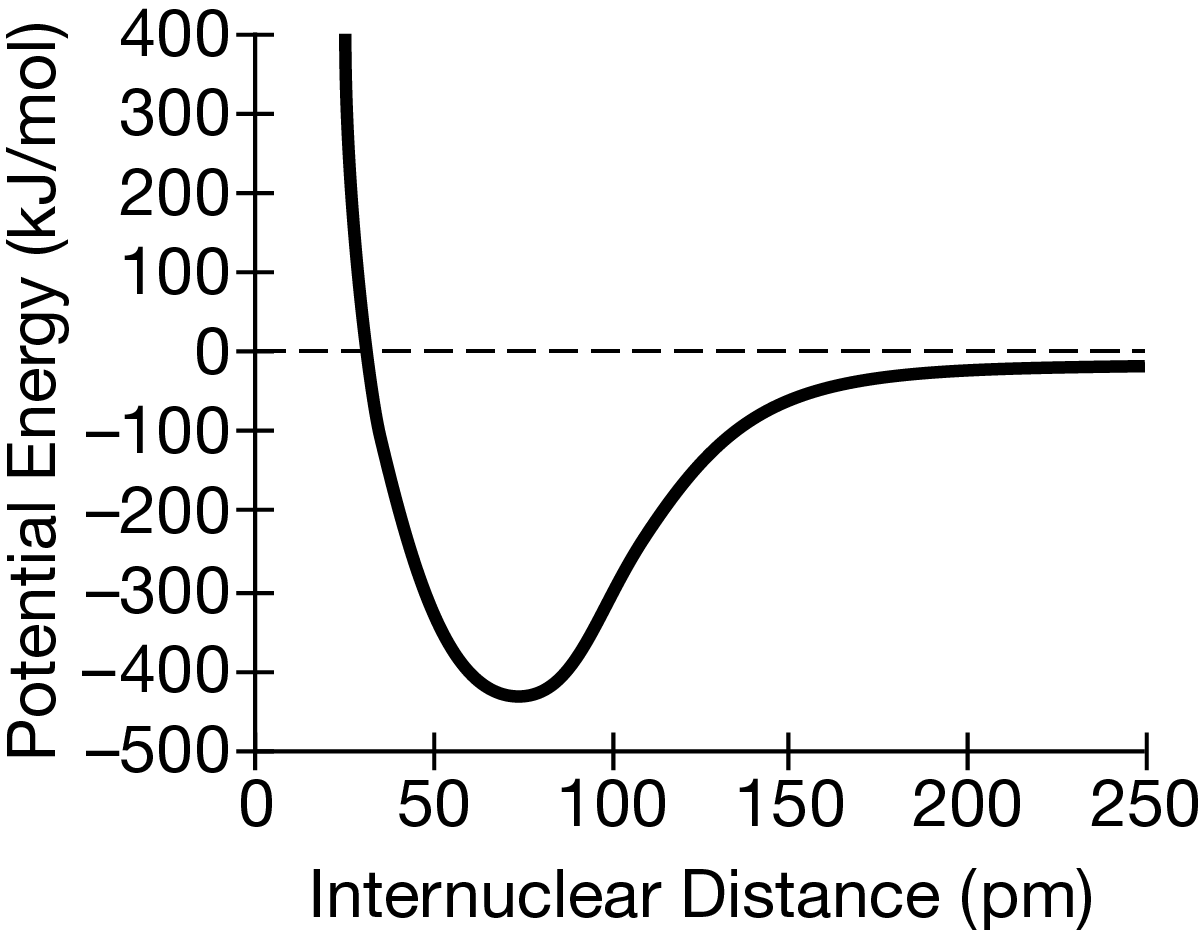
Which of the following can be inferred from the diagram above that shows the dependence of potential energy on the internuclear distance between two atoms?
The atoms form a bond with a bond length of 25pm.
The atoms form a bond with a bond length of 75pm
75pm.
The net force between the atoms is attractive at 25pm
25pm.
The net force between the atoms is attractive at 75pm
75pm.
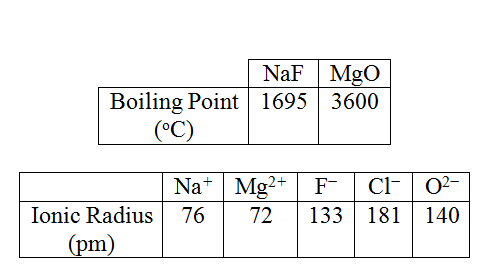
Based on the data in the tables above, which of the following statements provides the best prediction for the boiling point of NaCl ?
NaCl will have a lower boiling point than NaF because the coulombic attractions are weaker in NaCl than in NaF .
NaCl will have a boiling point between that of NaF and MgO because the covalent character of the bonds in NaCl is intermediate between that of MgO and NaF.
NaCl will have a higher boiling point than MgO because the ions are spaced farther apart in NaCl .
NaCl will have a higher boiling point than MgO because the energy required to transfer electrons from the anion to the cation is larger in NaCl than in MgO .
Has a central atom with less than an octet of electrons
H2O
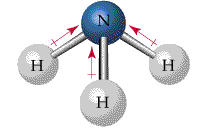
NH3
BH3
CH4
SiH4
Has two lone pairs on the central atom.
H2O
NH3
BH3
CH4
SiH4
Predicted to have the largest bond angles.
H2O
NH3
BH3
CH4
SiH4
Has trigonal pyramidal molecular geomtry.
H2O
NH3
BH3
CH4
SiH4
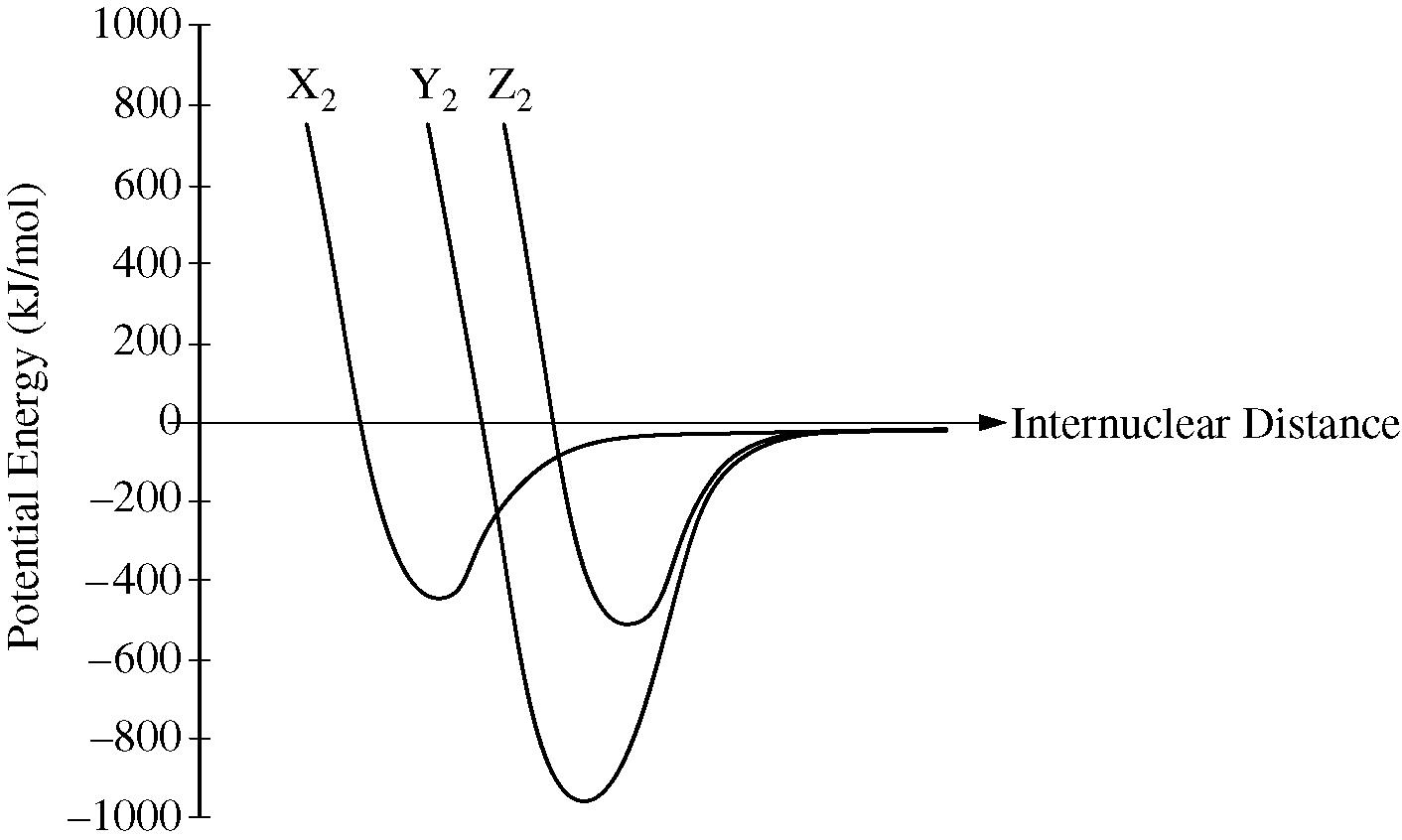
The potential energy as a function of internuclear distance for three diatomic molecules, X2, Y2, and Z2, is shown in the graph above. Based on the data in the graph, which of the following correctly identifies the diatomic molecules, X2, Y2, and Z2?
X2 = H2 , Y2 = N2 , Z2= O2
X2 = N2 , Y2 = H2 , Z2= O2
X2 = O2 , Y2 = N2 , Z2= H2
X2 = O2 , Y2 = H2 , Z2= N2
The lattice energy of a salt is related to the energy required to separate the ions. For which of the following pairs of ions is the energy that is required to separate the ions largest? (Assume that the distance between the ions in each pair is equal to the sum of the ionic radii.)
Na+(g) and Cl−(g)
Cs+(g) and Br−(g)
Mg2+(g) and O2−(g)
Ca2+(g) and O2−(g)
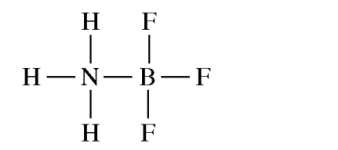
NH3 reacts with BF3 to form a single species. Which of the following structural diagrams is the most likely representation of the product of the reaction?
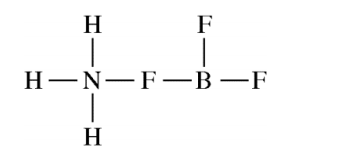
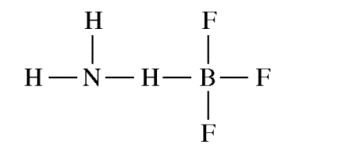
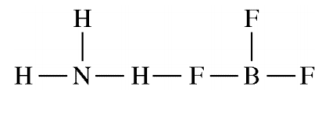
The melting point of MgO is higher than that of NaF. Explanations for this observation include which of the following?
I. Mg2+ is more positively charged than Na+.
II. O2- is more negatively charged than F-.
III. The O2- ion is smaller than the F- ion.
I and II only
II only
I and III only
II and III only
I, II , and III
Which of the following is an isomer of CH3OCH3 ?
CH3CH3
CH3COOH
CH3CH2CH3
CH3CH2OCH2CH3
CH3CH2OH
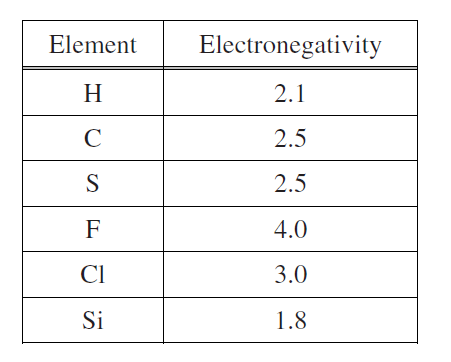
On the basis of the information above, which of the following arranges the binary compounds in order of increasing bond polarity?
CH4 <SiCl4 < SF4
CH4 < SF4 <SiCl4
SF4 < CH4 <SiCl4
SF4 <SiCl4 < CH4
Which of the following compounds contains both ionic and covalent bonds?
SO3
NH4Cl
MgF2
H2S
C2H5OH
The elements C and Se have the same electronegativity value, 2.55. Which of the following claims about the compound that forms from C and Se is most likely to be true?
The carbon-to-selenium bond is unstable
The carbon-to-selenium bond is nonpolar covalent
The compound has an empirical formula of CSe
A molecule of the compound will have a partial negative charge on the carbon atom.
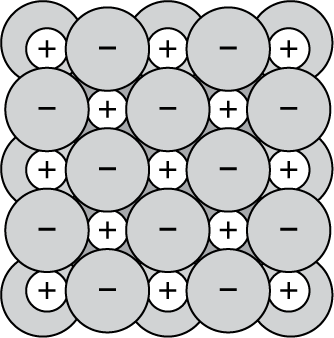
Which of the following correctly indicates whether the solid represented by the particulate model shown above conducts electricity and explains why or why not?
It conducts electricity because it is made of positive and negative ions.
It conducts electricity because it is made of particles of different sizes.
It conducts electricity because it is made of particles of different sizes.
It does not conduct electricity because there are small spaces between the particles.
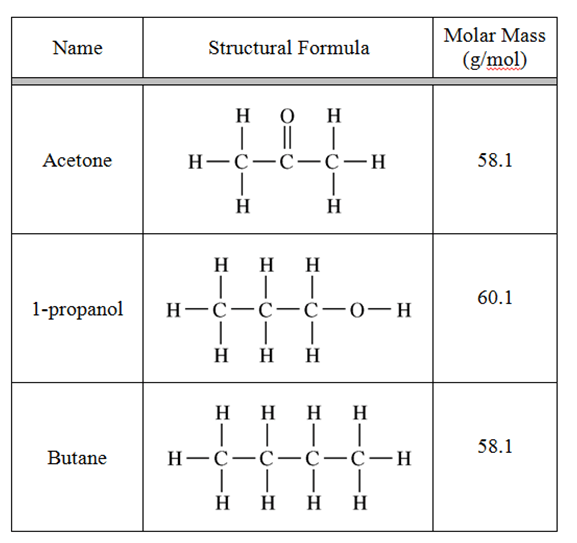
The table above shows the structural formulas and molar masses for three different compounds. Which of the following is a list of the compounds in order of increasing boiling points?
Butane < 1-propanol < acetone
Butane < acetone < 1-propanol
Acetone = butane < 1-propanol
1-propanol < acetone < butane

Solid carbon tetrachloride, CCl4(s), is represented by the diagram above. The attractions between the CCl4
molecules that hold the molecules together in the solid state are best identified as
intermolecular attractions resulting from temporary dipoles
nonpolar covalent bonds
polar covalent bonds
intermolecular attractions resulting from permanent dipoles
At 298 K and 1 atm, Br2 is a liquid with a high vapor pressure, and Cl2 is a gas. Those observations provide evidence that under the given conditions, the
forces among Br2 molecules are stronger than those among Cl2 molecules
forces among Cl2 molecules are stronger than the Cl−Cl bond
Br−Br bond is stronger than the Cl−Cl bond
Cl−Cl bond is stronger than the Br−Br bond
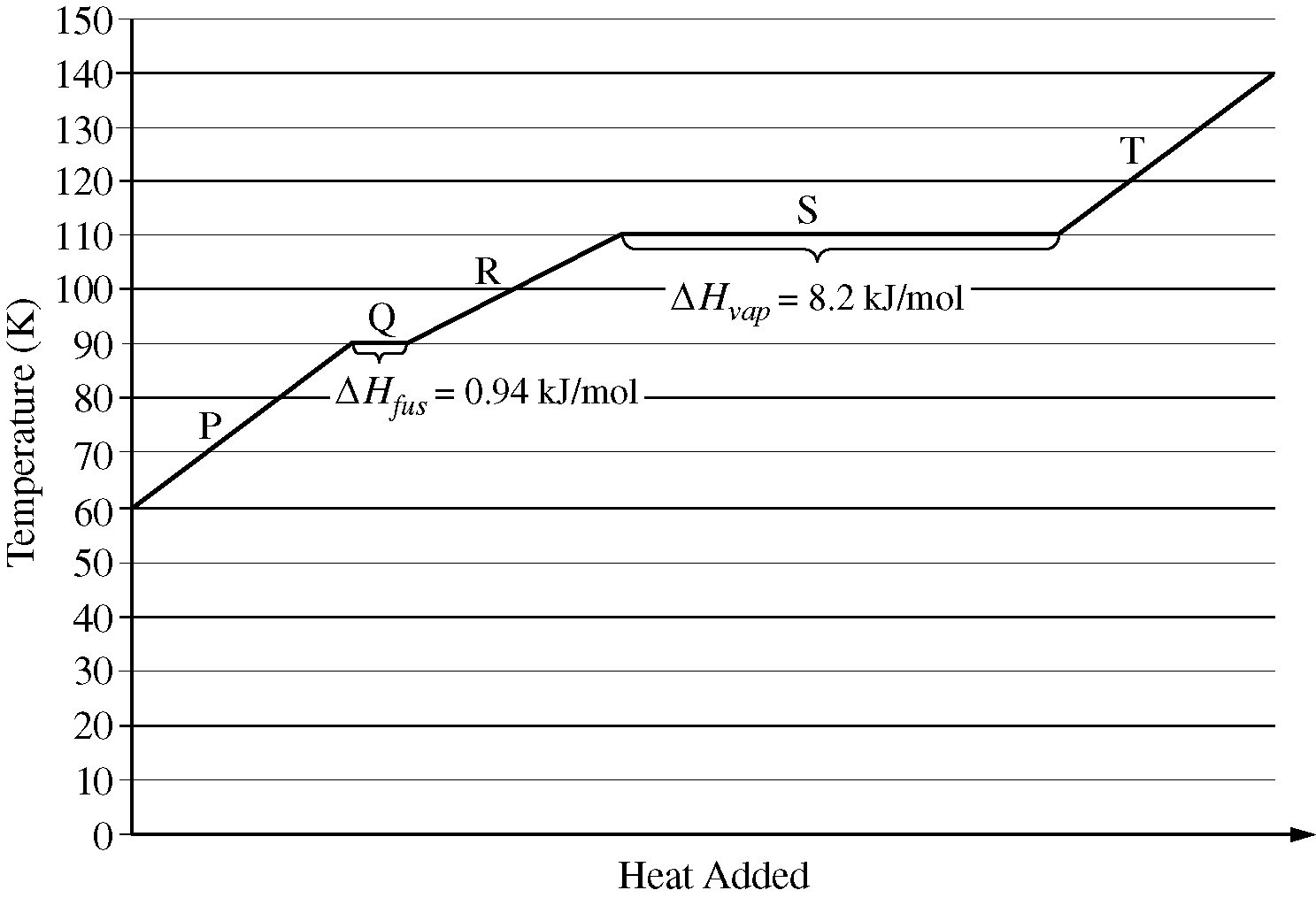
The enthalpy of vaporization of water is 40.7 kJ/mol. Which of the following best explains why the enthalpy of vaporization of methane is less than that of water?
Methane does not exhibit hydrogen bonding, but water does.
Methane has weaker dispersion forces.
Methane has a smaller molar mass.
Methane has a much lower density.
Which statement best helps to explain the observation that NH3(l) boils at −28°C , whereas PH3(l)boils at −126°C ?
NH3 has hydrogen bonding that is stronger than the dipole-dipole forces in PH3.
NH3 has hydrogen bonding that is weaker than the dipole-dipole forces in PH3.
The dispersion forces in NH3 are stronger than the dipole-dipole forces in PH3.
The dispersion forces in NH3 are weaker than the dispersion forces in PH3.
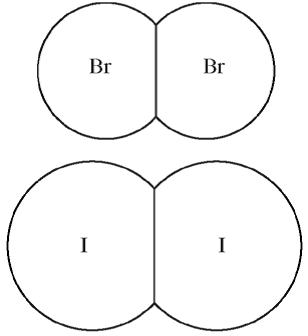
The diagram above shows molecules of Br2 and I2 drawn to the same scale. Which of the following is the best explanation for the difference in the boiling points of liquid Br2 and I2, which are 59oC and 184oC, respectively?
I2 molecules have electron clouds that are more polarizable than those of Br2 molecules, thus London dispersion forces are stronger in liquid I2
The covalent bonds in I2 molecules are weaker than those in Br2 molecules.
Solid iodine is a network covalent solid, whereas solid bromine is a molecular solid.
Bromine has a greater electronegativity than iodine, thus there are stronger dipole-dipole forces in liquid bromine than in liquid iodine.
Contains 1 sigma (σ) and 2 pi (π) bonds
Li2
B2
N2
O2
F2
Has a bond order of 2
Li2
B2
N2
O2
F2
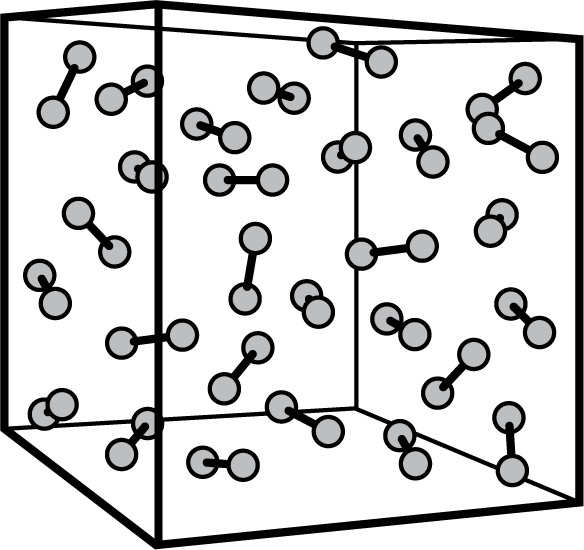
The diagram above is a molecular model of a gaseous diatomic element that is just above its boiling point. Intermolecular forces between the gas molecules will cause them to condense into the liquid phase if the temperature is lowered. Which of the following best describes how the model is limited in its depiction of the phenomenon?
It does not show how the temporary fluctuating dipoles of the molecular electron clouds result in a net force of attraction between the molecules.
It does not show how the interacting permanent dipoles of the molecules result in a net force of attraction between the molecules.
It does not show how the interactions between ions and the induced molecular dipoles result in a net force of attraction between the molecules.
It does not show how hydrogen bonds are constantly forming, breaking, and reforming, which results in a net force of attraction between the molecules.
Which compound in liquid form will have the highest vapor pressure?
CH4
CH3CH3
CH3COCH3
CH3CH2OH
SO2 molecules can form...
London dispersion forces
Dipole-dipole forces
Hydrogen bonds
HCl molecules can form...
London dispersion forces
Dipole-dipole forces
Hydrogen bonds
Which one has the highest boiling point?
CH4
SO2
H2O
Factor(s) that influence the strength of London dispersion forces
Molecular size
Molecular shape
Molecular polarity
Which of the following non-polar molecules has the highest boiling point? (Refer Page 15 - 17 of Intermolecular Forces)
CH4; molar mass = 16.04 g/mol
CCl4; molar mass = 153.82 g/mol
PF5; molar mass = 125.966 g/mol
Rn; molar mass = 222.01758 g/mol
Between HF and H2O... which one has a higher boiling point? (Refer Page 32 of Intermolecular Forces)
H2O
HF
Which of these has the strongest London forces?
F2
Br2
I2
Cl2
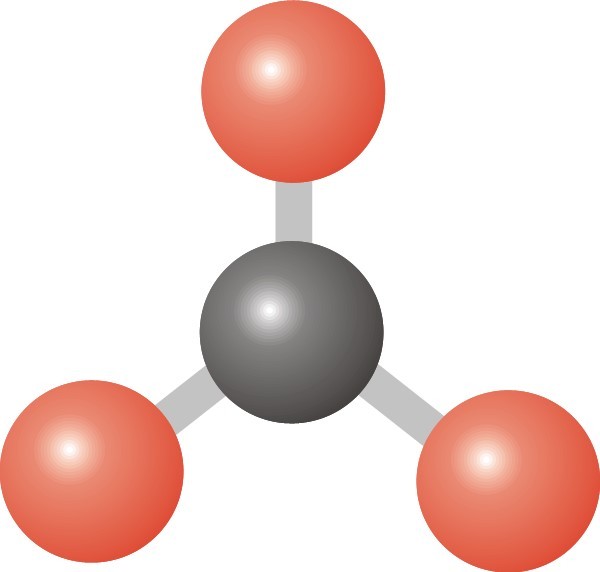
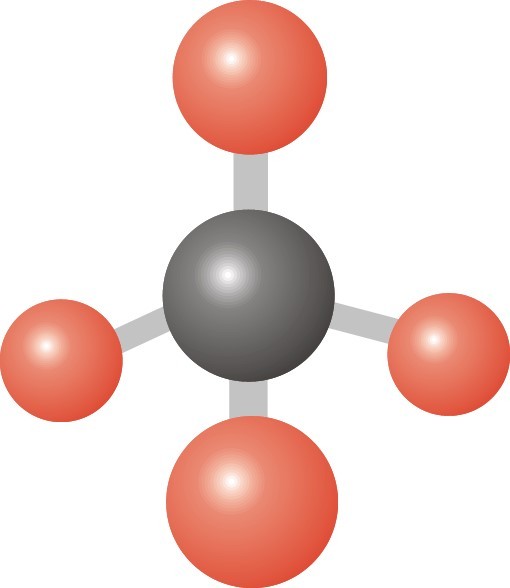
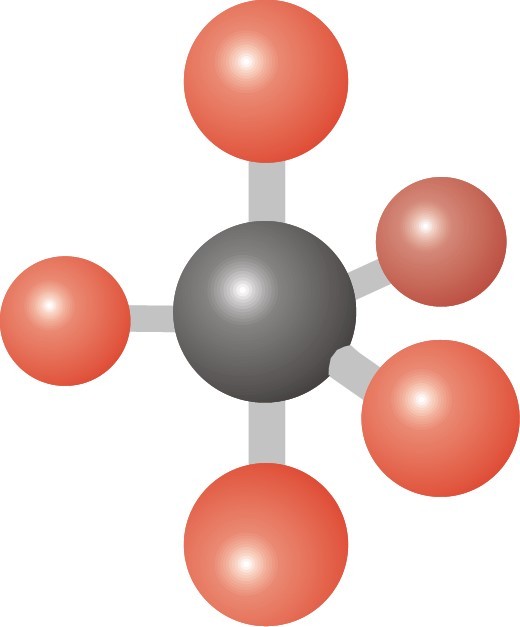
What molecular geometry would PH3 have?
Trigonal Pyramidal
Trigonal Bipyramidal
Bent
Linear
How many unshared pairs of electrons will a bent molecule have?
0
2
3
4
Use your knowledge and electronegativity sheet to predict what the following compound is classified as.
polar covalent
nonpolar covalent
ionic
metallic

Use your knowledge and electronegativity sheet to predict what the following compound is classified as.
nonpolar covalent
polar covalent
ionic
metallic

Which electron dot structure is correct for the element chlorine (Cl2)?
A
B
D
D

When the atoms in a molecule can form two different structures (not resonance structures), formal charge can help determine the best one (where lower or zero FC is best). A and B both follow the octet rule: use formal charge to determine which structure is the better one for NH3O.
A is the better structure for NH3O
B is the better structure for NH3O
Both structures are equally good.
Both structures are incorrect.

What is the formal charge on the bromine atom in this Lewis dot structure?
-1
+1
-2
+2

Using formal charges and the octet rule, determine which Lewis structure of OCN- is most stable.
a
b
c
d
e

