wayground logo

Free Printable Worksheets

Font size

S
M
L
XL
Worksheets

Force and Newton's Laws

Total questions: 40

Worksheet time: 55mins
Name
Class
Date
1.
If a force of 26 N is exerted on two balls, one with a mass of 0.52 kg and the other with a mass of 0.78 kg, which ball will have the greater acceleration?  (F=ma)
a)
The one with a mass of .78 kg will have the greatest acceleration.
b)
The one with a mass of .52 kg will have the greatest acceleration.
c)
They will both accelerate at the same rate.
2.
A 20 kg bike accelerates at 10 m/s2.  what was the force?
a)
25 Newtons
b)
20 Newtons
c)
200 Newtons
d)
10 Newtons
3.
Unit of mass
a)
m/s 2
b)
m/s
c)
newtons
d)
kg
4.
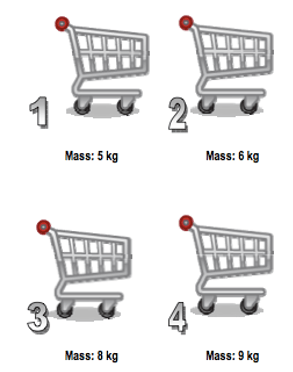
A force of 90N is applied to each cart below, which one will accelerate the fastest?
a)
Cart 1
b)
Cart 2
c)
Cart 3 
d)
Cart 4
5.

Why does a car accelerate faster with just the driver, compared to driver + 3 passengers?

a)

Car and driver has less mass than car, driver + 3 passengers

b)

Car and driver has more mass than car, driver + 3 passengers

c)

Car has less friction (drag)

d)

Car is accelerating faster

6.

A 2 kg brick is pulled by a force of 10N. Friction force is 4 N. What is the acceleration?

a)

3 N

b)

3 ms-2

c)

5 ms-2

d)

2 ms-2

7.
The mass of a car is 1000 kg.  How much force would be required to accelerate the car at a rate of 3 m/s2? 
a)
1000 ÷ 3
b)
3 ÷ 1000
c)
1000 x 3
8.
What is the net force?
a)
17 N Right
b)
3 N Right
c)
3 N Left
d)
17 N Left
9.

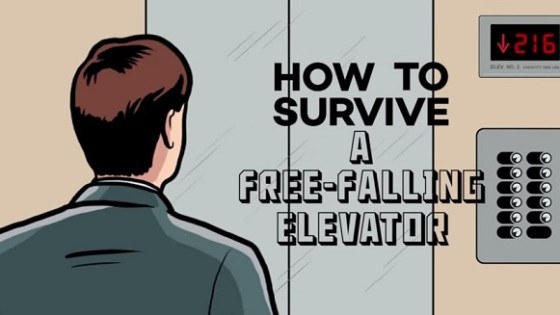
What is the force on a 1000 kg elevator that is falling freely at 9.8 m/sec2

a)

102.04 n

b)

9,800 n

c)

980 n

d)

103 n

10.
If an object mass =30 Kg on the Earth, what would be it's weight on Earth?
a)
30 N
b)
300 kg
c)
3000N
d)
300 N
11.
Joe and his boat have a mass of 130 kg together.  The boat weighs 420 N.   a)  What is the mass of the boat?
a)
1300N
b)
88N
c)
88Kg
d)
42Kg
12.
A parachutist has a mass of 80 kg. His parachute has a mass of 10 kg.'   What is their combined weight?
a)
800N
b)
100N
c)
90N
d)
900N
13.

What type of force is this man using to push his grocery cart?

a)

Normal Force

b)

Gravity

c)

Air Resistance

d)

Applied Force

14.
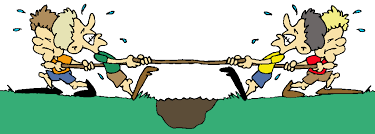
If these teams are pulling with the same amount of force what will happen?
a)
The boy in blue will win.
b)
They will not move at all.
c)
The boy in red will win.
d)
Both will fall down.
15.
Balanced or unbalanced?
a)
balanced
b)
unbalanced
16.
The sum of all forces acting on an object.
a)
Contact Force
b)
Balanced Force
c)
Unbalanced Force
d)
Net Force
17.
Jupiter has about 317 times more mass than Earth. What can you infer from this fact? 
a)
That Jupiter’s gravitational force is much weaker than on Earth’s gravitational force.
b)
That Jupiter’s gravitational force is much stronger than Earth’s gravitational force.
c)
That Jupiter’s and Earth’s gravitational forces are equal.
d)
Mass has no effect on the gravitational force between two objects
18.

If both forces are going in the same direction you should______ those forces

a)

Add

b)

Subtract

c)

Divide

d)

Multiply

19.

When forces are going in the opposite direction of each other you should do what do find the net force

a)

Subtract

b)

Add

c)

Divide

d)

Multiply

20.
According to Newton’s first law of motion, a moving object that is not acted on by an unbalanced force will
a)
remain in motion.
b)
eventually come to a stop.
c)
change its momentum.
d)
accelerate.
21.
A sled sliding on a flat, icy surface with a constant velocity is best described by
a)
Newton’s first law of motion for objects at rest.
b)
Newton’s first law of motion for objects in motion.
c)
Newton’s second law of motion.
d)
Newton’s third law of motion.
22.
Which law explains when a magician pulls a tablecloth out from under dishes and glasses on a table without disturbing them.
a)
Law 1
b)
Law 3
23.
A person steps out of the boat and onto the dock.  As the person moves forward onto the dock, the boat moves backward.  Which statement best describes the backward motion of the boat as the person steps forward?
a)
For every action there is an equal and opposite reaction.
b)
Every mass exerts a force on every other mass.
c)
An object at rest tends to stay at rest.
d)
Friction opposes the motion of an object.
24.
What is the definition of "weight"?
a)
the force in which gravity pulls on an object
b)
the time it takes to get on a ride 
c)
the amount of matter in an object
d)
the size of an object
25.
 267.5 N unbalanced force applied to push a stuffed chair across the room, causing an acceleration of 4.2 m/s2. What is the mass of the chair?
a)
26.75 kg
b)
63.69 kg 
c)
263.3 kg 
d)
1123.5 kg
26.
To test Newton’s law of gravity, Ben and Jerry climbed the football stadium at school and dropped an egg from the very top of the bleachers. Their egg dropped data can be seen in the table According to this data, What conclusion can the boys make regarding Newton’s law of gravity?
a)
a)  No conclusion can be drawn from the data
b)
a)  The acceleration due to gravity is not constant
c)
a)  The acceleration due to gravity of 9.8 m/s2 is refuted
d)
a)  The acceleration due to gravity of 9.8 m/s2 is supported
27.
Which of these best describes why your weight (on Earth) would change on another planet?
a)
weight doesn’t change, no matter where you are
b)
different planets have different gravitational pulls
c)
In general, the smaller the planet, the greater weight
d)
dehydration effects on different planets change weight
28.
An empty truck and a fully loaded truck are next to each other at a traffic light. When the light turns green, the lighter truck increases speed more quickly. Which of these best explains this situations
a)
Newton's first law
b)
Newton's second law
c)
Newton's third law
d)
Conservation of momentum
29.
Which of Newtons laws most accurately explains the situation:
Seat belts and airbags stop you from going through the windshield of a car if you are in an accident
a)
1st law
b)
2nd law
c)
3rd law
30.
Acceleration is produced when a force acts on a mass. The greater the mass (of the object being accelerated) the greater the amount of force needed (to accelerate the object).
a)
Newton's 1st Law
b)
Newton's 2nd Law
c)
Newton's 3rd Law
d)
None of them
31.

A leftward force is applied to a crate to push it across the floor at a constant speed. Which is the correct force diagram?

a)
b)
c)
d)
32.

A rightward force is applied to a dresser to accelerate it to the right across the bedroom floor.

a)
b)
c)
d)
33.

A downward-moving skydiver who has just opened the parachute is slowing down.

a)
b)
c)
d)
34.

The force that keeps objects on top of surfaces instead of letting them sink into the surface is known as:

a)

normal

b)

abnormal

c)

static

d)

inertia

35.

This diagram can be used to indicate which of the following? (TWO correct answers)

a)

a object at rest

b)

an object moving at a constant velocity (speed)

c)

an object accelerating

d)

(Trick question -- there is only one correct answer)

e)

an object decelerating

36.

Which way is the object moving?

a)

it's either not moving or moving at a constant speed due to balanced forces

b)

to the right

c)

to the bottom

d)

up

37.
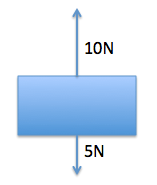
What is the net force on the block? (click on the words to view the picture)
a)
5 Newtons up
b)
5 Newtons down
c)
15 Newtons up
d)
15 Newtons down
38.
Which of the following statements is true? 
a)
Balanced forces cause a change in motion. 
b)
Unbalanced forces cause a change in motion. 
c)
Forces do not effect the change in motion. 
39.
If a 10 kilogram object accelerates suddenly at 15 m/s2, how much force was applied to the object?
a)
150 Newtons
b)
15 Newtons
c)
150 kilograms
d)
100 kilograms
40.
Angela blows air into a balloon and holds the end of it closed with her fingers. When she lets go of the end of the balloon, Angela observes that the release of the air propels the balloon.  The propelling of the balloon from the release of the air is an example of which of Newton’s laws? 
a)
The force of an object is the product of its mass multiplied by its acceleration. 
b)
 A force of attraction exists between any two objects with mass. 
c)
 For every action, there is an equal and opposite reaction.
d)
An object in motion tends to stay in motion unless an unbalanced force acts upon it.