wayground logo

Free Printable Worksheets

Font size

S
M
L
XL
Worksheets

Year 10 Genetics revision

Total questions: 65

Worksheet time: 1hrs 22mins

Name
Class
Date
1.

Which of the following best describes a DNA molecule?

a)

double helix

b)

contains amino acids

c)

homologous

d)

contains protein

2.

What are the nucleotides made of?

a)

Sugar, Phosphate, nitrogen base

b)

Phosphate, Guanine, nitrogen base

c)

Thymine, Adenine, Cytosine

d)

Phosphate, Nitrogen, Adenine

3.
Which shows the correct complementary base pairing for DNA?
a)
C-A, T-G
b)
A-G, C-T
c)
C-G, U-A
d)
T-A, G-C
4.
What does DNA stand for?
a)
Deoxyribonucleic acid
b)
Denitrogenous acid
c)
Deribonucleic acid
d)
Diribonucleic acid
5.

Bundled up, organized DNA is called a

a)

gene

b)

trait

c)

chromosome

d)

nucleotide

6.

Which of the following is NOT true of mutations?

a)

If they occur in germline cells they can't be passed to offspring

b)

They are changes in the genetic material of an organism

c)

They can involve duplication or deletion of a section of DNA

d)

They can have negative, positive or neutral effects on an organism

7.
Which best describes these fossils?
a)
The oldest fossils can be found on the lower layers
b)
The oldest fossils can be found at the top layers
c)
The youngest fossils are always found on the bottom layers
d)
You can not tell the age of any of these fossils
8.
If green is dominant over purple, then what is the genotype for this individual?
a)
Purple
b)
Green
c)
GG
d)
gg
9.
Which of the following terms refers to the different possibilities of a gene?
a)
chromosome
b)
DNA
c)
Punnett Squares
d)
allele
10.
This image shows a...
a)
Punnett Square
b)
Phenotype
c)
Genotype
d)
Dominant allele
11.
A phenotype is the...
a)
letter combination
b)
dominant gene
c)
recessive gene
d)
physical appearance
12.
Tt is-
a)
homozygous dominant
b)
homozygous recessive
c)
heterozygous
d)
none of these
13.
If a pea plant were homozygous recessive for height, how would its alleles be represented?
a)
TT
b)
Tt
c)
tt
d)
tT
14.

Which of the following genotypes is homozygous dominant?

a)

rr

b)

Rr

c)

RR

d)

RR and Rr

15.
Brown (B) is dominant over white (b). Which genotype is a purebred for brown fur?
a)
BB
b)
Bb
c)
bb
d)
All of the above
16.
This trait will always be expressed if present because it will mask the expression of others
a)
stem cells
b)
heterozygous
c)
dominant
d)
recessive
17.
B=brown eyes
b= blue eyes
What is true about two brothers that have brown eyes?
One has genotype BB the other Bb.
a)
they have same phenotype and genotype
b)
they have different genotypes and phenotypes
c)
they have same phenotype but different genotypes
d)
they have same genotype but different phenotypes
18.
Genotype refers to the ...
a)
physical expression of the genes
b)
the possible combination of alleles in a gene
c)
whether an allele is dominant or recessive
d)
how an organism will appear
19.
Which of the following is a phenotype?
a)
BB
b)
Bb
c)
bb
d)
Blue eyes
20.
the passing of genetic traits from parent to offspring.
a)
heredity
b)
trait
c)
gene
d)
allele
21.
How many affected females are present? 
a)
1
b)
2
c)
3
d)
4
22.
What is the symbol for an Affected Male? 
a)
Half Circle 
b)
Half Square 
c)
Full Shaded Circle 
d)
Full Shaded Square 
23.
How many offsprings did generation 2 have? 
a)
5
b)
8
c)
9
d)
10
24.
How many carrier males are present? 
a)
2
b)
4
c)
6
d)
8
25.
How many generations are shown in this pedigree?
a)
1
b)
2
c)
3
d)
4
26.
Hemophilia is a recessive sex-linked trait. If H = normal & h = has hemophilia, which genotype represents a male with hemophilia. 
a)
XHY
b)
XHXh
c)
XhXh
d)
Xh
27.

Cystic fibrosis is an autosomal recessive disease .


Study the pedigree what are the possible genotypes of #10?

a)

AA

b)

AA or Aa

c)

Aa

d)

aa

28.

Cystic fibrosis is an autosomal recessive disease .


Study the pedigree what is the genotype of #9?

a)

AA

b)

Aa

c)

aa

d)

XaXa

29.

Fragile-X syndrome is a recessive sex-linked disorder located on the X chromosome.


Study the pedigree. What is the Genotype of #3?

a)

XHXh

b)

XhXh

c)

XHXH

d)

XHY

30.

In Mice a single gene (B or B) determines tail length the Short Tail allele is sex linked and Dominant.


Individual 6 is a Female. What is her genotype?

a)

XBXb

b)

XBXB

c)

XbXb

d)

XbY

31.

In cats, long hair is recessive to short hair. A true-breeding (homozygous) long haired male is mated with a short-haired heterozygous female. What will their offspring look like? You may choose more than one answer.

a)

50% long haired

b)

50% short haired

c)

100% short haired

d)

100% long haired

32.
What are the possible genotypes for this cross?
a)
TT = 25% Tt= 50% tt=25%
b)
all tall
c)
TT= 75% tt = 25%
d)
Tt = 100%
33.
Dominant alleles are represented by a:
a)
Male gene
b)
lowercase letter
c)
recessive trait
d)
capital letter
34.
Duchenne muscular dystrophy is a recessive x-linked disorder.
According to the Punnett square, what percentage of male offspring will have the disorder?
a)
0%
b)
25%
c)
50%
d)
100%
35.

In fruit flies, red eye color is a sex-linked trait that is dominant over white eye colour..

According to the Punnett square, what percentage of female offspring will have red eyes?

a)

0%

b)

25%

c)

50%

d)

100%

36.
Colorblindness is a recessive x-linked disorder.
Which genotype represents a female who is colorblind?
a)
XNXn
b)
XnXn
c)
XNXN
d)
XnY
37.
Mark is heterozygous. If B is for brown hair, and b is for blonde hair, what is Mark's genotype?
a)
BB
b)
bb
c)
Bb
d)
bB
38.

These types of alleles are only expressed if the organism has two copies

a)

dominant

b)

recessive

c)

homozygous

d)

heterozygous

39.
Any change in the sequence of DNA is...
a)
transgenic shift
b)
Single Genotype
c)
Monohybrid Trait
d)
Mutation
40.

What is a Gene?

a)

A segment of amino acids that encodes for a protein

b)

A chromosome

c)

A segment of DNA that encodes for a protein

d)

Your genome

41.
What do hurtful mutations do? 
a)
Decrease chances of survival 
b)
Increases changes of survival 
c)
Decreases likelihood of developing cancer
d)
Increases likelihood of developing cancer
42.
In a certain species of plant, the color purple (P) is dominant to the color white (p).
According to the Punnett Square, what is the probability of an offspring being white?
a)
25%
b)
0%
c)
100%
d)
50%
43.
What animal is Darwin known for studying?
a)
dinosaurs
b)
tunicates
c)
finches
d)
horses
44.
Who was Charles Darwin?
a)
A naturalist who came up with the theory of evolution
b)
A scientist who studied plants
c)
A geologist who looked at rocks and fossils
d)
A paleontologist who studied dinosaurs
45.
Relative dating
a)
gives the exact age of rocks and fossils
b)
is when you date your cousin
c)
gives the approximate age of rocks
d)
tells us who to trust
46.
Survival of the fittest or when favorable adaptations reproduce faster is called what?
a)
Evolution
b)
Adaptation
c)
Natural selection
d)
Fossilization
47.
According to the diagram, which organism is older?
a)
ammonite
b)
coral
c)
gastropod
d)
trilobite
48.
The ability of an organism to survive and reproduce in its specific environment 
a)
diversity.
b)
evolution
c)
adaptation
d)
 fitness
49.
Why are advantageous traits more likely to be passed onto offspring?
a)
Because they are more likely to survive and reproduce.
b)
Because they come from dominant alleles.
c)
Because they come from recessive alleles.
d)
Because the trait is an acquired phenotype.
50.
Which of the following is NOT an example of natural selection? 
a)
People selectively breeding hamsters.
b)
Insect populations developing resistance to certain pesticides.
c)
Bacteria becoming resistant to antibiotics.
d)
Male birds of certain species developing colorful feathers to attract female mates.
51.
Which term refers to the process by which individuals that are better suited to the environment survive and reproduce therefore passing down their genes to their offspring? 
a)
Evolution 
b)
Variation 
c)
Adaptation
d)
Natural Selection 
52.
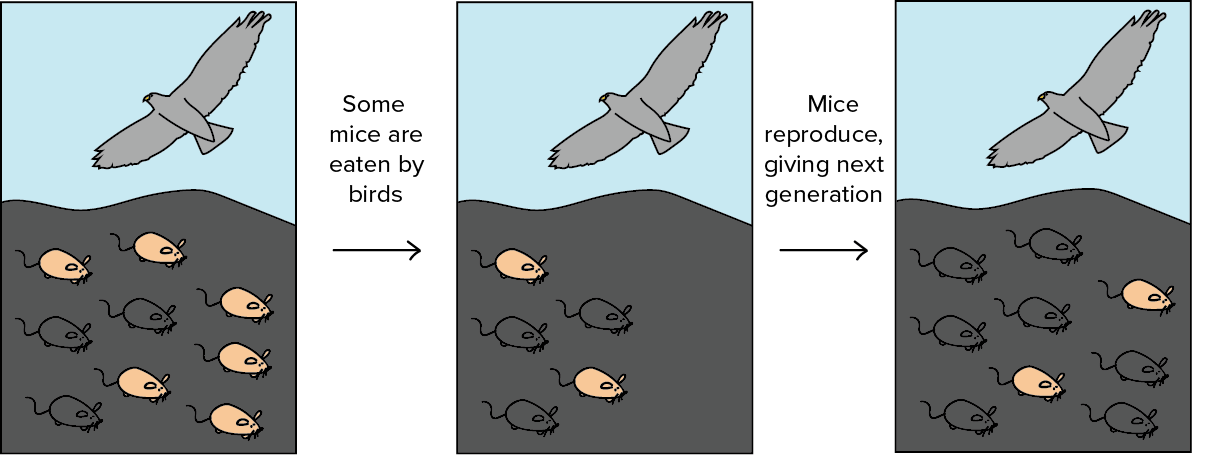
Why is the mouse population changing over time?
a)
The light mice can reproduce more successfully than the dark mice
b)
The hawks eat more dark mice than light mice because the dark mice taste better
c)
The hawks eat more light mice than dark mice because they can see the light mice more easily
d)
The hawks eat more dark mice than light mice because they can see the dark mice more easily
53.
a bird that can easily outcompete other birds for food and that can produce many eggs has a high
a)
sexuality
b)
mutation rate
c)
fitness
d)
adaptability
54.
Individuals that are well adapted to their environment will survive and produce
a)
better traits
b)
stronger genes
c)
more offspring
d)
fewer mutations
55.

Process that uses the properties of atoms in rocks and other objects to determine their ages

a)

relative dating

b)

radioactive decay

c)

absolute dating

d)

no dating

56.

Which statement is true?

a)

Layer C is the oldest

b)

Layer B is older than Layer A

c)

Layer B is older than Layer C

d)

Layer A is the youngest

57.

The mineralized impression of the organism left in the sediment is called a mould mold. The mineralized sediment that fills the mold is called a cast.

What type of fossil is pictured here?

a)

Mold fossil

b)

Trace fossil

c)

Cast fossil

d)

Body fossil

58.

The mineralized impression of the organism left in the sediment is called a mould mold. The mineralized sediment that fills the mold is called a cast.

What type of fossil is pictured here?

a)

Mold fossil

b)

Trace fossil

c)

Cast fossil

d)

Body fossil

59.

What type of fossil is pictured here?

a)

Forest fossil

b)

Trace fossil

c)

Cast fossil

d)

Body fossil

60.

The Galapagos Finches have different beaks because

a)

it is an adaptation to the food type available in the bird's habitat

b)

they come from a different species of bird

c)

the beak stretches farther

d)

they use it to fight different birds

61.

Which statement is part of Darwin’s theory of evolution by natural selection?

a)

More offspring are produced than can possibly survive.

b)

The organisms that are the fittest are always largest and strongest.

c)

Mutations always lead to fitter offspring

d)

Acquired characteristics are passed down to offspring

62.

This laboratory procedure is known as

a)

karyotype

b)

gel electrophoresis

c)

chromatography

d)

base pairing

63.

Gel electrophoresis is used to separate DNA fragments on the basis of which property?

a)

size

b)

colour

c)

amount of negative charge

d)

phenotype

64.
Why do the fragments of DNA in gel electrophoresis travel away from the negative electrode?
a)
DNA is negatively charged so attracted to the positive end of the unit
b)
DNA is positively charged to attracted to the negative end of the unit
c)
the agarose gel in negatively charged
d)
the agarose gel is positively charged
65.
In gel electrophoresis, the largest DNA fragment will appear
a)
closest to the starting wells
b)
farthest from the starting wells
c)
three quarters away from the starting wells
d)
it depends on how many fragments there are