wayground logo

Free Printable Worksheets

Font size

S
M
L
XL
Worksheets

chemical bond practice

Total questions: 93

Worksheet time: 1hrs 22mins

Name
Class
Date
1.
Compared to ionic compounds, molecular compounds generally have...
a)
good conductivity
b)
greater densities
c)
more chemical bonds
d)
a low boiling point
2.
Compared to ionic compounds, molecular compounds generally have...
a)
stronger chemical bonds
b)
poor conductivity
c)
a high melting point
d)
lower densities
3.
The chemical bond formed when two atoms share electrons  is called a(an) IONIC bond. 
a)
True
b)
False
4.
Covalent bonds usually form when a nonmetal combines with a(an) METAL.
a)
True
b)
False
5.
How do covalent bonds form?
a)
Donating & receiving valence e- between atoms.
b)
Opposite slight charges attract each other between compounds.
c)
Scientists are still not sure how they form.
d)
Sharing valence e- between atoms.
6.
What two types of atoms make a covalent bond?
a)
2 Nonmetals
b)
1 Nonmetal and 1 Metal
c)
2 Metals
d)
2 Noble Gases
7.

Water, H2O, is classified as what type of molecule?

a)

a polar molecule

b)

a nonpolar molecule

c)

a coordinate covalent compound

d)

an ionic compound

8.

A molecule made up entirely of the same element will have an electron distribution that is ___

a)

completely symmetrical

b)

asymmetrical

c)

decreasing from left to right

d)

polar

9.

What is the measure of the tendency of an atom to attract bonding electrons called?

a)

ionization energy

b)

electron charisma

c)

dipole momentum

d)

electronegativity

10.

Electronegativity increases from left to right on the periodic table because there are ___

a)

fewer protons in the atoms

b)

more protons in the atoms

c)

fewer electron shells

d)

more electron shells

11.
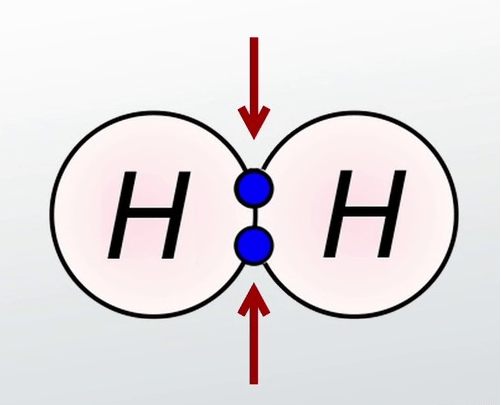
What type of bond is shown in this image?
a)
Ionic
b)
Polar Covalent
c)
Nonpolar Covalent
d)
Van der Waals Force
12.
Diatomic elements are defined as IDENTICAL elements that bond with each other (i.e. Oxygen with Oxygen).  What type of bond should they form?
a)
Ionic
b)
Polar Covalent
c)
Nonpolar Covalent
d)
Van der Waals force
13.
What elements generally make an ionic bond?
a)
metal and nonmetal
b)
2 or more nonmetals
c)
metal
d)
none of the above
14.

In a polar covalent bond, electrons are shared:

a)

equally

b)

unequally

c)

between two metals

d)

between a metal and a non-metal

15.
Diatomic elements are defined as IDENTICAL elements that bond with each other (i.e. Oxygen with Oxygen).  What type of bond should they form?
a)
Ionic
b)
Polar Covalent
c)
Nonpolar Covalent
d)
Van der Waals force
16.

What type of chemical bond holds NaCl, an ionic crystal, together?

a)

Metallic Bond

b)

Ionic Bond

c)

Covalent Bond

17.

Which pair of characteristics is most closely associated with metallic solids?

I. low melting point

II. high malleability

III. low thermal conductivity

IV. high electrical conductivity

a)

I and II

b)

I and III

c)

II and III

d)

II and IV

e)

III and IV

18.

Select all correct statements

a)

Metals often form lattices in the solid state

b)

Metals cannot exist in the liquid state

c)

It is difficult to introduce other elements into the metallic crystal

d)

Alloys have properties that differ from the properties of the elements from which they were made

e)

All metals are malleable

19.

Electrons involved in metallic bonding are reffered to as (a)   electrons

20.

Which property of metals is represented by the image ?

a)

High boiling and melting points

b)

Density

c)

Ductility

d)

Malleability

21.

Which property of metals is represented by the image ?

a)

Ductility

b)

Malleability

c)

Durability

22.

The (a)   model proposes that all metal atoms in a metallic bond contribute their valence electrons to the metallic lattice

23.
What is the basis of a metallic bond?
a)
the attraction of neutral metal atoms.
b)
the attraction between protons and neutrons.
c)
the attraction between positive metal ions and interlocking electrons.
d)
the attraction between positive metal ions and free floating electrons.
24.
At room temperature, most metals are
a)
liquid
b)
solid
c)
gas
d)
an alloy
25.
What does malleable mean?
a)
able to be shaped
b)
will break easily
c)
can be used for wire
d)
is shiny
26.
Which of these is NOT an alloy?
a)
bronze
b)
copper
c)
brass
d)
stainless steel
27.

What is the ability of a substance to be pulled into a wire?

a)

Malleability

b)

Ductility

c)

Conductivity

d)

Solubility

28.
Why do metals conduct
a)
They are shiny
b)
The electrons are held tightly within the lattice
c)
The electrons are delocalised and able to move
d)
The electrons are shared between two metal ions
29.
A mixture of two or more metals is called:
a)
mixture
b)
solution
c)
compound
d)
alloy
30.
Metallic bonding is...
a)
a type of covalent bond.
b)
a type of ionic bond.
c)
an attraction between positive ions and electrons.
31.
I can hit a metal with a hammer without the metal shattering because of its __________.
a)
Ductility
b)
Malleability
c)
Conductivity
d)
Lustrousness
32.
Why are alloys generally used to make everyday objects?
a)
Alloys are often stronger and less active than pure metals.
b)
Alloys have higher melting point than pure metals.
c)
Alloys are less expensive to produce than pure metals.
d)
Alloys have ionic bonds instead of metallic bonds.
33.

Compounds composed of a ______________ and _____________ like the compound CaCl2 , are ionic compounds.

a)

metal ... metal

b)

nonmetal ... nonmetal

c)

metal ... nonmetal

34.
In general, this type of bond will form a compound with a high melting point.
a)
Ionic
b)
Covalent
35.
Ionic Bonding involves...
a)
The transfer of protons
b)
The transfer of nuetrons 
c)
The transfer of electrons
d)
None Of the above
36.
What elements generally make an ionic bond?
a)
metal and nonmetal
b)
2 or more nonmetals
c)
metal
d)
none of the above
37.

What property is describing an ionic compound?

a)

shares electrons

b)

high melting point

c)

weak bonds

d)

made up of nonmetals.

38.

Why do atoms form bonds?

a)

to attain a noble gas configuration

b)

to increase their mass

c)

to increase their atomic number

d)

to attain an alkali metal configuration

39.
Molten compound conducts electricity.
a)
ionic compound
b)
covalent compound
40.
When dissolved in water, the solution is a good conductor of electricity.
a)
ionic compounds
b)
covalent compounds
41.
When dissolved in water, the solution does NOT conduct electricity.
a)
ionic compounds
b)
covalent compounds
42.
usually hard but brittle
a)
ionic compounds
b)
covalent compounds
43.
Which of the following is a molecular compound?
a)
CaO
b)
NaCl
c)
CaCl2
d)
CH4
44.
Water striders can walk across the surface of calm water. Their feet push the surface of the water down slightly, but they do not break the surface. Why?
a)
The insects are light enough so they do not break the hydrogen bonds holding the water molecules together
b)
The insects actually use their wings to hover slightly above the water’s surface and they only skim it with their feet.
c)
The insect’s feet are non-polar, so they are repelled by the polar water molecules and are pushed away from the water’s surface.
d)
The insects are small enough to see the individual water molecules, so they are able to step carefully from one molecule to the next
45.
What two elements make up water?
a)
Helium and oxygen
b)
Hydrogen and oxygen
c)
helium and carbon
d)
oxygen and carbon
46.
Attractions between water molecules are called
a)
Covalent bonds
b)
Ionic bonds
c)
Polar bonds
d)
Hydrogen bonds
47.
Water is polar because...
a)
The unequal sharing of electrons gives the water molecule a slight negative charge near its oxygen atom and a slight positive charge near its hydrogen atoms.
b)
The molecule has two poles, at which the it is colder than other regions of the molecule.
c)
The unequal sharing of electrons gives the water molecule a slight negative charge near its hydrogen atoms and a slight positive charge near its oxygen atom.
d)
The water molecule is neutral.
48.

How many hydrogen atoms are in a water molecule?

a)

5

b)

1

c)

2

d)

0

49.

The bond that holds the Oxygen and Hydrogen atoms together in a water molecule is a ________ bond.

a)

ionic

b)

Hydrogen

c)

Covalent

d)

Weak

50.

_________ bonds form between ions.

a)

ionic

b)

covalent

c)

hydrogen

d)

polar

51.
Which category of elements is commonly used to make computer chips and solar cells due to their ability to conduct electricity only under certain conditions?
a)
metals
b)
metalloids
c)
nonmetals
d)
noble gases
52.
Which of the following compounds does NOT contain molecules?
a)
H2
b)
NaCl
c)
CO2
d)
H2O
53.
Ionization energies tend to
a)
Decrease as you move to the right side and up on the periodic table
b)
Increase as you move to the bottom and right on the periodic table
c)
Increase as you move to the right side and up on the periodic table
54.
Ionic bonding always takes place between 
a)
ions of opposite electrical charge
b)
ions of the same electrical charge
c)
ions of the same size
d)
ions of the same size and opposite charge
55.
What is an atom or group of atoms that has an electric charge?
a)
ion
b)
metal
c)
nonmetal
d)
ionic compound
56.

The following properties are all characteristics of ionic compounds EXCEPT

a)

high melting and boiling points

b)

soft

c)

crystal lattice structure

d)

conduct electricity when dissolved in water

57.
Which of the following is a property of an ionic compound?
a)
high melting point
b)
soft
c)
malleable
d)
liquid at room temperature
58.

What type of forces hold on an ionic lattice together?

a)

Electrostatic attraction forces

b)

Covalent bond

c)

Metallic bond

d)

Van der Waals forces

59.

What properties does an ionic compound have?

a)

A low boiling point and it conducts electricity when dissolved in water

b)

A high melting and it conducts electricity when liquid

c)

A high boiling point and it conducts electricity when solid

60.

Ionic compounds conduct electricity when dissolved in water. Which statement below best explains the property?

a)

Ions are free to move.

b)

Electrons are free to move.

c)

Bonds are strong.

d)

There are weak intermolecular forces of attraction.

61.
The reason that a sodium atom bonds with a chlorine atom is because
a)
Sodium transfers an electron to Chlorine
b)
oppositely charged ions form a strong electrostatic attraction
c)
ions are the same size
d)
the ions have a full outer shell
62.

Describe COHESION.

a)

Water molecules attracted to other substances.

b)

Water molecules climbing upwards against the force of gravity.

c)

Water molecules dissolving many substances because of its polarity.

d)

Water molecules attracted to other water molecules.

63.

Describe ADHESION.

a)

Water molecules attracted to other substances.

b)

Water molecules climbing upwards against the force of gravity.

c)

Water molecules dissolving many substances because of its polarity.

d)

Water molecules attracted to other water molecules.

64.

Attractions between water molecules are called

a)

Covalent bonds

b)

Ionic bonds

c)

Polar bonds

d)

Hydrogen bonds

65.

Which end of the water molecule has a slightly positive charge?

a)

the oxygen end

b)

the hydrogen end

c)

both ends are slightly positive

d)

neither end is positive

66.

Which term refers to water having a slightly positive and a slighty negative charge on its ends?

a)

cohesion

b)

surface tension

c)

polar

d)

adhesion

67.

Which end of the water molecule has a slightly negative charge?

a)

the oxygen end

b)

the hydrogen end

c)

both ends are slightly negative

d)

neither end is negative

68.

Why is water so good at dissolving so many substances?

a)

it is polar

b)

it is less dense as a solid

c)

cohesion

d)

adhesion

69.
Surface tension is caused by ...
a)
strong cohesion between water molecules
b)
strong adhesion between the water molecules
c)
condensation
d)
water cycle
70.
What elements generally make an ionic bond?
a)
metal and nonmetal
b)
2 or more nonmetals
c)
metal
d)
none of the above
71.
In chemical compounds, covalent bonds form when
a)
the electronegativity difference between two atoms is very large.
b)
electrons are completely transferred between two metals.
c)
pairs of electrons are shared between two nonmetal atoms.
d)
two nonmetal atoms are attracted to each other by opposite charges.
72.
Predict the bond that will form between Be and F.
a)
Ionic
b)
Covalent
73.
Predict the bond that will form between Se and Cl.
a)
Ionic
b)
Covalent
74.
A _______ is a charged particle because it has more or fewer electrons than protons.  When an atom _____ an electron, it becomes a positively charged ion.  When an atom ____an electron, it becomes a negatively charged ion.
a)
isotope, gains, loses
b)
isotope, loses, gains
c)
ion, loses, gains
d)
ion, gains, loses
75.

Atoms are electrically attracted by the

a)

electrostatic force

b)

Star Wars force

c)

gravitational force

76.

The ideal distance between atoms is

a)

six feet

b)

atom spacing measurement

c)

the bond length

77.

The ability of an atom to share electrons is called

a)

electronegativity

b)

electropositivity

c)

science

78.

A covalent bond with an uneven separation of charges is _________ covalent.

a)

polar

b)

nonpolar

c)

North Polar

79.

A covalent bond with an equal separation of charges is _________ covalent.

a)

polar

b)

nonpolar

c)

North Polar

80.

_________ compounds are typically crystalline.

a)

Ionic

b)

Covalent

c)

Protein

81.

_________ compounds typically conduct electricity.

a)

Ionic

b)

Covalent

c)

Both

82.

What is formed when an atom receives electron?

a)

Anion

b)

Cation

c)

Ionic bond

d)

Covalent bond

83.

Which of the following represents the electron arrangement for the compound sodium chloride, NaCl?

a)
b)
c)
d)
84.
What molecule is this?
a)
CO
b)
CO2
c)
C2O
d)
C2O2
85.
What is the basis of a metallic bond?
a)
the attraction of neutral metal atoms.
b)
the attraction between protons and neutrons.
c)
the attraction between positive metal ions and interlocking electrons.
d)
the attraction between positive metal ions and free floating electrons.
86.
What is similar and about ionic and covalent bonds?
a)
Both involve the combining of atoms to form compounds and/or molecules
b)
Both involve the combining of atoms to form atoms and/or molecules
87.
What is a molecule made from the covalent bond of 2 atoms of the same type?
a)
Diatomic Molecule
b)
Ionic Compound
c)
Covalent Molecule
88.
What is the difference between an atom and a compound?
a)
An atom is a single element and a compound is a combination of different atoms.
b)
A compound is a single element and an atom is a combination of different atoms.
89.

A neutral particle that forms as a result of electron sharing among atoms

a)

Ion

b)

Molecule

c)

Polar Molecule

d)

Nonpolar Molecule

90.

Molecule that shares electrons equally and does not have oppositely charged ends

a)

Ion

b)

Molecule

c)

Polar Molecule

d)

Nonpolar Molecule

91.

A neutral molecule in which unequal electron sharing results in a slightly positive end and slightly negative end

a)

Ion

b)

Molecule

c)

Polar Molecule

d)

Nonpolar Molecule

92.
Force that holds together atoms in a substance
a)
Chemical Formula
b)
Chemical Bond
c)
Ionizaton
d)
Compound
93.

What is the difference between a formula unit and a molecule?

a)

formula unit - ionic compound

molecule - covalent/molecular compound

b)

formula unit - big

molecule - small

c)

formula unit - covalent/molecular compound

molecule - ionic compound

d)

formula unit - small

molecule - big