wayground logo

Free Printable Worksheets

Font size

S
M
L
XL
Worksheets

Honors Chemistry Unit 2 Exam Review

Total questions: 92

Worksheet time: 1hrs 14mins

Name
Class
Date
1.
What makes something radioactive?
a)
elements with an atomic number above 81
b)
an unstable nucleus
c)
contaminated sewage
d)
It decays over time
2.
Has a mass of 4 and a charge of +2
a)
Alpha
b)
Beta
c)
Gamma
3.
Has the symbol
a)
Alpha
b)
Beta 
c)
Gamma
4.
This is the symbol for a(n)
a)
alpha particle
b)
beta particle
c)
gamma particle
5.
Takes two small nuclei and combines them into a larger nucleus
a)
fission
b)
fusion
6.

The splitting of a large nucleus into smaller nuclei is

a)

fusion

b)

fission

c)

half-life

d)

gamma radiation

7.
How is nuclear fusion different from nuclear fission?
a)
In fusion, the product is a larger atomic nucleus.
b)
Fission produces energy but fusion does not.
c)
Fusion produces energy but fission does not.
d)
In fission, the product is a larger atomic nucleus.
8.
Which type of nuclear radiation is being emitted here?
a)
Alpha
b)
beta
c)
gamma 
d)
none
9.
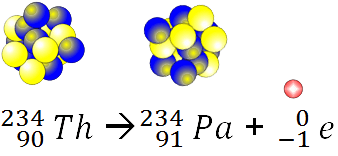
This is an example of ---
a)
Radioactive Decay
b)
Nuclear Fission
c)
Nuclear Fusion
d)
Fossil fuel reaction
10.
Which type of nuclear radiation is being emitted here?
a)
alpha
b)
beta
c)
gamma
d)
none
11.
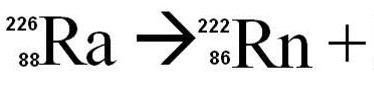
What particle completes this reaction?
a)
alpha particle
b)
beta particle
c)
gamma particle
d)
neutron
12.

Why does alpha decay occur?

a)

The nucleus is too large to be stable

b)

The proton to neutron ratio is unstable

c)

The nucleus is in an excited state. This usually follows other types of decay.

13.

Why does beta decay occur?

a)

The nucleus is too large to be stable

b)

The proton to neutron ratio is unstable

c)

The nucleus is in an excited state. This usually follows other types of decay.

14.

Which atoms are isotopes of each other? (Select all that apply)

a)

Carbon-13

b)

Nitrogen-14

c)

Carbon-14

d)

None of these

15.

What things will you need to calculate the atomic mass of an element? (Select all that apply)

a)

Number of protons and neutrons

b)

Abundance of every isotope in nature

c)

Mass number of every isotope in nature

d)

None of these

16.

The atomic mass of Beryllium is 9.012 g. Which isotope of Beryllium is most abundant?

a)
b)
c)
d)

None of these

17.

What happens if you change the number of protons in an atom?

a)

The atomic mass will change

b)

A new element will form

c)

Energy will be destroyed

d)

None of these

18.

Why do we not include electrons when we calculate the mass number of an element?

a)

Electrons are so small, they don't contribute much to the mass of an atom

b)

Electrons have a negative charge, and we do not want to subtract from the mass

c)

Protons and electrons cancel each other's charges out. To avoid the cancelling, electrons aren't included

d)

None of these

19.

What is the difference between the isotopes Nitrogen-14 and Nitrogen-15?

a)

Their position on the Periodic Table

b)

The number of neutrons in the nucleus

c)

The number of protons in the nucleus

d)

The charge of each isotope

20.

A sample of a radioactive isotope had a mass of 10 g. After 2 days, 0.625 g of the isotope was left. What is the half-life?

a)

2 days

b)

1 day

c)

1/2 days

d)

1/4 days

21.

What is the charge of a Magnesium atom with 10 electrons?

a)

-2

b)

-1

c)

+1

d)

+2

22.

Which sub atomic particle has a positive charge?

a)

Protist

b)

Neutron

c)

Electron

d)

Proton

23.

What three subatomic particles make up an atom?

a)

Protists, Neurons, Electrodes

b)

Protons, Neutrons, Electrons

c)

Protons, Neurons, Electrodes

d)

Protists, Neutrons, Electrodes

24.

How many protons are in one oxygen atom?

a)

8

b)

7

c)

15.999

d)

23.999

25.

How many electrons are in one neutral Lithium atom?

a)

3

b)

4

c)

6.941

d)

9.941

26.

How many neutrons are in one neutral Lithium atom?

a)

3

b)

4

c)

6.941

d)

9.941

27.

Which of the following pairs of compounds demonstrates the Law of Multiple Proportions?

a)

CO and CO2

b)

H2O and H2S

c)

HCl and Cl2

d)

NaCl and H2O

28.

J.J. Thomson discovered negatively charged particles called __________________ and developed the ________________________ model to try to explain their existence in a neutral atom.

a)

electrons; Rutherfordian

b)

electrons; Plum-Pudding

c)

protons; proton

d)

protons; Plum-Pudding

29.

Rutherford's gold-foil experiments concluded that all atoms have a small, dense, positively charged nucleus which makes up nearly all of the ______________ of an atom.

a)

volume

b)

mass

30.

The Bohr model of the atom showed that electrons can have different energy values and restricted the electrons positions to be ______________________

a)

in an electron cloud

b)

inside the nucleus

c)

in distinct energy levels (or orbits)

31.

In the nuclear symbol shown, how many protons are there?

a)

36

b)

17

c)

-1

d)

19

32.

In the nuclear symbol shown, how many neutrons are there?

a)

14

b)

6

c)

8

d)

20

33.

In the nuclear symbol shown, how many total electrons are there?

a)

23

b)

11

c)

12

d)

10

34.

Based on the symbol shown of an oxide ion, how many total electrons does it have? (only put the number as your answer)

(a)  

35.

Use the image to help. How many neutrons would there be in an atom of silver-107?

a)

107

b)

47

c)

60

d)

61

36.

Use the image to help you recall the definition of isotopes. Isotopes are atoms of the same element with

a)

different numbers of neutrons, and therefore, different masses

b)

different numbers of protons, and therefore, different masses

c)

different numbers of electrons that lead to a charge

37.

There are two naturally occurring isotopes of chlorine. Chlorine-35 occurs in samples at about 75.76%. Chlorine-37 occurs in samples at about 24.24%. Based on this information, what is an approximate average atomic mass for the element chlorine?

a)

Between 35 and 36 amu

b)

Between 36 and 37 amu

c)

less than 35 amu

d)

greater than 37 amu

38.

Nuclear reactions occur because ________________ nuclei release energy and change their numbers of protons and neutrons to become _____________________

a)

stable; unstable

b)

unstable; stable

39.

The symbol shown is used to represent what type of nuclear decay particle?

a)

alpha particle

b)

beta particle

c)

gamma ray

d)

positron

40.

List the types of nuclear radiation in order from least harmful to most harmful.

a)

gamma < alpha < beta

b)

alpha < gamma < beta

c)

alpha < beta < gamma

d)

gamma < beta < alpha

41.

How many half-lives go by if a sample of a certain isotope decays from 1000 grams down to 62.5 grams?

a)

4

b)

5

c)

16

42.

If the half-life of a certain isotope is 15.0 years, how many grams of that isotope will remain in a 300.0 gram sample after 45 years pass by?

a)

100 grams

b)

0 grams

c)

75 grams

d)

37.5 grams

43.
How many protons are in an atom with an atomic number of 20, an atomic mass of 45, and a charge of +2?
a)
20
b)
10
c)
2
d)
18
44.
How many electrons are in an atom that has an atomic number of 34, an atomic mass of 74 and a charge of -2?
a)
34
b)
36
c)
2
d)
40
45.
What particle provided the positive charge for an atom?
a)
proton 
b)
neutron
c)
electron
d)
nucleus
46.
How many protons are in this element?
a)
79
b)
196
c)
117
d)
Cannot be determined
47.
How many neutrons will an atom have it has an atomic number of 26, an atomic mass of 58 and a charge of +3?
a)
26
b)
58
c)
32
d)
3
48.
The dense center region of an atom
a)
electron cloud
b)
core
c)
nucleus
d)
centrino
49.
Subatomic particle that determines the identity of the atom
a)
proton
b)
nucleus
c)
electron
d)
neutron
50.
An atom with an unequal number of protons and electrons is said to have (a) ___.
a)
no charge
b)
balance
c)
charge
d)
unbalance
51.
How many electrons would an atom of Krypton have?
a)
83.80
b)
36
c)
12
d)
none
52.
In the isotope name, Hydrogen-3, what does the 3 represent?
a)
charge
b)
mass
c)
atomic number
d)
number of electrons
53.
What element is represented in this Bohr Model? 
a)
Carbon
b)
Hydrogen
c)
Aluminum
d)
Lithium
54.
In order of most to least penetrating radiation we have
a)
Alpha , Beta,  Gamma
b)
Beta , Gamma , Alpha
c)
Gamma, Beta, Alpha
d)
Gamma, Alpha, Beta
55.
This type of  reaction occurs when a heavy nucleus, such as U-235, splits into two or more parts. [KEY WORD: SPLIT]
a)
Fission
b)
Fusion
c)
Chain reaction
d)
synthesis
56.
How many protons and neutrons in 24X50 [Hint: Protons is the ATOMIC NUMBER or Number of the BOTTOM]
a)
P = 24 N = 50
b)
P = 24 N = 26
c)
P = 26 N = 24
d)
P = 50 N = 24
57.
What does alpha radiation emit?
a)
an electron
b)
a helium nucleus
c)
just energy
d)
none of the choices are correct
58.
If we start off with element 24X50 after an alpha decay we get another element Y that looks like
a)
22Y50
b)
22Y46
c)
20Y48
d)
26Y54
59.
Which type of nuclear radiation is being emitted here?
a)
alpha
b)
beta
c)
gamma
d)
none
60.
Which type of nuclear radiation is being emitted here?
a)
Alpha
b)
beta
c)
gamma 
d)
none
61.
If we start off with element 24X50 after an beta decay we get another element Y that looks like
a)
23Y50
b)
22Y46
c)
25Y50
d)
24Y50
62.
What subatomic particles would you find in the nucleus of an atom?
a)
Protons only
b)
Protons and Neutrons
c)
Neutrons and Electrons
d)
Protons and Electrons 
63.
Which subatomic particles contribute the most to the mass of an atom?
a)
Protons, Neutrons, Electrons
b)
Protons only
c)
Protons and Electrons
d)
Protons and Neutrons
64.
What is the number of protons that the element in this image contain?
a)
14
b)
7
c)
15
d)
18
65.
If an atom has 12 positively charged subatomic particles, which of the following must it also have to be considered a neutral atom?
a)
12 neutrons
b)
12 electrons
c)
12 protons
d)
24 protons and neutrons
66.
An atom has 10 protons, 15 neutrons and 10 electrons what is its mass number.
a)
20
b)
10
c)
5
d)
25
67.
Which letter represents a neutron?
a)
A
b)
B
c)
C
d)
D
68.
Which letter represents an electron?
a)
A
b)
B
c)
C
d)
D
69.
Which subatomic particle has a positive (+) charge?
a)
Neutron
b)
Proton
c)
Electron
70.
Which subatomic particle has a negative (-) charge?
a)
Proton
b)
Electron
c)
Neutron
71.
Which subatomic particle has a neutral or no charge?
a)
Proton
b)
Electron
c)
Neutron
72.
This particle determines what element you have - the elements identity.
a)
electron
b)
proton
c)
neutron
d)
valence shell
73.
Which of the following is the missing product for this reaction?
a)
Sc-42
b)
Ca-20
c)
Sc-42
d)
Ca-42
74.
Which of the following is the missing product for this reaction?
a)
He-4
b)
Be-4
c)
He-2
d)
Be-2
75.
What type of reaction is this?
a)
Alpha
b)
Beta
c)
Gamma
76.
What type of reaction is this?
a)
Alpha
b)
Beta
c)
Gamma
77.
What happens to the atomic number during alpha decay?
a)
The atomic number decreases by 4
b)
The atomic number increases by 1
c)
The atomic number decreases by 2.
d)
The atomic number stays the same.
78.
Balance the following equation:
146C --> 0-1e + ________
a)
145B
b)
146C
c)
147N
d)
42He
79.

In the symbol 167N what the 7 stand for?

a)

Mass number

b)

Atomic number

c)

Atomic mass

d)

Number of neutrons

80.
Complete the nuclear equation and determine the type of decay that is occurring in this reaction. 
a)
alpha
b)
beta
c)
gamma
d)
none
81.
24.1% of all the isotopes of a an element have a mass of 75.23 amu, 48.7% have a mass of 74.61 amu, and 27.2% have a mass of 75.20 amu.
What is the average mass of this element?
a)
74.92 amu
b)
24.97 amu
c)
75.01 amu
d)
74.51 amu
82.
What does the 1.00794 stand for?
a)
Hydrogen
b)
atomic number
c)
atomic mass
d)
atomic explosion
83.

Calculate the average atomic mass of the element iron (Fe) using the following data:

[Isotope / % abundance]

[Iron 54 / 6% ] [Iron 56 / 92% ] [ Iron 57 / 2% ]

a)

53.7 amu

b)

54.9 amu

c)

5592.0 amu

d)

55.9 amu

84.
An isotope has three forms.  30% have a mass of 4 amu, 20% have a mass of 5 amu and 50% have a mass of 3 amu.  Average atomic mass will be closest to
a)
2 amu
b)
3 amu
c)
4 amu
d)
5 amu
85.
4.35% of all X atoms have a mass of 39.946 amu. 83.79% have a mass of 41.941 amu, 9.50% have a mass of 42.941 amu, and 2.36% have a mass of 43.939 amu. What is the average atomic mass of atom X?
a)
41.97 amu
b)
42.19 amu
c)
10.43 amu
d)
40.04 amu
86.
If an atom contains exactly three protons, then it's an atom of _____
a)
lithium
b)
gold
c)
nitrogen
d)
carbon
87.
Calcium has three different isotopes. One has a mass of 35.00 amu; another has a mass of 41.00 amu; and another has a mass of 40.00 amu. Which isotope is the most abundant of the three?
a)
40.00 amu
b)
41.00 amu
c)
35.00 amu
d)
impossible to tell
88.
An element has three different isotopes. One has a mass of 35.00 amu; another has a mass of 36.00  amu; and another has a mass of 38.00  amu. What is the average atomic mass of this element?
a)
36.33 amu
b)
37.00 amu
c)
12.11 amu
d)
impossible to tell
89.
4.35% of all X atoms have a mass of 39.946 amu. 83.79% have a mass of 41.941 amu, 9.50% have a mass of 42.941 amu, and 2.36% have a mass of 43.939 amu. What is the average atomic mass of atom X?
a)
41.97 amu
b)
42.19 amu
c)
10.43 amu
d)
40.04 amu
90.
Calculate the average atomic mass of silver.
a)
106.38649amu
b)
111.91896amu
c)
107.8677amu
d)
121
91.
An element has two naturally occurring isotopes. One is 10.013 amu and is 19.9% abundant. The other is 11.01 amu and is 80.1% abundant. What is the average atomic mass? What element is it?
a)
9.012, Beryllium
b)
12.011, Carbon
c)
6.941, Lithium
d)
10.812, Boron
92.
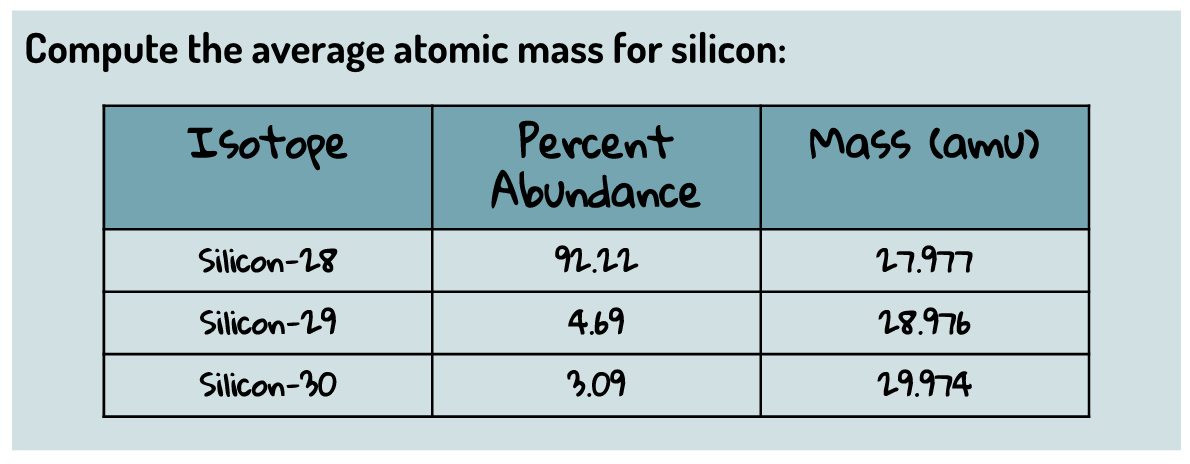
Compute the average atomic mass for silicon:
a)
27.977
b)
28.09
c)
28.976
d)
The average mass cannot be determined from provided information.