
 Worksheets
Ch15 - Genetics and Evolution
Total questions: 35
Worksheet time: 2hrs 17mins
Mutations are important because they bring about
death of the organism in which they develop
genetic variation needed for a population to evolve
benefits for the individual, not for the population
behavioural changes necessary for natural selection
Which of these describes a species that has become extinct?
fewer members of the species are dying than being born
more members of the species are dying than being born
very few members of a species are alive, most have died.
all members of a species have died
According to most scientists, what is the ultimate cause of most mass extinctions?
overhunting
evolution of new species to replace old ones
major change in environment
asteroid impact

True or False? Many scientists think that an asteroid caused the dinosaurs to go extinct.
True
False
When organisms are better adapted to their environment they will survive and reproduce more successfully than organisms less adapted. This process is called what?
Selective breeding
Natural Selection
Cloning
Artificial Selection
Choose all that apply. Fossils are great clues to life in the past. However, they have limitations. Some of those limitations are:
We have fossils for only 1% of species believed to have lived - incomplete record.
They are fragile and break easy loosing any evidence we have.
They do not show us internal structures.
They are too deep in the Earth to find.
Choose the correct order of taxa from LARGEST to SMALLEST
Kingdom, Phylum, Class, Order, Family, Species, Genus
Kingdom, Phylum, Class, Order, Species, Family, Genus
Kingdom, Phylum, Class, Order, Family, Genus, Species
Kingdom, Phylum, Class, Order, Genus, Species, Family
The three Domains are:
Plant, Animal, Bacteria
Bacteria, Archaea, Eukarya
Fungi, Animal, Plant
Eukaryotes, Prokaryotes, Plants
Term given to describe the 2 name naming system is:
dichotomous naming
binomial naming
biological naming
trinomial naming
What is the scientific name for a dog?
Dog
familiarius
Canis familiarius
Canis
the largest classification category
Kindgom
Phylum
Order
Species
the smallest, most specific classification category
Genus
Phylum
Order
Species
Subdivision of a kingdom
Genus
Phylum
Order
Species
Subdivision of a class
Genus
Phylum
Order
Species
First classified organisms based on their body structure, size, shape colour, and method of obtaining food (Use of scientific names).
Aristotle
Linnaeus
Woese
Darwin
Which of the following is the correct way to show the scientific name for tiger?
Panthera Tigris
Panthera tigris
panthera Tigris
panthera tigris

The scientific name for water bear is Hypsibius dujardini. What is its genus?
Hypsibius
dujardini
water
tardigrade

Who is the closest relative to the birds?
crocodiles
sharks
fish
amphibians
Who is the closest relative to the sharks?
cannot tell
sharks
ray-finned fish
amphibians

According to this evolutionary tree, which organism is most distantly related to the human?
crayfish
grasshopper
perch
frog

On this evolutionary tree, which organism is the closest relative of the human?
Frog
Hare
Caiman
Parrot

Where is the T.rex and frog's common ancestor?
Point A
Point B
Point C
Point D

Which two animals are most closely related?
Swordfish and Frog
Swordfish and Alligator
Frog and Alligator
T. rex and Alligator

Where is the sponge and mouse's most common ancestor?
Point E
Point B
Point C
Point D

Who shares a more distant common ancestor?
Sponge and Mouse
Mouse and Mushroom
Tomato and Fern
cannot tell

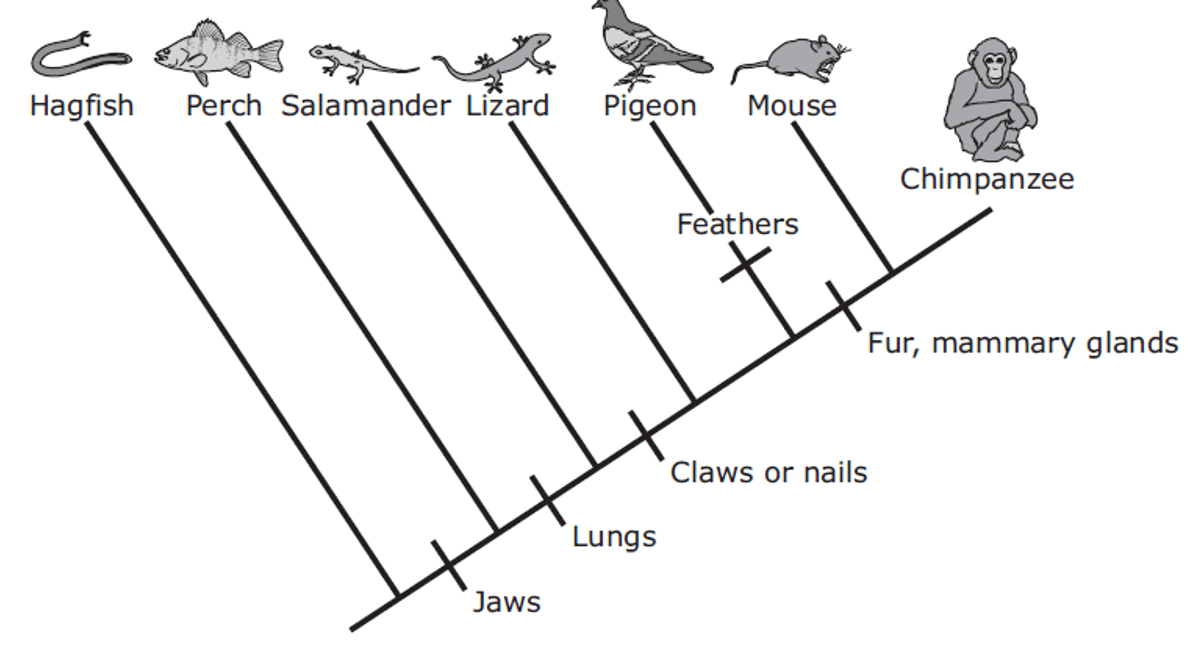
All the animals to the right of the hagfish would have the common characteristic of -
Fur
Claws or nails
Lungs
Jaws

