
NEW
Font size
 Worksheets
Grade 7 Science Baseline
Total questions: 50
Worksheet time: 25mins
1. An empty paper cup is the same temperature as the air in the room. A student fills the cup with cold water. Which of the following describes how thermal energy is transferred? (SC.7.P.11.4)
a. Thermal energy is transferred from the cold water to the cup until they are at the same temperature.
b. Thermal energy is transferred from the cup to the cold water until they are at the same temperature.
c. Thermal energy is transferred from the cup to the cold water until the cup has no more thermal energy.
d. Thermal energy is not transferred between the cup and the cold water.

In the morning, a student puts a warm can of soda in a cooler filled with ice. He closes the cooler. At lunch, the can of soda is colder. What happened to the total amount of energy in the cooler containing the can of soda and the ice?
(Assume that no energy is transferred into or out of the cooler when it is closed.) (SC.7.P.11.3)
a. The total amount of energy increased because the energy that the can of soda transferred to the ice is greater than the energy that the ice lost.
b. The total amount of energy decreased because the can of soda has less energy than it started with, and the amount of energy the ice has did not change.
c. The total amount of energy stayed the same because the amount of energy that the can of soda lost is equal to the amount of energy that the ice gained.
The total amount of energy stayed the same because being warmer or colder does not affect the amount of energy objects have.
3. According to the theory of natural selection, what would happen to a species of lizards when a new predator is introduced into the environment where the lizards live? (SC.7.L.15.2)
a. The lizards that already have the physical traits needed to avoid the new predator would be more likely to survive and reproduce, and the ones that do not would be less likely to survive and reproduce.
b. All of the lizards would try to develop new physical traits to avoid the new predator.
c. Some of the lizards would try to develop new physical traits to avoid the new predator, and the other lizards would die.
d. Because all lizards of the same species have the same physical traits, one lizard would not have an advantage over another lizard. They would either all survive or all die.
4. The eye color of children often resembles the eye color of their parents. Which of the following is genetically passed from parents to children? (SC.7.L.16.1)
a. Particles of color are passed from parents to children.
b. Cells that become the colored part of the eye are passed from parents to children.
c. Molecules that contain the information that determines eye color are passed from parents to children.
Nothing having anything to do with eye color is passed from parents to children.

In 1893, a large area of a national forest was home to mountain lions, coyotes, and bobcats as well as about 3,000 deer.
The deer ate grass, and the mountain lions, coyotes, and bobcats ate deer.
Around 1900, hunters began killing large numbers of mountain lions, coyotes, and bobcats. By 1923, there were 100,000 deer in this population.
Using only the relationships between the plants and animals described above, which of the following statements could explain why the population of deer increased so much? (SC.7.L.17.2)
a. The number of deer increased because without predators, the deer lived longer and had more offspring that also lived longer.
b. The number of deer increased because populations are always increasing.
c. The number of deer increased because with fewer mountain lions, coyotes, and bobcats, the deer had more food to eat.
There is not enough information to tell why the deer population increased.
6. Which of the following statements is TRUE about competition between organisms with the same needs when resources are limited? (SC.7.L.17.2)
a. Animals are the only organisms that compete for resources.
b. Plants are the only organisms that compete for resources.
c. Neither plants nor animals compete for resources.
Both plants and animals compete for resources.
7. Which of the following is TRUE about how wind can change earth’s solid rock layer and loose material on top of it? (SC.7.E.6.2).
a. Wind can break rocks, carry rocks, and drop rocks in new locations.
b. Wind can break rocks, but cannot carry and drop them in new locations.
c. Wind can carry rocks and drop them in new locations, but cannot break rocks.
Wind cannot break rocks, carry rocks, or drop them in new locations.

8. In the figure above, which of the following is the pathway of light that allows the child to see the ball? (SC.7.P.10.2)
a. Light bulb → child's eyes → ball
b. Child's eyes → light bulb → ball
c. Ball → light bulb → child's eyes
d. Light bulb → ball → child’s eyes
9. Which of the following is designed to convert energy into mechanical work?
(SC.7.P.11.2)
a. Electric fan
b. Kerosene heater
c. Flashlight
d. Baking oven
10. Which of the following is most consistent with the modern theory of evolution?
(SC.7.L.15.2)
a. Parents pass their physical traits to their offspring; those offspring with traits that help them survive in the environment are able to reproduce.
b. Parents change their physical traits in order to survive in the environment, then those parental traits are passed to their offspring.
c. Life on this planet came from another planet far out in space.
d. Living organisms have not changed for hundreds of millions of years.
11. A son inherits traits (SC.7.L.15.2)
a. only from his father
b. only from his mother
c. from both his father and his mother
d. from either his father or his mother, but not from both
12. In a healthy forest, dead trees and limbs fall to the ground and decompose. Which of these statements best describes why decomposition is important to a forest ecosystem? (SC.7.L.17.1)
a. Nutrients are released when wood is broken down.
b. Worms produce oxygen used by other organisms.
c. Dead trees provide nest sites for many different species of birds.
d. Water is stored in dead trees and limbs.
13. According to the plate tectonic theory, Australia was a part of the supercontinent Pangaea. Millions of years ago Pangaea divided, and eventually Australia was separated as its own continent. Which of the following is most likely a result of the isolation of the Australian continent for millions of years? (SC.7.E.6.4, SC.7.N.3.1)
a. Australia has no fossil record of species evolution.
b. Australia has a large number of species that are not found anywhere else.
c. Plant populations in Australia have all evolved to be self-pollinating to maximize their chance for reproduction.
Animal populations in Australia have little genetic diversity and are less likely to survive environmental changes.
14. As a river enters a larger body of water, sediments are deposited over a wide area. Which of these landforms is likely to be formed at the site of deposition?
(SC.7.E.6.2; Fair Game: SC.6.E.6.2, SC.6.E.6.1)
a. Cave
b. Mountain
c. Delta
d. Valley

The arrows in the picture below show several ways heat is transferred from the Sun as it strikes sand on the surface of a beach.
Which arrow shows convection? (SC.6.E.7.1)
1
2
3
4
16. Which of the following traits is most influenced by the environment? (SC.7.L.15.2)
a. Body weight
b. Eye color
c. Blood type
d. Color blindness

A student studying spiders creates the table shown below. What is the best conclusion the student can make based on this information? (SC.7.N.1.1; SC.7.N.1.6)
a. Web spiders are larger than hunting spiders.
b. Wolf spiders are the largest of these spiders.
c. Hunting spiders usually have warning color patterns.
d. Jumping spiders are faster than yellow garden spiders.

Some students hypothesize that heating a mixture of any substance and water will always increase the amount of the substance that will dissolve in the water. The table shows results of an investigation testing this hypothesis. The results for which of the substances tested weaken this hypothesis? (SC.7.N.1.2)
a. Substance W
b. Substance X
c. Substance Y
Substance Z
19. A group of students found metamorphic rocks near a campsite. The presence of metamorphic rocks is most likely evidence of? (SC.7.E.6.2)
a. dinosaur activity
b. sediment deposition
c. high pressure
d. wind-borne sand
20. Deforestation occurs when large areas of trees are cut down. Which of the following impacts on the environment would result from deforestation? (SC.7.E.6.6)
a. increased erosion
b. colder temperatures
c. excess ground moisture
d. greater oxygen production

Which of these best describes what happens to the light ray in the diagram?
(SC.7.P.10.2, SC.7.P.10.3)
a. reflection
b. absorption
c. attraction
d. refraction
22. The presence of hair on the middle section of the fingers (H) is a dominant trait in humans. Two parents with this dominant trait have children. Some of the children have this trait, and some children do not. Which of the following Punnett squares shows the genotypes of the parents and children in this family? (SC.7.L.16.2)


23. The petals of flowers often are brightly colored. These petals provide a benefit for the plant because they? (SC.7.L.15.3)
a. prevent insects from taking pollen to other flowers
b. hides the plant from predators that would eat its flowers
c. protect the leaves from injury by birds and insects
d. attracts insects that can carry the pollen needed for plant reproduction

The photographs below show how a change in climate is affecting the size of Grinnell Glacier in Glacier National Park. Which of the following best explains the change in the glacier between 1910 and 1997? (SC.7.E.6.6; Fair Game: SC.6.E.7.6)
a. Higher average temperatures
b. Higher frequency of earthquakes
c. Higher total precipitation
d. Higher rates of wind erosion
25. While investigating applications of science knowledge, Willy learned that scientists have used genetic engineering techniques to attach insulin-producing genes to bacterial DNA. These bacteria produce large amounts of scarce human hormones. Scientists predict that hormones produced by bacteria will be inexpensive and will not cause allergic reactions. (SC.7.N.1.5)
Scientists developed hormone-producing bacteria because they wanted to
a. Learn about bacteria.
b. Discover a cure for diseases.
c. Find a way to increase the supply of hormones for use by humans.
d. Compare the hormones produced by bacteria with hormones produced naturally.
26. For rabbits, having long hair is an advantage over having short hair in environments with? (SC.7.L.15.2)
a. high levels of rain
b. a large number of competitors
c. low temperatures
d. few predators
n experiment is being done to determine how light affects the growth of three different types of pea plants. Peas of each type are planted in several cups, and the cups are labeled X, Y, or Z to show the type of pea planted in each. Some cups are set in each of three locations to receive different amounts of light. Which of the following best shows how the plants should be arranged for the experiment?
(SC.7.N.1.4)


A quarry is an open pit from which rock can be obtained by digging, cutting, or blasting. The quarry shown below cuts through several layers of sedimentary limestone rock, labeled W through Z. Some of the rock from the quarry is crushed to make gravel of various sizes. The rock and gravel are used in the construction of buildings and roads. Large diesel machines and trucks remove the rock and gravel and transport it to construction sites. 28. Before the quarry was dug, the land contained more vegetation. What impact has this change most likely had on the local ecosystem? (SC.7.E.6.2, SC.7.E.6.6)
a. Larger predator populations
b. A lower number of producers
c. A greater number of herbivores
d. A smaller amount of available carbon dioxide

29. Diesel fuel is used in the engines of the machines and trucks at the quarry. Which of these is the main energy transformation as the fuel is used by the engines?
(SC.7.P.11.2)
a. Electrical energy is converted to heat energy.
b. Heat energy is converted to potential energy.
c. Electrical energy is converted to kinetic energy.
d. Chemical energy is converted to kinetic energy.

30. In the food web below, which of the following organisms feeds on the largest variety of different producers? (SC.7.L.17.1)


31. In spring 2003, a natural rock outcropping in New Hampshire called the Old Man of the Mountain collapsed. Which of the following most likely loosened the rock and caused it to fall? (SC.7.E.6.2; Fair Game: SC.6.E.6.1)
a. Heat turning sedimentary rock into metamorphic rock
b. Water freezing and thawing inside cracks in the rock
c. Volcanic activity producing pressure at the rock’s base
d. Oxygen reacting with iron on the surface of the rock.
32. Which energy transformation occurs when a match is lit? (SC.7.P.11.2)
a. Chemical energy to heat energy
b. Heat energy to potential energy
c. Electrical energy to heat energy
d. Kinetic energy to potential energy

33. The picture below shows four varieties of the same species of grass that grow in a prairie ecosystem. Which variety has the best chance of surviving a long period of dry weather? (SC.7.L.15.3)
a. Variety 1
b. Variety 2
c. Variety 3
d. Variety 4

34. Glossy leaves are smooth and shiny. What percent of offspring from the cross shown below will have glossy leaves? (SC.7.L.16.2)
G = glossy leaves (dominant trait)
g = non-glossy leaves (recessive trait)
0%
25%
50%
100%
35. Which diagram best represents the type of plate movement that results in mountain building? (SC.7.E.6.5)


A candle is placed on a ruled grid in front of a mirror, as shown. At what point will the reflection of the candle appear to be? (SC.7.P.10.2)
a. Point A
b. Point B
c. Point C
d. Point D
37. Traits are transferred from generation to generation through the (SC.7.L.16.1)
a. sperm only
b. egg only
c. sperm and the egg
d. testes

The diagram below shows the Pacific Ring of Fire. Earthquakes and volcanic activity occur along the Ring of Fire. Which of the following best explains why? (SC.7.E.6.2)
a. It is located at the boundaries of tectonic plates.
b. It is located at the boundary of deep and shallow water.
c. It is located where the major ocean currents meet.
d. It is located where ocean temperature is the highest.
39. Which of the following takes place during fertilization in animals and most flowering plants? (SC.7.L.16.3)
a. production of sperm and egg
b. joining of sperm and egg
c. division of egg
d. development of embryo
40. Which diagram below illustrates the absorption of light energy? (SC.7.P.10.2)


41. Which procedure best determines whether water temperature affects the weathering of sedimentary rocks? (SC.7.N.1.4)
a. Test three identical sedimentary rocks, one each in three different water temperatures.
b. Test three identical sedimentary rocks in one water temperature.
c. Test one crushed sedimentary rock and one whole sedimentary rock in water.
d. Test three identical sedimentary rocks, one each in an acid, a base, and water.
42. Denise was driving east over a hill in the afternoon, shortly after a rain shower. Suddenly the sun broke through the clouds, and she saw a rainbow ahead of her. Which of the following made the rainbow possible? (SC.7.P.10.1)
a. Sunlight can be separated into all the colors of the rainbow.
b. Water reflects sunlight like a mirror to make it look colored.
c. Overhead black clouds reflect in puddles to cause a mirage.
d. Air pollution causes the sky to look colored under these conditions.

43. The graph shows the results of a photosynthesis investigation on algae. Which question was the scientist most likely studying? (SC.7.N.1.4)
a. Why is the rate of photosynthesis different in high light intensity from low light intensity?
b. Why does increasing the light intensity increase the rate of photosynthesis in algae?
c. How is the rate of photosynthesis in algae at two light intensities affected by different temperatures?
d. How does increasing the rate of photosynthesis in algae change its temperature?

44. Based on the diagram, which process explains why less dense, hot magma rises to the surface to displace denser, cooler magma? (SC.7.E.6.1, SC.7.N.1.7)
a. conduction
b. diffusion
c. radiation
d. convection

45. The graph below shows how a white-tailed deer population recovered over a ten-year period after a population crash. Wolves in the same area feed primarily on deer. Which graph below shows the most likely change in wolf population for the same ten-year period? (SC.7.L.15.3)


46. In pea plants, the trait for round seeds is dominant over the trait for wrinkled seeds. If a pure dominant plant with round seeds is crossed with a plant with wrinkled seeds, what can be predicted about the offspring plants? (SC.7.L.16.2)
a. Offspring plants will all have round seeds.
b. Offspring plants will all have wrinkled seeds.
c. Each offspring plant will have some round and some wrinkled seeds.
d. Unless the plant with wrinkled seeds was pure recessive, no prediction can be made.

What do the arrows in the food chain below indicate about the flow of energy in an ecosystem? (SC.7.P.11.2)
a. Energy is continuously recycled by the organisms in an ecosystem.
b. Energy flows in one direction in an ecosystem, from producers to consumers.
c. More of the available energy in an ecosystem is given to large animals than to small animals.
d. Organisms at the end of the food chain receive more energy than those at the beginning.

48. Keesha did an experiment to study the rate of photosynthesis in the water plant Elodea. She placed a piece of Elodea in a beaker of water and set the beaker 10 centimeters (cm) from a light source. Keesha counted the bubbles released from the plant every minute for five minutes (min). She repeated the process two more times. First, she moved the light to 20 cm from the beaker, and then she moved the light to 30 cm from the beaker. Keesha’s setup and data are shown below.(SC.7.N.1.4) What is the outcome variable (dependent variable) in this experiment?
a. the number of bubbles produced
b. the type of plant placed in the beaker
c. the distance of the light source from the plant
d. the amount of time the bubbles were counted

49. The following statements were taken from the procedures of four different investigations. The statement from which investigation is an example of repetition? (SC.7.N.1.2)
a. Investigation 1
b. Investigation 2
c. Investigation 3
d. Investigation 4
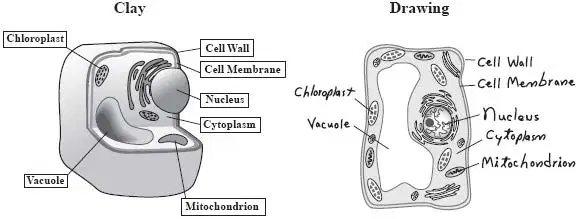
Two type of models that can be used to show details of the structures of cells are shown. Which of the following describes limitations of the drawing but NOT the clay model?
It does not represent the main parts of a cell.
It does not contain the correct number of nuclei.
It cannot represent a living cell, since a true cell is three-dimensional.
It cannot represent a true cell, since the cytoplasm should be in constant motion.

