
 Worksheets
Knife Skills and Classic Cuts
Total questions: 39
Worksheet time: 20mins

This is a ________ knife.
Tourne
Granton/Santoku
Chef's
Cleaver

Rondelle Slice

What type of cut is this?
Chiffonade
Julienne
Brunoise
Batonnet

What type of cut is this?
Brunoise 1/8" x 1/8"
Batonnet 1/4" x1/4" x 2"
Julienne 1/8"x1/8"x2"
Dice (large) 3/4"x3/4"
A sharp knife is more dangerous than a dull knife.
True
False
What are the dimensions of a julienne?
1/4" X 1/4" X 2"
Slices that are the same thickness
1/8" X 1/8" X 1/8"
1/8" X 1/8" X 2"

What cut is this?
Rondelle
Brunoise
Tourne
Batonnet
Leaves or herbs cut into very thin strips is called? (we used spinach to practice)
Emincer
Sliced
Chiffonade
Minced
What is the purpose(s) of having nice cuts?
Even cooking
Consistency throughout the industry
Appearance
Demonstrate your knife skills
All options are correct
When you are carrying a knife through the you should...
People will see you have a knife and move
Keep it hidden so it is safe
Have another student carry it for you
Announce "Knife" while walking and carry it at your side, point down
A paring knife is used for hand held cutting jobs.
True
False
What are the two most common knives used in a kitchen?
Chef and Utility
Chef and Paring
Utility and Paring
Chef and Serrated
What are factors to consider what choosing a knife
ease of use
handle comfort
handle weight and material
all of the above
What is the tang of the knife?
One continuous piece of metal that extends from the tip of the knife to or through the handle
Handle of the knife
The top of the knife blade
Working part of the knife
Where is the spine of the knife?
One continuous piece of metal that extends to the edge of the handle
Pointed part of the blade
The top of the knife blade, opposite the knife edge
Working part of the knife
Cutting boards must be cleaned and sanitized after each use to avoid cross-contamination?
True
False
What knife is used for chopping, slicing, and most other cutting tasks?
Utility knife
Chef knife
Paring knife
Serrated knife
Which knife is useful for cutting breads and pastries?
Utility knife
Serrated knife
Paring knife
Chef knife

Which knife is designed to cut away skin and peel, also useful for cutting intricate garnishes and other detail work? It is generally meant for cutting in your hand and for small work on the cutting board
Chef knife
Utility
Serrated knife
Paring knife
A knife does a better job of cutting or slicing food when it is sharp?
True
False
How should you wash your knives?
Leave knives in sink to clean later
Wash, rinse, dry, and put away
Damp towel
How should you pass a knife to another person?
Put knife on counter with handle away from you
Put knife on counter with blade away from you
Near edge of counter
How should you carry a knife through the kitchen?
In front of you
Down and away from you
With both hands
What is the correct way to hold any food product with the off hand?
Fingers straight
Fingers bent

Fingers in a claw position, (curled completely under so knuckles are knife guide is also okay)
How should a knife be positioned if it is not in use, but you will need it soon?
Knife block
In sink
In drawer
Away from the edge of the counter near cutting board
Why should you NOT use a dull knife
Accidental cuts are less likely
Accidental cuts are more likely
Requires less pressure to slice vegetables
Uses less time for sharpening
Why is the hand-claw technique important when cutting?
Keeps fingers from cramping
Prevents strain on wrist
Keeps food sanitary
Guides food and prevents cuts
An elongate slice is a result of what cut?
round
square
thin
diagonal
Which vegetable cut is a 3/4" cube?
Julienne
large dice
mince
tournee
A _____ knife is a safe knife.
Dull
Small
Large
Sharp
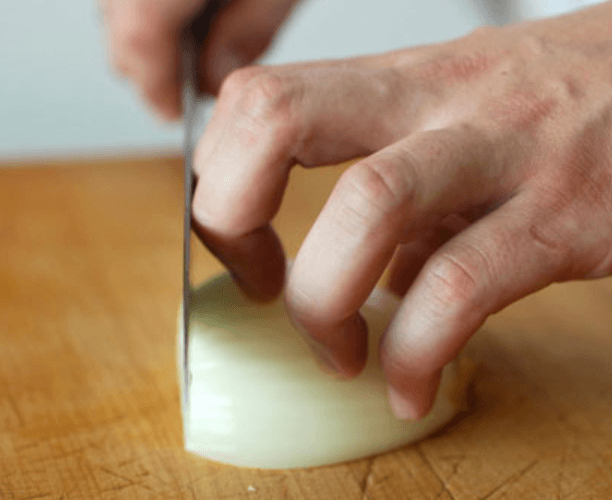
use the _________ or _________ technique to protect fingers while cutting foods.
Claw grip
flat fingers
Nuckle grip
Palm grip
Not cutting foods on a cutting board can cause your knife to ____________.
become sharper
slip while cutting
Dull/Damage the blade.
Ruin your countertops

A medium dice measures at _____________.
½ x ½ x ½ inches
¼ x ¼ x 2 inches
¼ x ¼ x ¼ inches
1/8 x 1/8 x 2 inches

Batonnet and Julienne are always _____" in length.
1 inch
2 inch
3 inch
4 inch
A Batonnet is a _________ shaped cut.
"french fry"
Cube
Very fine matchstick
Very fine cube
What types of food would a chiffonade cut be appropriate for?
Breads
Carrots
Meats
Herbs

