Wayground logo

Free Printable Worksheets

Font size

S
M
L
XL
Worksheets

Ecosystem Assessment Review

Total questions: 50

Worksheet time: 35mins

Name
Class
Date
1.

If the population of a certain predator increases there is often ______________________________ its prey.

a)

an increases of the population of

b)

a decrease of the population of

c)

no impact found on

2.
Temperature, light, air, water, and soil are all  _____  parts of the environment
a)
alive
b)
biotic 
c)
abiotic
d)
living
3.
A living or once-living organisms in an ecosystem is a
a)
population
b)
biotic factor
c)
abiotic factor
d)
community
4.
Limiting factors are sometimes helpful because they can keep the population from getting too large.
a)
True
b)
False
5.
If there is more food than usual in an ecosystem, then...
a)
Populations will stay the same
b)
Populations will decrease
c)
Populations will increase
6.
Any thing or organism that regulates the size of a population of another organism is known as __________.
a)
a limiting measure
b)
a limiting factor
c)
factorization
d)
materialization of precipitation
7.
All members of one species in a certain area.
a)
Population
b)
Limiting Factors
c)
Immigration
d)
Birth Rate
8.
The largest number of organisms that the environment can support. 
a)
Carrying Capacity
b)
Limiting Factor
9.

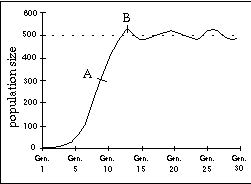
What is the carrying capacity of the graph?

a)

1000

b)

8000

c)

800

d)

600

10.

What happens if a population grows past its carrying capacity?

a)

The population keeps growing

b)

The population starts to die off

c)

The entire species will go extinct

d)

The carrying capacity just increases

11.

What is the carrying capacity of the graph?

a)

around 500

b)

more than 800

c)

less than 300

d)

around 700

12.

Look at the diagram of the food web. The arrows means “eaten by.”


What will happen if the number of snakes goes down?

a)

The owl will eat the grass

b)

The number of frogs will go down

c)

The hawk and owl will have less food

d)

The number of mice and grasshoppers will go up.

13.

What happens to the amount of available energy in the pyramid as it moves up through the different levels?

a)

it increases

b)

it decreases

c)

it remains the same

d)

it decreases, then increases

14.
A consumer gets energy by doing what?
a)
Making it themselves.
b)
Breaking down biotic wastes and dead organisms and returning raw materials to the ecosystem.
c)
Soaking it up from the ground.
d)
Feeding on other organisms.
15.
An organism that lives by breaking apart dead organic matter into simpler parts is...
a)
scavenger
b)
consumer
c)
decomposer
d)
carnivore
16.
A __________ includes all living and non-living things in an environment. 
a)
population
b)
niche
c)
abitotic
d)
ecosystem
17.

Which organism make their own food through the process of photosynthesis?

a)

decomposer, ex mushrooms

b)

consumer, ex tiger

c)

herbivore, ex cow

d)

producer, ex grass

18.
Which is true about the first (bottom) trophic level in an energy pyramid?
a)
It has the most available energy and includes all consumers
b)
It has the most avaliable energy and includes all producers
c)
It includes primary consumers (heterotrophs), which are known as herbivores
d)
In includes primary consumers (autotrophs), which are known as herbivores
19.
In the energy pyramid here, how much of the energy in the producers gets passed to the herbivores?
a)
10%
b)
20%
c)
80%
d)
90%
20.
Consumer that eats plants
a)
heterotroph
b)
herbivore
c)
producer
d)
community
21.
organisms that relies on other organisms for food; consumer
a)
herbivore
b)
decomposer
c)
heterotroph
d)
species
22.
Organisms that feed on both living producers and other consumers.
a)
Carnivores
b)
Omnivores
c)
Herbivores
d)
Detritivores
23.
An organism that helps to recycle nutrients within an ecosystem by eating dead or decaying organisms is a:
a)
Predator
b)
Autotroph
c)
Producer
d)
Decomposer
24.
Where does the energy start in this food chain?
a)
Plant
b)
Sun
c)
Deer
d)
Wolf
25.
What does NOT produce carbon dioxide?
a)
Photosynthesis
b)
Burning Fossil Fuels
c)
Animal respiration
d)
Plants decaying
26.
Combustion is another word for __________.
a)
Transportation
b)
Respiration
c)
Fossil Fuels
d)
Burning
27.
TRUE or FALSE?
All of the carbon in existence is continually recycled in the carbon cycle.
a)
True
b)
False
28.
Organisms that do not decompose can be buried and become what?
a)
water
b)
nutrients
c)
air
d)
fossil fuels
29.
Which of the following removes carbon from the atmosphere?
a)
Combustion
b)
Respiration
c)
Photosynthesis
d)
Death
30.
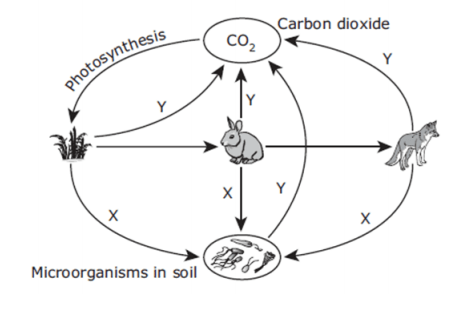
The diagram shows the flow of organic molecules through an ecosystem. What two processes are identified by the labels X and Y?
a)
X : Respiration
Y : Predation
b)
X : Adaptation
Y : Decomposition
c)
X : Fermentation
Y : Nitrogen Fixation
d)
X : Decomposition
Y : Respiration
31.
The average temperature of the surface of Earth has increased approximately 1°C in the past century. Which reason best explains this increase in temperature?
a)
lower levels of ozone in the atmosphere
b)
lower levels of nitrogen in the atmosphere
c)
higher levels of carbon dioxide and other greenhouse gases in the atmosphere
d)
higher levels of oxygen in the atmosphere
32.
Organisms that break down dead plants & animals and release nitrogen back into atmosphere...
a)
bacteria
b)
plants
c)
animals
d)
producers
33.
Organisms that need nitrogen to survive
a)
only plants
b)
only animals
c)
only bacteria
d)
all living organisms
34.
Plants and animals cannot use nitrogen directly from the air.
a)
True
b)
False
35.
After plants and animals contain nitrogen, what puts it back into atmosphere and soil?
a)
decomposition
b)
precipitation
c)
condensation
d)
bacteria
36.
The process in which Nitrogen circulates and is recycled is called ____________
a)
The nitrogen cycle
b)
The water cycle
c)
The carbon cycle
d)
Nitrogen Fixation 
37.

What converts nitrogen gas into a usable form for plants and animals?

a)

bacteria

b)

rain

c)

fungi

d)

car exhaust

38.

This is NOT a part of the phosphorus cycle.

a)

Phosphate is incorporated into sedimentary rocks

b)

Phosphate bound to soil

c)

Atmospheric phosphate

d)

Phosphate is absorbed from the soil by plants

39.
Phosphorous is passed from plants to ____ who eat them
a)
plants
b)
animals
c)
scavengers
40.
Which of the following statements is true of the phosphorus cycle?
a)
Phosphorus enters the atmosphere as phosphates.
b)
The phosphorus cycle utilizes the processes of erosion, and weathering.
c)
Phosphates are used in carbohydrate and glucose storage.
d)
The phosphorus cycle utilizes bacteria to breakdown phosphates and make them available for plants.
41.
What role do decomposers play in the phosphorous cycle?
a)
absorb phosphorous 
b)
release phosphorous into atmosphere
c)
return phosphorous into the soil
d)
combustion
42.
This is released by the weathering of rocks.
a)
Carbon
b)
Oxygen
c)
Phosphorus
d)
Nitrogen
43.

Why were wolves absent from Yellowstone from the 1920's to 1995?

a)

There was no prey available, so they starved.

b)

When all the elk died, the wolves moved to Canada.

c)

Humans hunted and killed all the wolves in Yellowstone and the surrounding area.

d)

The wolves migrated south to Texas for a warmer climate.

44.

Other species that feed from an elk killed by wolves include

a)

foxes, rabbits, and mice

b)

bears, foxes, and beavers

c)

bears, eagles, and coyotes

d)

beavers, rabbits, and mice

45.

Explain why the population of elk built up.

a)

There were just a lot of them and so they reproduced quickly.

b)

There was lots of food for the elk in the park so they reproduced well.

c)

There was no natural predator to hunt them so they became over populated.

d)

No one is actually sure why this happened.

46.

What happened to the vegetation because of the elk population?

a)

The elk ate it all, They reduced the vegetation to almost nothing, or they devoured it, leaving it bare.

b)

Nothing at all. the vegetation just grew as normal.

c)

A drought actually caused the vegetation to die and the elk trampled what was left.

d)

The elk ate some of it but lots of the vegetation remained.

47.
Which of the following is the best conclusion that can be made from this graph?
a)
atmospheric carbon dioxide levels have been decreasing since 1960
b)
Hawaii has a lot of carbon dioxide
c)
humans have been working hard to decrease carbon dioxide levels
d)
atmospheric carbon dioxide levels have increased steadily since 1960
48.

The main human activity that releases greenhouse gases is

a)

using public transportation and there by reduce the affects of greenhouse gases.

b)

burning fossil fuels

c)

texting on cellphones

d)

eating meat

49.
 What is the greenhouse effect?
a)
The warming of a planet due to trapped radiation.
b)
The cooling of Earth due to air pollution.
c)
The heating of a solid, such as a rock.
50.
Which natural process removes carbon dioxide from the atmosphere?
a)
forest fires
b)
volcanic eruptions
c)
cellular respiration
d)
photosynthesis