Wayground logo

Free Printable Worksheets

Font size

S
M
L
XL
Worksheets

Adv Chem Orbital Diagrams

Total questions: 43

Worksheet time: 1hrs 1mins

Name
Class
Date
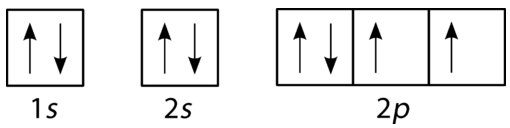
1.
Which element is pictured?
a)
neon
b)
fluorine
c)
magnesium
d)
argon
2.
What is the shape of an s orbital?
a)
sphere
b)
dumbbell
c)
double dumbbell
d)
TOO COMPLEX TO KNOW IT.
3.
Which orbital has the least amount of energy? 
a)
p orbital
b)
d orbital
c)
s orbital 
d)
What is an orbital?
4.
How many half-filled orbitals would silicon contain?
a)
0
b)
2
c)
1
d)
3
5.
Which element would have zero half-filled orbitals?
a)
potassium
b)
copper
c)
magnesium
d)
oxygen
6.
Which element would have 5 half-filled orbitals?
a)
sodium
b)
manganese
c)
sulfur
d)
uranium
7.
How many p electrons are in bromine?
a)
5
b)
12
c)
17
d)
6
8.
How many d electrons are in zirconium?
a)
2
b)
12
c)
40
d)
10
9.
What is the maximum capacity for an orbital?
a)
2
b)
8
c)
6
d)
10
10.
What is the Pauli Exclusion Principle?
a)
An atomic orbital can only hold a maximum of 2 electrons, each with opposite spins
b)
An atomic orbital can hold a minimum of 6 electrons, each with opposite spins
c)
An atomic orbital can hold a maximum of 6 electrons, each with the same spin
d)
An atomic orbital can hold a minimum of 2 electrons, each with opposite spins
11.
Electrons occupy orbitals of lowest energy first is part of what electron configuration rule?
a)
Hund’s Rule
b)
Aufbau Principle
c)
Pauli Exclusion Principle
12.
What is incorrect about this orbital diagram?
a)
Both arrows in the 2p box should be pointing up
b)
There is nothing incorrect with this diagram
c)
There should be one electron in the first 2p box and one in the 2nd 2p box
d)
All the arrows should be pointing up.
13.
This orbital diagram represents:  
a)
C
b)
B
c)
N
d)
O
14.
This orbital diagram represents:  
a)
C
b)
B
c)
N
d)
O
15.
In an orbital diagram,  an arrow represents: 
a)
an electron
b)
an orbital
c)
an element
16.
The maximum number of electrons that can be placed in an f orbital.  
a)
2
b)
6
c)
10
d)
14
17.
Which orbital shows a violation of the Pauli Exclusion Principle?
a)
A
b)
B
c)
C
d)
D
18.
Which orbital shows a violation of the Aufbau Principle?
a)
A
b)
B
c)
C
d)
D
19.
Which orbital shows a violation of Hund's Rule?
a)
A
b)
B
c)
C
d)
D
20.
When an electron absorbs energy it moves from the ____ state to the ___ state.
a)
ground; excited
b)
excited; ground
c)
low; photon
d)
photon, low
21.
Which element is depicted from this atomic orbital diagram?
a)
Carbon
b)
Nitrogen
c)
Oxygen
d)
Phosphorus
22.
Which element is depicted from this orbital diagram
a)
Fluorine
b)
Neon
c)
Chlorine
d)
Argon
23.
Which guideline, Hund’s rule or the Pauli exclusion principle, is violated in the following orbital diagrams?
a)
Hund's
b)
Aufbau's
c)
Pauli's Exclusive
24.
Which guideline, Hund’s rule or the Pauli exclusion principle, is violated in the following orbital diagrams?
a)
Hund's
b)
Aufbau's
c)
Pauli's Exclusive
25.
Which guideline, Hund’s rule or the Pauli exclusion principle, is violated in the following orbital diagrams?
a)
Aufbau's
b)
Hund's
c)
Pauli exclusive
26.
Electrons are paired based on their spin directions, clockwise and counterclockwise, is what electron configuration rule?
a)
Hund’s Rule
b)
Aufbau Principle
c)
Pauli Exclusion Principle
27.

True or False: The ground state is the highest energy state of an atom.

a)

True

b)

False

28.
For an electron to change from ground state to an excited stated it must...
a)
Absorb energy
b)
Release energy
29.
Line emission spectrum shown below happens when
a)
Electron transition from lower to higher energy level.
b)
Electron transition from higher to lower energy level.
c)
Electron exist in fixed energy states
d)
Electron transition between different energy levels.
30.
Emission of light from an atom occurs when an electron
a)
drops from a higher to a lower energy level.
b)
   jumps from a lower to a higher energy level.   
c)
   moves within its atomic orbital.
d)
falls into the nucleus.
31.
Why are line emission spectra of elements called "atomic fingerprints"?
a)
They are all the same
b)
They are all unique
c)
They are all similar
d)
They all contain colored light
32.

All stars are composed of a mixture of elements. When these elements are heated they emit specific amounts of electromagnetic radiation, known as an emission spectrum. Each element emits a unique, identifiable, spectrum.


Using the Bright-line emission spectrum chart below, identify the elements present in this modeled star (found in the line labeled “mixture”).

a)

Lithium and cadmium are in the mixture. Strontium is not in the mixture.

b)

Lithium and strontium are in the mixture. Cadmium is not in the mixture

c)

Cadmium and strontium are in the mixture. Lithium is not in the mixture

d)

All of the shown elements are present in the mixture.

33.

The unknown emissions spectra belongs to the element

a)

Hydrogen

b)

Mercury

c)

Neon

d)

Sodium

34.

The unknown emissions spectra belongs to the element

a)

Hydrogen

b)

Mercury

c)

Neon

d)

Sodium

35.
What gases are in the unknown mixture?
a)
Gas B & Gas D
b)
Gas C & Gas B
c)
Gas A & Gas D
d)
Gas D & Gas C
36.

Which element(s) is/are found in the star's spectra below?

a)

Hydrogen only

b)

Hydrogen & Helium

c)

Calcium only

d)

Hydrogen & Calcium

37.
Which elements are in the unknown sample?
a)
A and B
b)
B and C
c)
A and D
d)
B and D
38.
The parallel lines represents...
a)
energy levels of the atom
b)
energy levels of the electrons
c)
energy levels of the photons
d)
energy levels of the nucleus
39.

If an electron moves from n=4 to n=2 it ____

a)

absorbs energy

b)

releases energy

40.

Look carefully at the picture. It shows an electron in the excited state on the left, and the electron returning to its ground state on the right. When the electron return to the ground state it emits a_______________________.

a)

blast of cold air

b)

electrostatic charge

c)

proton

d)

photon (light)

41.

The picture shows an atom in the ground state absorbing energy and the electron jumps to the excited state. Which state has higher energy?

a)

Ground State

b)

Excited State

42.

Each element produces its own pattern of emission spectra lines because each element has its own distinct

a)

Speed of light

b)

Electron configuration

c)

Number of neutrons

d)

None of these

43.

The unknown emissions spectra belongs to the element

a)

Hydrogen

b)

Mercury

c)

Neon

d)

Helium