Wayground logo

Free Printable Worksheets

Font size

S
M
L
XL
Worksheets

Unit 6 Review assignment

Total questions: 56

Worksheet time: 1hrs 13mins

Name
Class
Date
1.

What reaction has the following general formula:

AB --> A + B

a)

Combination

b)

Decomposition

c)

Single Replacement

d)

Double Replacement

e)

Combustion

2.

What reaction has the following general formula:

A + CD --> C + AD

a)

Combination

b)

Decomposition

c)

Single Replacement

d)

Double Replacement

e)

Combustion

3.

What reaction has the following general formula:

AB + CD --> CB + AD

a)

Combination

b)

Decomposition

c)

Single Replacement

d)

Double Replacement

e)

Combustion

4.

What reaction has the following general formula:

A + B --> AB

a)

Combination

b)

Decomposition

c)

Single Replacement

d)

Double Replacement

e)

Combustion

5.

What reaction has the following general formula:
 CxHy + O2 −>CO2 + H2OC_xH_y\ +\ O_2\ ->CO_{2\ }+\ H_2O  

a)

Combination

b)

Decomposition

c)

Single Replacement

d)

Double Replacement

e)

Combustion

6.

What is the general reaction scheme for a single replacement reaction?

a)

A + B --> AB

b)

AB --> A + B

c)

A + CD --> C + AD

d)

AB + CD --> CB + AD

e)

CxHy+O2 −> CO2+H2OC_xH_y+O_2\ ->\ CO_2+H_2O

7.

What is the general reaction scheme for a combustion  reaction?

a)

A + B --> AB

b)

AB --> A + B

c)

A + CD --> C + AD

d)

AB + CD --> CB + AD

e)

CxHy+O2 −> CO2+H2OC_xH_y+O_2\ ->\ CO_2+H_2O

8.

What is the general reaction scheme for a combination reaction?

a)

A + B --> AB

b)

AB --> A + B

c)

A + CD --> C + AD

d)

AB + CD --> CB + AD

e)

CxHy+O2 −> CO2+H2OC_xH_y+O_2\ ->\ CO_2+H_2O

9.

What is the left part of a chemical equation called?

2H2 + O2 ---> 2H2O

a)

Reactants

b)

Yields

c)

Products

d)

Chemical equation

10.

What is the right part of a chemical equation called?

2H2 + O2 ---> 2H2O

a)

Reactants

b)

Yields

c)

Products

d)

Chemical Equation

11.

What is the total number of atoms present in 5Na3PO4?

a)

5

b)

55

c)

40

d)

8

12.

What is the little number after an element in a chemical equation called?

Example: H2

a)

Coefficient

b)

Atom

c)

Subscript

d)

Equation

13.

Is the following equation balanced?

Al + O2 ---> 2Al2O3

a)

YES

b)

NO

14.

What is the number before a chemical formula called?

Example: 2H2 + O2 ---> 2H2O

a)

Coefficient

b)

Atom

c)

Subscript

d)

Equation

15.

Is the following equation balanced?

4Fe + 3O2 ---> 2Fe2O3

a)

YES

b)

NO

16.

Chemical Reaction

a)

a substance formed as a result of a chemical reaction

b)

a change in matter that produces one or more new substances

c)

the process in which substances undergo chemical changes that result in the formation of new substances

d)

a substance that enters into a chemical reaction

17.

The Law of Conservation of Matter

a)

tells how many atoms of an element are contained in one molecule or formula unit.

b)

the starting materials in a chemical reaction

c)

the new substances that are formed in a chemical reaction

d)

A law stating that atoms are not created or destroyed during a chemical reaction.

18.

Balance this equation

_Al +_HCl --> _H2 +_AlCl3

a)

2,6,3,2

b)

it's already balanced

c)

4,12,3,4

d)

2,1,4,5

19.

The coefficient in 3H2O is

a)

6

b)

5

c)

2

d)

3

20.
How many atoms of carbon (C) are in C6H12O6?
a)
3
b)
6
c)
12
d)
24
21.
How many Hydrogen are in 4H2O?
a)
6
b)
8
c)
2
d)
4
22.
What is a coefficient?
a)
The small number on the right of the chemical symbol.
b)
The large number in front of a chemical formula.
c)
The number in between the chemical symbols.
d)
The number behind a chemical formula.
23.
What is the part of the chemical equation in green called? 
Fe + S --> FeS
a)
products
b)
reactants
c)
yield
d)
chemical formula
24.
What is the little number after an element in a chemical equation called.
Example: H2
a)
Coefficient 
b)
Subscript
c)
Atom
d)
Equation
25.

What are the seven diatomic elements?

a)

H2, Cl2, Br2, O2, N2, I2, F2

b)

H2, Cl2, I2, F2, Hg2, Br2, Fe2

c)

H2, Cu2, Ni2, B2, O2, I2, Fe2

26.

What are diatomic elements?

a)

Elements that form two-atom molecules when not combined in a compound.

b)

Two elements that combine with one atom from each element.

c)

Elements that are always in pairs no matter what.

27.

What number do the diatomic elements form on the periodic table?

a)

7

b)

1

c)

2

28.
The mass of one mole of substance is called...
a)
molecular mass
b)
mole constant
c)
molar mass
d)
atomic weight
29.

What is the molar mass of sodium?

a)

11 g/mol

b)

23 g/mol

c)

45.98 g/mol

d)

3 g/mol

30.

What is the molar mass of fluorine gas?

(beware -check your diatomics!)

a)

18.998 g/mol

b)

38 g/mol

c)

9 g/mol

d)

18 g/mol

31.

Name for NaH

a)

sodium hydrogen

b)

potassium hydride

c)

sodium hydride

d)

potassium hydrogen

32.

Formula for barium sulfide

a)

B2S3

b)

BaS

c)

Ba2S

d)

BaS2

33.

Formula for lead (II) chloride

a)

PbCl2

b)

Pb2Cl

c)

Pb2Cl3

d)

Pb3Cl2

34.

Formula for Disilicon Heptasulfide

a)

SiS6

b)

SiS7

c)

Si2S6

d)

Si2S7

35.

Name for LiOH

a)

lithium hydrogen oxide

b)

lithium hydroxide

c)

lithium (II) hydroxide

d)

lithium (I) hydroxide

36.

Name for H3P

a)

Trihydrogen phosphoride

b)

Trihydrophosphoric acid

c)

Hydrophosphoric acid

d)

Hydrogen phosphoride

37.

Formula for Carbonic acid

a)

H2CO3

b)

H2C2O4

c)

H2CO2

d)

HC2O4

38.

Formula for Cobalt (II) bromide

a)

CoBr

b)

Co2Br2

c)

Co2Br

d)

CoBr2

39.
According to the octet rule most elements need _______ valence electrons.
a)
2
b)
8
c)
6
d)
18
40.
Hydrogen needs _____ electrons in its valence shell to be stable.
a)
4
b)
6
c)
8
d)
2
41.
Three pairs of electrons are shared in a
a)
Single bond
b)
Double bond
c)
Triple bond
42.
A covalent bond is
a)
a bond that shares electrons metallicaly
b)
A bond that shares electrons with non metals
c)
Metalloids bonding
d)
metals and nonmetals bonding
43.
Which of the following is the correct Lewis dot structure for the molecule fluorine (F2)?
a)
A
b)
B
c)
C
d)
D
44.
For the Balanced Reaction: 3 Mg + 1 Fe2O3 → 3 MgO + 2 Fe; What is the Ratio of moles of MgO to moles Fe?
a)
3mol Mg / 2 mol Fe
b)
2 mol Mg/ 3 mol Fe
c)
1 mol Fe/ 2 mol Fe
d)
3 mol MgO / 2 mol Fe
45.
CH4 + 2 O2 → CO2 + 2 H2O
How many moles of carbon dioxide are produced from the combustion of 110 g of CH4?
a)
13.7 mol
b)
2.75 mol
c)
6.11 mol
d)
6.85 mol
46.
B2H6 + 3O2 -->2 HBO2 + 2 H2O
 What mass of O2 will be needed to burn 36.1 g of B2H6?
a)
13.8 g O2
b)
3.86 mol of O2
c)
124 g O2
47.
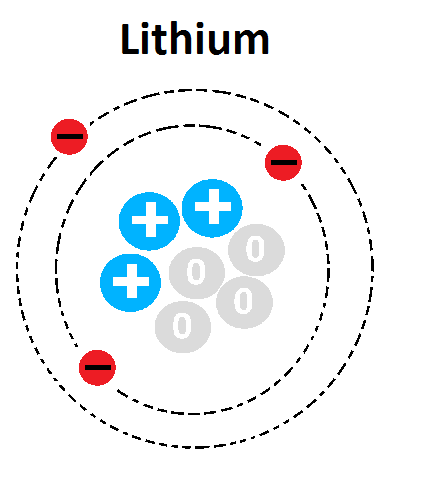
What is the name of this element?
a)
Helium
b)
Hydrogen
c)
Argon
d)
Silver
48.
What is the mass number of this atom?
a)
1
b)
3
c)
4
d)
7
49.
What is the atomic number of this atom?
a)
2
b)
4
c)
6
d)
none of the above
50.
Matter can not be created nor destroyed: it can only be
a)
Destroyed a little bit
b)
Invisible
c)
Transformed, changed
d)
None of the above
51.
A chemical reaction is balanced when
a)
both sides have the same elements
b)
Both sides have the same  number of atoms
c)
Same subscripts
d)
Same coefficients
52.
In a synthesis reaction
a)
A compound breaks apart into two or more compounds
b)
Two or more compounds make one single product
c)
CO2 and H2O must be products
d)
O2 must be a reactant
53.
Which of these is not a chemical reaction?
a)
Burning of wood
b)
Milk going bad
c)
Mixing vinegar and baking soda
d)
Melting of ice
54.
A precipitate is a 
a)
liquid that forms when two solids are reacted
b)
a solid that forms when two liquids are mixed
c)
a gas that forms when vinegar and baking soda react
d)
a change of color in a solution
55.
If reaction starts with 20g of reactants it should produce 
a)
a total of 40g of products
b)
a total of 10g of products
c)
a total of 80 g of products
d)
a total of 20g of products
56.
In a reaction A + B ----> C,  reactant A has 5g and product  C has 9g. How many grams does reactant B should have? 
a)
4g
b)
5g
c)
9g
d)
14g