
 Worksheets
Waves Unit Test Part 1
Total questions: 35
Worksheet time: 3hrs 49mins
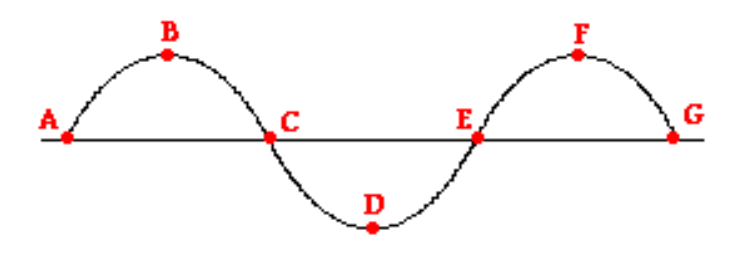
The highest point on a wave
Crest
Trough
Frequency
Amplitude
Lowest point on a wave
Wavelength
Crest
Trough
Period
The distance between two waves
Amplitude
Frequency
Wavelength
Period

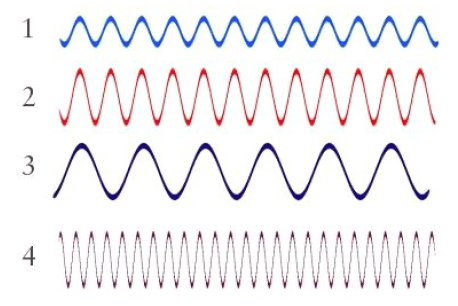
Which wave would have a softer sound?
Left
Right
When talking about the amount of times a wave passes a point in 1 second is called
Wavelength
Amplitude
Period
Frequency

What type of wave is this?
Longitudinal
Transverse
Surface
Hello/Goodbye
Which of the following can sound travel through?
Solid
Liquid
Gas
All of the above
regular disturbances that carry energy through matter or space
Crest
Energy
Wave
Trough

Which is an example of electromagnetic wave?
Light
X-rays
Radio
All are examples of electromagnetic waves.
What is the unit of measure for frequency?
Centimeters
Degrees
Hertz
Decibels
Electromagnetic waves vary in
the speed they travel in a vacuum.
wavelength and frequency.
the way they reflect.
the orientation of their electric and magnetic fields.
Infrared rays have a shorter wavelength than
Ultraviolet ray.
X-rays.
radar waves.
gamma rays
The waves with the longest wavelengths in the electromagnetic spectrum are
Infrared rays.
radio waves
gamma rays
X-rays
The visible light spectrum ranges between
radar waves and X-rays.
television waves and infrared rays.
infrared rays and ultraviolet rays.
ultraviolet rays and gamma rays.
Cellular telephones utilize
radar waves.
very high frequency waves.
very low frequency waves.
microwaves.
Which is an example of a radio wave
television
heat lamp
vision
sun light

How are Electromagnetic waves different from Mechanical waves?
EM waves have very short wavelengths
EM waves transmit energy instead of matter
EM waves can travel through the vacuum of space (without particles)
EM waves can change direction by reflection

What type of interference is represented in this diagram?
Constructive
Destructive

What type of interference do noise cancelling headphones use?
Constructive Interference
Destructive Interference

Sound waves in musical instruments or tubes create standing waves that enhance which type of interference to make louder sounds?
Constructive
Destructive

When a compression interferes with another compression, what occurs?
They counteract and the wave stops.
They combine to create a larger compression.
They combine to create a rarefaction.
None of the above.
When a crest and a trough interfere, what occurs?
They combine to create a higher amplitude wave.
They counteract and the wave either lessens or stops completely.
The wave changes into a longitudinal wave.

Two waves E and G are shown. The waves have the same speed.
Which statement is correct?
Wave E has a greater amplitude than wave G.
Wave E has a greater intensity than wave G.
Wave E has a smaller frequency than wave G.
Wave E has a smaller wavelength than wave G.

