Wayground logo

Free Printable Worksheets

Font size

S
M
L
XL
Worksheets

Waves Test Review

Total questions: 65

Worksheet time: 42mins

Name
Class
Date
1.
Is this a longitudinal or transverse wave?
a)
Longitudinal
b)
Transverse
2.
Which letter shows the crest?
a)
F
b)
G
c)
H
d)
J
3.
The trough is represented by which letter?
a)
F
b)
G
c)
H
d)
J
4.
The wavelength is represented by which letter?
a)
F
b)
G
c)
H
d)
J
5.
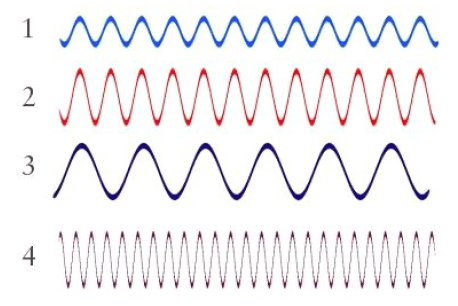
The amplitude is represented by which number?
a)
1
b)
2
c)
3
d)
4
6.
Letter A represents which part of the wave?
a)
compressions
b)
crests
c)
wavelength
d)
rarefactions
7.
Letter B represents which part of the wave?
a)
amplitude
b)
compressions
c)
rarefactions
d)
trough
8.
Which letter combination represents the wavelength?
a)
A to B
b)
B to C
c)
A to E
d)
C to E
9.
Which wave has more energy?
a)
red
b)
blue
10.
A substance through which a wave can travel 
a)
medium
b)
trough
c)
rarefaction
d)
mechanical
11.
The number of waves that pass a point in a given amount of time, measured in hertz.
a)
medium
b)
frequency
c)
amplitude
d)
wavelength
12.
A wave that requires a medium to travel through
a)
electromagnetic wave
b)
longitudinal wave
c)
mechanical wave
d)
transverse wave
13.
A wave that does NOT require a medium to travel through
a)
transverse wave
b)
longitudinal wave
c)
electromagnetic wave
d)
mechanical wave
14.

When waves can travel straight through a substance. This is called...

a)

Reflection

b)

Absorption

c)

Transmission

d)

Medium

15.

Sometimes waves travel into a substance and stay there. This is...

a)

absorption

b)

transmission

c)

reflection

16.

A disturbance that transfers energy from one place to another

a)
wave
b)
electromagnetic wave
c)
medium
d)
mechanical wave
17.

Use the diagram to answer the question.

Which of the following choices best describes wave A as compared to wave B?

a)

Wave A has a longer wavelength, lower frequency, same amplitude

b)

Wave A has a shorter wavelength, higher frequency, same amplitude

c)

Wave A has a shorter wavelength, lower frequency, lower amplitude

d)

Wave A has a longer wavelength, higher frequency, higher amplitude

18.

The speed of a wave depends on:

a)

The amplitude of the wave

b)

The frequency of the wave

c)

The medium it is traveling through

19.
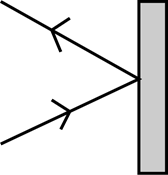
The illustration shows a light ray striking an object.
In the illustration, the light ray striking the object is-
a)
absorbed
b)
stopped
c)
reflected
d)
refracted
20.
Law of reflection state that - The angle of incidence is .................. to the angle of reflection.
a)
equal
b)
double
c)
half
21.

A student placed a pencil in a cup of water. The pencil appears broken because light

a)

always travels in a straight line.

b)

bends when it passes through water.

c)

makes the water in the glass evaporate.

d)

reflects the pencil on the water's surface.

22.

A wave with a large wavelength will have a ______ frequency and _____ energy

a)

high, low

b)

high, high

c)

low, high

d)

low, low

23.
Which wave in the diagram has the greatest wavelength?
a)
1
b)
2
c)
3
d)
4
24.
High energy waves have a ____. 
a)
high frequency
b)
low frequency
c)
small amplitude
d)
big wavelength
25.
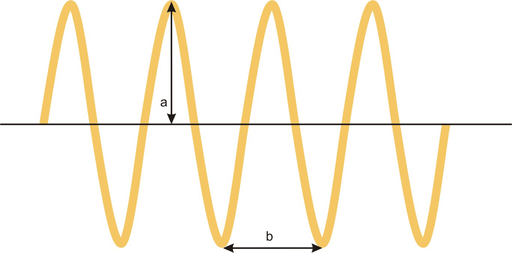
How many waves are in this wave chain?
a)
6
b)
3
c)
4
d)
5
26.

Why does sound travel faster in water than in air?

a)

The particles in water are more tightly packed together

b)

The particles in water are more spaced apart

27.

If more energy is added to a wave, what characteristic changes?

a)

wavelength

b)

wave speed

c)

amplitude

d)

wave type

28.

A wave takes 2 seconds to travel 4 meters, what is the speed at which it travels? speed=distance/time

a)

8 m/s

b)

4 m/s

c)

6 m/s

d)

2 m/s

29.

Sound needs matter to travel through. This is why they say that space is a silent place. Therefore a sound wave must be considered a

a)

electromagnetic wave

b)

longitudinal wave

c)

mechanical wave

d)

transverse wave

30.

The relationship between wavelength and frequency is inversely proportional. This means that as frequency increases wavelength . . .

a)

increases

b)

decreases

c)

stays the same

31.
If you want to change the pitch of a sound, you have to change the ___
a)
frequency
b)
amplitude
c)
speed
d)
volume
32.
This is the unit used to measure the volume of a sound. 
a)
Decibel
b)
Medium
c)
Vibration
d)
Oscilloscope
33.
This is what you get when sound waves are reflected, or bounce back, off of a hard surface.
a)
Amplitude
b)
Pitch
c)
Volume
d)
Echo
34.
Which feature of sound is determined by amplitude?
a)
Pitch
b)
Smoothness
c)
Loudness
35.
What is changed in the second picture?
a)
Someone is talking louder in picture 2
b)
Someone is talking softer in picture 2
c)
Someone is talking lower pitch in picture 2
d)
Someone is talking higher pitch in picture 2
36.
What is changed in the second picture?
a)
Someone is talking louder in picture 2
b)
Someone is talking softer in picture 2
c)
Someone is talking lower pitch in picture 2
d)
Someone is talking higher pitch in picture 2
37.

This wave transfers energy from one place to another.

a)

Light

b)

Sound

c)

Both

38.

This is a longitudinal wave

a)

Light

b)

Sound

c)

Both

39.

This is a transverse wave

a)

Light

b)

Sound

c)

Both

40.

Travels the fastest

a)

Light

b)

Sound

c)

Both

41.

This wave is caused by the vibration of particles

a)

Light

b)

Sound

c)

Both

42.

This wave can travel through empty space (a vacuum)

a)

Light

b)

Sound

c)

Both

43.

If lightning strikes you see it before you hear the thunder because...

a)

Sound travels faster than light

b)

Light travels faster than sound

44.

Mechanical waves usually travel fastest through:

a)

solids

b)

liquids

c)

gases

45.

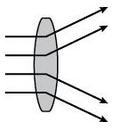
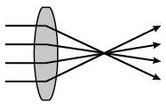
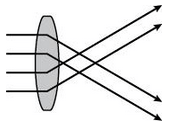
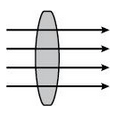
Which lens represents the path light takes through a concave lens?

a)
b)
c)
d)
46.

Which figure represents the path light takes through a convex lens?
a)
b)
c)
d)
47.

A lens that is thinner in the middle than on the outside is called ___.

a)

diverging

b)

concave

c)

convex

d)

achromatic

48.

A lens that is thicker in the middle than on the outside is called ___.

a)

diverging

b)

concave

c)

convex

d)

achromatic

49.

Light travels in ________ lines.

a)

space

b)

directions

c)

bounces

d)

straight

50.

A material that allows light to pass through it.

a)

opaque

b)

translucent

c)

transparent

d)

prism

51.

To bend light waves.

a)

opaque

b)

refract

c)

reflect

d)

prism

52.

A material that DOES NOT allow light to pass through it.

a)

opaque

b)

translucent

c)

transparent

d)

prism

53.

A material that allows SOME light to pass through it.

a)

opaque

b)

translucent

c)

transparent

d)

prism

54.

A cut piece of clear glass or plastic in the form of a triangle that separates white light into the different colors.

a)
Person
b)
Prison
c)
Prism
d)
Preacher
55.
a)
Reflection
b)
Refraction
56.
If you are wearing a black sweatshirt, what happens to most of the light that strikes the sweatshirt 
a)
It is absorbed
b)
It is reflected
c)
It is transmitted
57.
Why does an apple appear red?
a)
All colors are absorbed & none are reflected
b)
All colors are absorbed except for blue, which is reflected
c)
All colors are reflected and none are absorbed
d)
All colors are absorbed except for red, which is reflected
58.

The light bulb is....

a)

luminous

b)

non-luminous

59.

The book is...

a)

luminous

b)

non-luminous

60.

Which of the following has the most energy?

a)

X-rays

b)

The color green

c)

Microwaves

d)

ultraviolet

61.

Which color of visible light has the longest wavelength?

a)

Red

b)

Orange

c)

Yellow

d)

Blue

62.
Which has the LONGEST wavelength and, therefore, the lowest frequency/energy
a)
Gamma Rays
b)
Radio Waves
c)
Visible Light
d)
Infrared rays
63.
Which has the SHORTEST wavelength and, therefore, the highest frequency/most energy
a)
Radio waves
b)
Ultraviolet Rays
c)
Gamma Rays
d)
X-rays
64.
Which section of the spectrum is the ONLY one we can see?
a)
X-rays
b)
Visible Light
c)
Gamma Rays
d)
Ultraviolet Rays
65.
What is this
a)
opaque
b)
transparent
c)
translucent