wayground logo

Free Printable Worksheets

Font size

S
M
L
XL
Worksheets

Final wave Review

Total questions: 63

Worksheet time: 1hrs 19mins

Name
Class
Date
1.
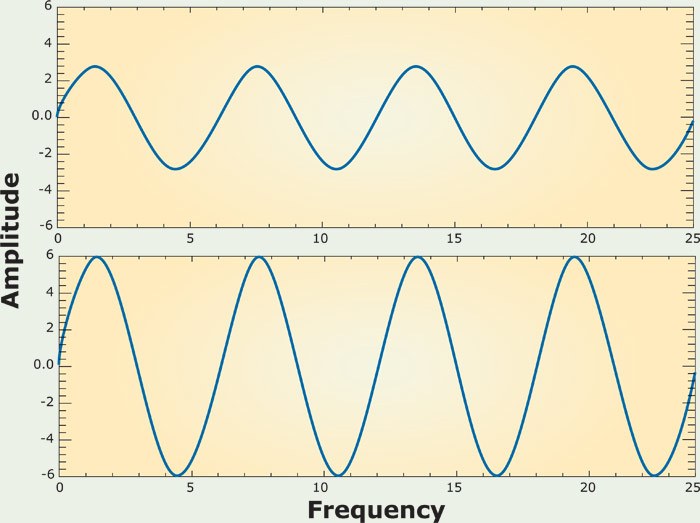
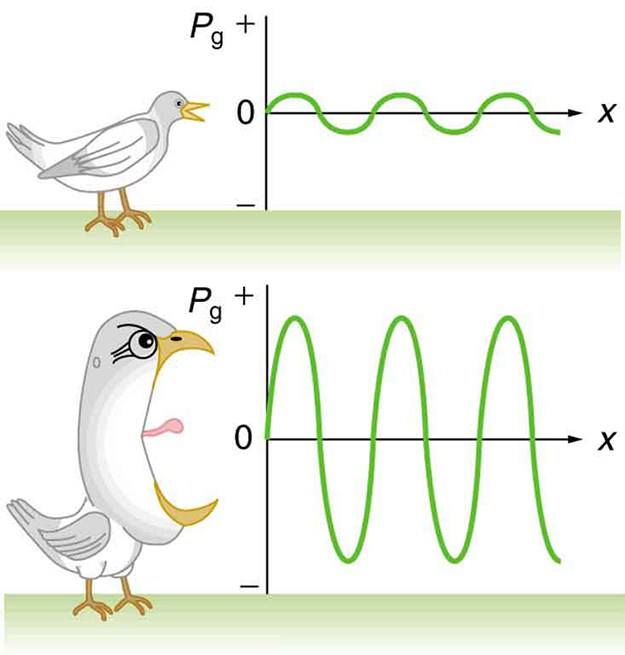
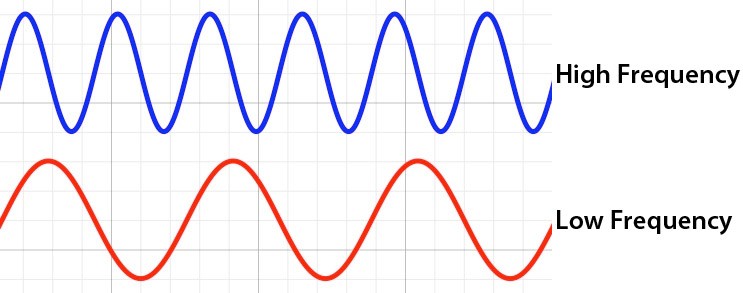
Which wave has a higher amplitude?
a)
The wave on top
b)
The wave on bottom
c)
They both have the same amplitude
2.
When a wave passes from one medium to another, the ________ may change.
a)
speed
b)
frequency
c)
wavelength
d)
speed, frequency, and wavelength
3.
The shortest wavelength in visible light is______.
a)
violet
b)
red
c)
blue
d)
yellow
4.
The higher the frequency the ______ the energy. 
a)
higher
b)
lower
c)
neither, stays the same
5.
__________ is number of waves in a give time.
a)
Wavelength
b)
Mechanical Waves
c)
Transverse
d)
Frequency
6.
Waves that require a medium to travel are known as 
a)
transverse waves
b)
mechanical waves 
c)
ocean waves 
d)
light waves 
7.
Which object would be the best at reflecting light waves?
a)
windows
b)
mirrors
c)
notebooks
d)
tables
8.

Which material does sound travel the fastest?

a)

solid

b)

liquid

c)

gases

d)

a vacuum

9.
High frequency waves have _________ wavelengths.
a)
varying
b)
long
c)
the same
d)
short
10.
Look carefully at the waves.  Which carries the most energy?
a)
microwave
b)
infrared
c)
ultraviolet
d)
x-ray
11.
Which color has the longest wavelength?
a)
red
b)
orange
c)
blue
d)
violet
12.

Put the visible light colors in order from lowest frequency to highest frequency

a)

Violet, Blue, Green, Orange, Yellow, Red

b)

Red, Yellow, Green, Orange, Violet, Blue

c)

Red, Orange, Yellow, Green, Blue, Violet

d)

Blue, Violet, Green, Yellow, Orange, Red

13.

Select the correct order of waves on the Electromagnetic Spectrum from high energy to low energy.

a)

Radio, Micro, Infrared, Visible, UV, X-ray, Gamma

b)

Gamma, X-ray, UV, Visible, Infrared, Micro, Radio

c)

Visible, Micro, Infrared, UV, X-ray, Gamma, Radio

d)

Micro, Radio, Visible, Infrared, UV, X-ray, Gamma
14.
When a sound is louder what measurement gets bigger?
a)
Frequency 
b)
Amplitude 
c)
Wavelength 
d)
Crest
15.
What does pitch depend on?
a)
amplitude 
b)
frequency
c)
intensity 
d)
volume of sound
16.

What is a natural Vaccuum that Sound cannot travel through?

a)

Water

b)

Air

c)

Liquids

d)

Outer Space

17.

Sound waves will travel the fastest through

a)

steel

b)

the ocean

c)

outer space

d)

the air

18.
Which color has the least amount of energy?
a)
red
b)
orange
c)
green
d)
blue
19.
Which section of the spectrum is the ONLY one we can see?
a)
X-rays
b)
Visible Light
c)
Gamma Rays
d)
Ultraviolet Rays
20.
Nuclear weapons are examples of __________. 
a)
x-rays
b)
ultraviolet rays
c)
gamma rays
d)
infrared rays
21.

Air and water are examples of ___ through which sound travels.

a)

vacuums

b)

atoms

c)

waves

d)

mediums

22.

How can you determine the compressional wave with the highest pitch?

a)

the wave that has the thickest/widest compression

b)

the wave that has the shortest wavelength

c)

the wave that has the longest wavelength

d)

the wave that has the thicket/widest rarefaction

23.
What kind of wave is pictured?
a)
Transverse
b)
Longitudinal
c)
surface
d)
none of the above
24.
It is the part of the wave where the particles are spread out.  It is part B in this picture. 
a)
Compression
b)
Rarefaction
c)
Amplitude
d)
Wavelength
25.
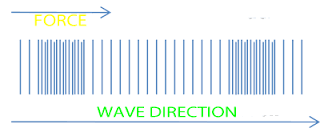
What kind of wave is pictured?
a)
Transverse Wave
b)
Longitudinal Wave
c)
compressional wave
d)
none of the above
26.
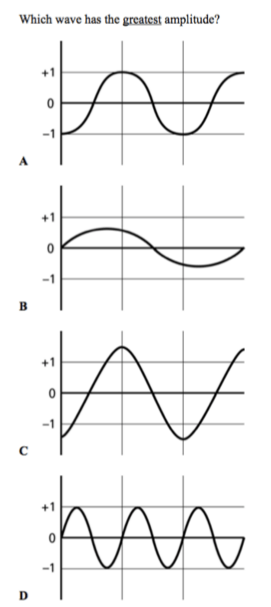
Which wave has the greatest amplitude?
a)
A
b)
B
c)
C
d)
D
27.

Sound waves travel fastest in ____ and slowest in ____

a)

solids, gases

b)

gases, solids

c)

solids, solids

28.

What is the ability to cause change?

a)

energy

b)

matter

c)

volume

29.

What does a wave carry from place to place?

a)

energy

b)

matter

c)

people

30.

The highest point on a transverse wave is the

a)

compression

b)

crest

c)

rest position

d)

trough

31.

The lowest point on a transverse wave is the

a)

compression

b)

crest

c)

rest position

d)

trough

32.

Which property of the wave would change if you changed the amount of energy the wave had?

a)

amplitude

b)

frequency

c)

wavelength

d)

wave speed

33.

If the wavelength of a wave increased, what would happen to the frequency?

a)

decrease

b)

increase

c)

stay the same

34.

Mechanical waves usually travel fastest through:

a)

solids

b)

liquids

c)

gases

35.

A wave that can travel through matter and empty space is a:

a)

electromagnetic wave

b)

longitudinal wavy

c)

transverse wave

36.

Which are properties of a mechanical wave?

a)

can be longitudinal or transverse

b)

can move through space

c)

must have matter to move

d)

carries energy

37.

What are properties of electromagnetic waves?

a)

carry energy

b)

can move through space

c)

can move through matter

d)

include x-rays

38.

As a longitudinal wave moves forward, the particles move:

a)

perpendicular to the wave's motion

b)

parallel to the wave's motion

c)

stand in one place

d)

move completely down the spring
39.
Mechanical waves are created when a source of energy causes a medium to...
a)
Move
b)
Expand
c)
Vibrate
d)
Compress
40.
Waves that move the particles of the medium parallel to the direction in which the waves are traveling are called
a)
Surface Waves
b)
Combination Waves
c)
Longitudinal Waves
d)
Transverse Waves
41.
The maximum distance that the particles of a medium move from the rest position is the
a)
Wavelength of the Wave
b)
Frequency of the Wave
c)
Amplitude of the Wave
d)
Speed of the Wave
42.
The distance between two corresponding parts of a wave is the wave’s
a)
Wavelength
b)
Frequency
c)
Amplitude
d)
Speed
43.
The interaction between two waves that meet is called
a)
refraction
b)
reflection
c)
diffreaction
d)
interference
44.
Why do you see lightning from a distant storm before you hear thunder?
a)
Your eyes react faster than your ears
b)
Light travels faster than sound
c)
The thunder is produced after the lightening
45.
Mechanical waves are classified according to
a)
how they move
b)
their source
c)
their shape 
d)
their size
46.
           In ____________________ interference, the energy of the combined wave is greater than the energy of each of the two waves.
a)
constructive
b)
destructive
c)
rarefraction
d)
combination
47.
How can you measure the wavelength of a transverse wave?
a)
crest to crest
b)
amplitude (height of the wave)
c)
frequency of the wave in a given time
d)
Speed
48.
A standing wave appears to be staying in one place.
a)
True
b)
False
49.
Destructive interference is 
a)
When the two waves affect  each other in a negative way 
b)
The two waves add together and produce a single wave of greater amplitude
c)
Are in phase 
50.
Constructive interference is
a)
When two waves affect one another in  a positive way.
b)
Produce a single wave of greater amplitude (add together)
c)
Both
51.
What is "?" ?
a)
rarefaction
b)
compression
c)
expansion
d)
reflection
52.
Which property of these waves differs?
a)
Frequency
b)
Wavelength
c)
Amplitude
d)
Pitch
53.
Which waves do NOT need a medium?
a)
Sound
b)
Ocean
c)
Seismic
d)
Light
54.
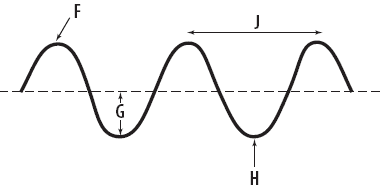
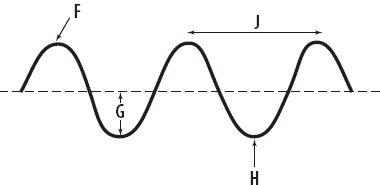
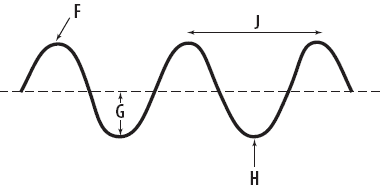
Which letter is a crest?
a)
F
b)
G
c)
H
d)
J
55.
What type of waves have compressions and rarefactions?
a)
longitudinal
b)
transverse
56.
Which letter shows amplitude?
a)
F
b)
G
c)
H
d)
J
57.
Which letter is a trough?
a)
F
b)
G
c)
H
d)
J
58.
Frequency is measured in
a)
Newtons
b)
Joules
c)
Hertz
d)
Decibels
59.
A disturbance that travels through a medium as a longitudinal wave
a)
sound
b)
wavelength
c)
pitch
d)
frequency
60.
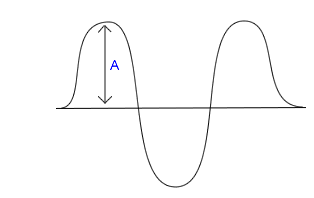
If the distance represented by the letter A (the amplitude) were increased, how would it change the sound?
a)
The sound would be higher. 
b)
The sound would be lower. 
c)
The sound would be softer. 
d)
The sound would be louder. 
61.
Sound waves are what kind of wave?
a)
Longitudinal
b)
Transverse
c)
Surface
d)
Electromagnetic
62.

What type of energy does a sound wave have?

a)

Mechanical

b)

Radiant

c)

Electrical

d)

Sound

63.

True or False: Sound waves are faster than light.

a)

False

b)

True