
 Worksheets
Taxonomy/Immunity- Remote
Total questions: 50
Worksheet time: 1hrs 1mins
Name
Class
Date
1.
Which 2 organisms would be able to reproduce and produce fertile offspring?
a)
2 organisms in the same class
b)
2 organisms in the same family
c)
2 organisms in the same genus
d)
2 organisms in the same species
2.
The scientific name for an organism is made from the:
a)
class and family name
b)
genus and species name
c)
domain and kingdom name
d)
kingdom and phylum name
3.

An illustration and a dichotomous key are given. What is the correct classification for this organism?
a)
Class Insecta
b)
Order Amblygygi
c)
Order Araneae
d)
Order Scorpiones
4.

Which organism in the table shown is most closely related to the common dolphin?
a)
human
b)
killer whale
c)
giant kelp
d)
bat star
5.
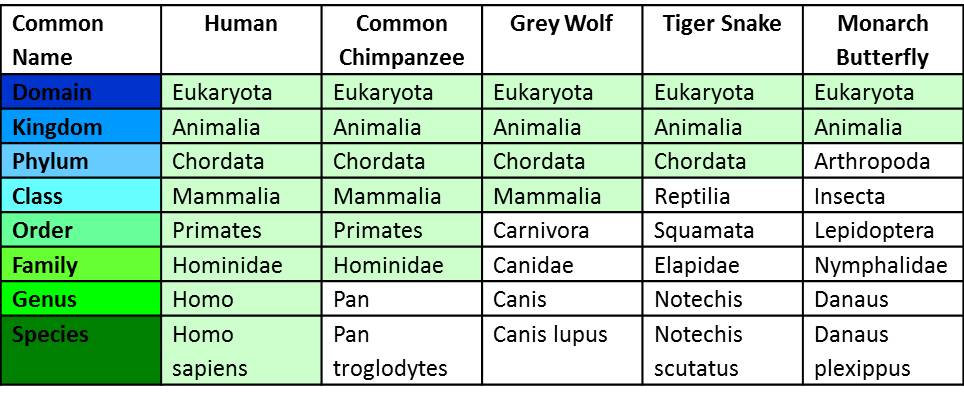
Which organism in the table is least closely related to the chimpanzee?
a)
human
b)
grey wolf
c)
tiger snake
d)
monarch butterfly
6.
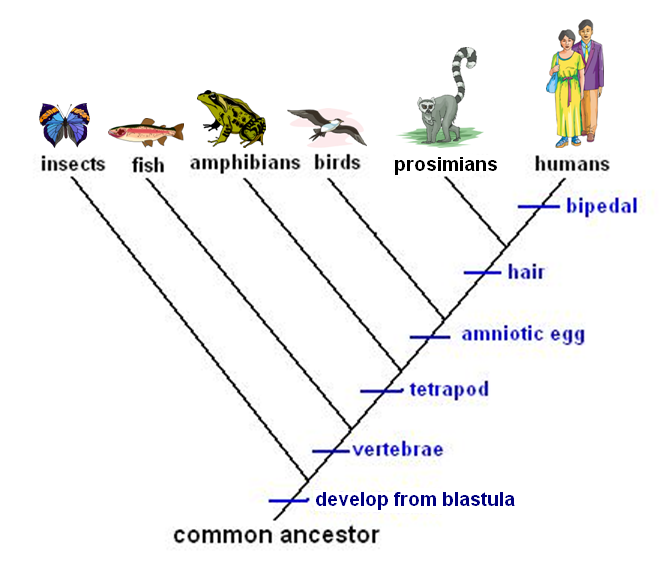
Which organisms pictured on the cladogram have hair?
a)
prosimians only
b)
prosimians and humans
c)
humans only
d)
prosimians and birds
7.
What kingdom do unicellular, prokaryotic organisms that live in extreme environments?
a)
Animal
b)
Archaebacteria
c)
Eubacteria
d)
Plant
8.
I have a nuclear membrane, can do photosynthesis and am multicellular. What kingdom do I belong to?
a)
Animalia
b)
Archaebacteria
c)
Plantae
d)
Protista
9.
The science of describing, classifying, and naming living things is called:
a)
Geology
b)
Biology
c)
Taxonomy
d)
Chemistry
10.
Organisms in this smallest taxonomic group share many characteristics.
a)
domain
b)
kingdom
c)
species
d)
class
11.
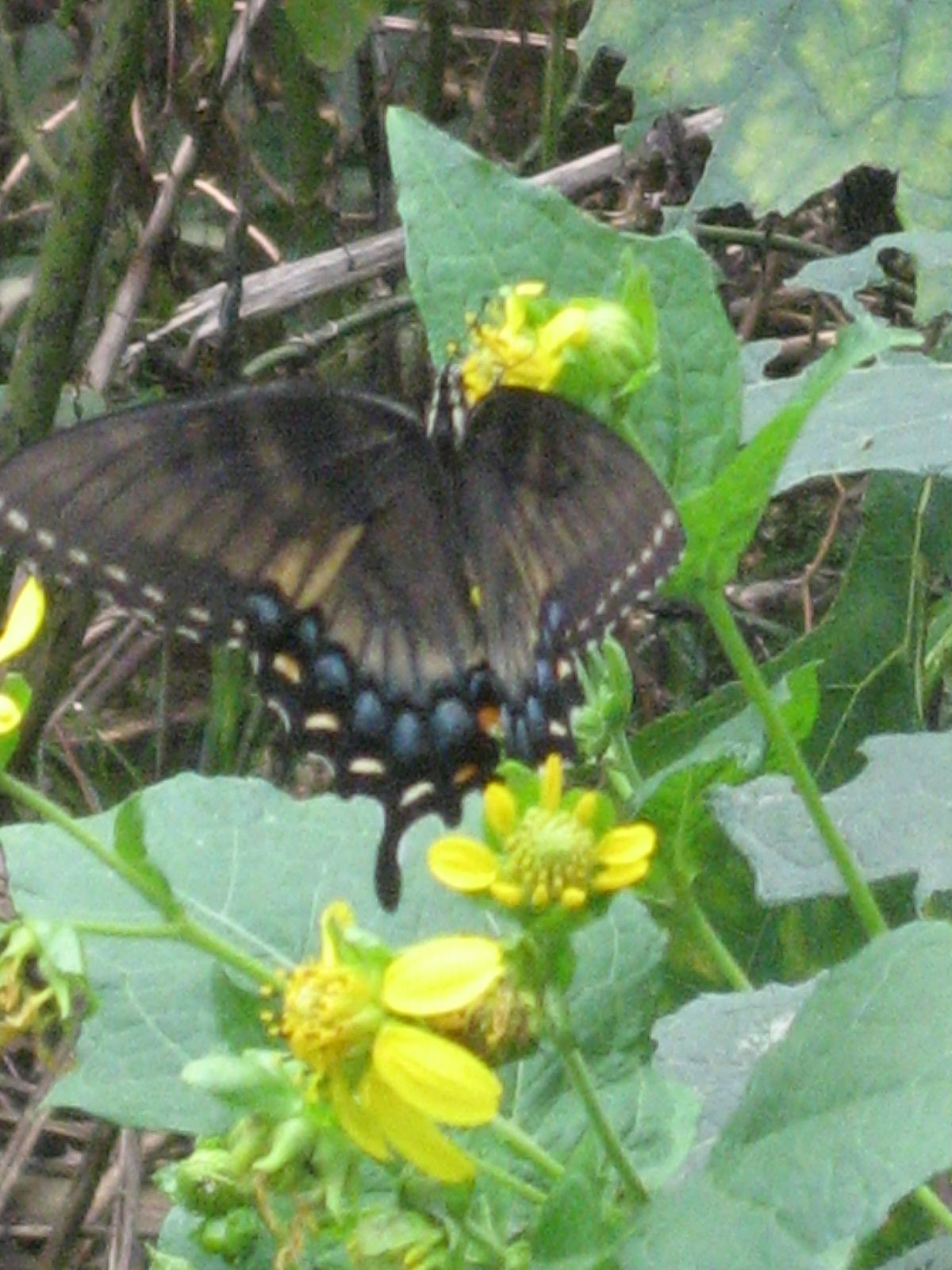
The 8 levels of classification, broadest to most specific.
a)
Domain, Genus, Family, Order, Class, Phylum, Kingdom, Species
b)
Domain, Species, Kingdom, Genus, Phylum, Family, Class, Order
c)
Domain, Kingdom, Phylum, Class, Order, Family, Genus, Species
d)
Order, Kingdom, Species, Domain, Phylum, Family, Class, Genus
12.
An example of an unicellular organism would be:
a)
monkey
b)
bacteria
c)
spider
d)
human
13.
Members of this kingdom are multicellular and heterotrophic.
a)
Plantae
b)
Protista
c)
Animalia
d)
Achaebacteria
14.
This organism is multicellular, heterotroph, that has a cell wall made of chitin and long hyphae used for food absorption. What kingdom does it belong in?
a)
fungi
b)
plantae
c)
animalia
d)
eubacteria
15.
This organism is found in pond water. It has a nucleus, is microscopic, unicellular and can perform photosynthesis. What kingdom does it belong in?
a)
protista
b)
eubacteria
c)
archaebacteria
d)
plantae
16.
This organism is multicellular, autotroph, that has a cell wall made of cellulose.
a)
animalia
b)
plantae
c)
fungi
d)
eubacteria
17.
Term given to describe the 2 name naming system is:
a)
dichotomous key
b)
binomial nomenclature
c)
2 scientific names
d)
binomial key
18.
Who first proposed binomial nomenclature as a way of classifying organisms?
a)
Carolus Linnaeus
b)
Carl's Jr.
c)
Charles Darwin
d)
Henry Groseclose
19.

Which trait do only humans have, according to the cladogram?
a)
jaws
b)
mammary glands & hair
c)
terrestrial during all life stages
d)
bipedal & opposable thumbs
20.
Which of the following is NOT a rule of binomial nomenclature?
a)
Entire name should be written in capital letters.
b)
First name is genus, second name is species.
c)
Must be italicized or underlined.
d)
First name is capitalized, second name is lowercase.
21.

According to the image, the dog is MOST CLOSELY related to which organism?
a)
Wolf
b)
Plant
c)
Cat
d)
Insect
22.

What part of the phage is the DNA?
a)
A
b)
B
c)
C
d)
D
23.

A(n) _____ is a virus that enters a bacterial cell.
a)
endospore
b)
decomposer
c)
plasmid
d)
bacteriophage
24.
Which viral life cycle kills its host cell by busting open the walls to let multiple replicated viruses escape?
a)
lytic
b)
mitosis
c)
lysogenic
d)
S phase
25.
Which viral life cycle allows viral genetic material to lay dormant while the host cell reproduces?
a)
lytic
b)
mitosis
c)
lysogenic
d)
S phase
26.
What do viruses need to reproduce?
a)
they need genetic material
b)
They need a host cell
c)
They need bacteria
d)
They need insulin
27.

Using this dichotomous key, identity the name of the circled fish.
a)
band-tail puffer
b)
spotted goat fish
c)
peacock flounder
d)
trumpet fish
28.

A student discovers an arachnid with a segmented abdomen, long legs, and a tail with no stinger. The student uses the dichotomous key below to identify it. Which arachnid has the student found?
a)
Whip Scorpion
b)
Wind Scorpion
c)
Daddy long legs
d)
Scorpion
29.
Why is it important to complete a course of antibiotics?
a)
to prevent antibiotic resistance
b)
so you do not waste drugs
c)
because antibiotics are good for you
30.
What is the cellular response in acquired immunity?
a)
Red blood cells bring oxygen to keep us healthy
b)
Toxins cause of to get sick once pathogens enter
c)
T-Cells and Macrophages attack pathogens once antibodies recognize them
d)
Antibodies attack pathogens once T-cells recognize them
31.

These cells are responsible for identifying the "enemy" in an immune response.
a)
Killer-T Cells
b)
B Cells
c)
Helper-T Cells
d)
Antibodies
32.

What do antibodies attach to on the pathogen?
a)
Anti inflammatory
b)
Antigens
c)
Antiseptic
d)
Antibodies
33.
Which is NOT considered FIRST line of defense?
a)
White Blood Cells
b)
Skin
c)
Hair
d)
Mucous Membranes
34.

Which disease is caused by a bacteria?
a)
Malaria
b)
The flu
c)
Strep Throat
d)
Athlete's foot
35.

Disease-causing microorganism, such as fungi, bacteria, or a virus.
a)
pathogen
b)
allergen
c)
prion
d)
antigen
36.
What function does mucus play in the immune system?
a)
traps foreign particles from entering the body
b)
moistens food
c)
produces WBCs
d)
acts as a lubricant
37.
What does HIV do to our immune system?
a)
It makes our immune system more stronger
b)
It attacks red blood cells
c)
It attacks our brain to stop working
d)
It attacks our white blood cells and weakens our immune system to the point where our body cannot fight pathogens
38.
What is a non-living organism that contains genetic material and hijacks cells?
a)
Bacteria
b)
Acne
c)
Virus
d)
Allergen
39.
Influenza and Zika both cause:
a)
Bacterial Infection
b)
Allergic reaction
c)
result from mosquito bites
d)
Viral infection
40.
A weakened or dead virus can act as a-
a)
vaccine
b)
leukocyte
c)
allergen
d)
macrophage
41.
What cell is used to stop an immune response?
a)
Macrophage
b)
Helper T Cell
c)
Killer T Cell
d)
Suppressor Cell
42.

How is a virus DIFFERENT from bacteria?
a)
Viruses do not contain genetic material
b)
Viruses cannot reproduce without a host
c)
Viruses don't have antigens
d)
Viruses and bacteria are identical
43.
____ occurs when the antibodies that fight the pathogen come from another source rather than from a person's own body. (ex. babies get immunity from breast milk)
a)
Passive immunity
b)
Active immunity
c)
Diarrhea
d)
vomiting
44.
___ occurs when a person's own immune system makes antibodies in response to the pathogen. (ex. If you get the chicken pox you will not get it again in life.)
a)
Passive immunity
b)
Sneezing and coughing
c)
Active immunity
d)
Distant immunity
45.
An organism made up of more than one cell would be called:
a)
multicellular
b)
unicellular
c)
heterotroph
d)
autotroph
46.

I am prokaryotic and am found everywhere. What kingdom do I belong to?
a)
Eubacteria
b)
Archaebacteria
c)
Fungi
d)
Protista
47.
I'm motile and have no cell walls. What kingdom do I belong to?
a)
Animalia
b)
Archaebacteria
c)
Eubacteria
d)
Plantae
48.
Which organisms are most closely related?
a)
Equus caballas (Horse) & Equus burchellii (Zebra)
b)
Cyanea artica (Jellyfish) &
Ctenodiscus crispatus (Mud Starfish)
Ctenodiscus crispatus (Mud Starfish)
c)
Naja naja (cobra) & Glycine max (soya bean)
d)
Ophiocomina nigra (black brittle star) & Brassica nigra (black mustard)
49.
Prokaryotes do not have a nucleus or membrane bound organelles.
a)
True
b)
False
50.

According to the diagram, the dog shares the LEAST number of characteristics with what organism?
a)
Plant
b)
Wolf
c)
Cat
d)
Insect
100 %

