wayground logo

Free Printable Worksheets

Font size

S
M
L
XL
Worksheets

Y11 Revision for CA1.3

Total questions: 78

Worksheet time: 45mins

Name
Class
Date
1.
What is meant by the term "Stakeholder"?
a)
A stakeholder is the person who owns a product or organisations
b)
A stakeholder is anyone who has an interst in or concern about a product or organisation
c)
A stakeholder is the person who buys products from an organisation
d)
A stakeholder is the person who creates the legislation that governs the buying and selling products
2.
Which statement would be made by a business that is considered socially responsible?
a)
"We pollute a little bit to make our product"
b)
"Our products are made with recycled bottles and cans"
c)
"We are able to help the community by employing children"
d)
"The river is contaminated, but our product is free"
3.
Which of the following is not an environmental issue?
a)
Nuclear waste
b)
Rubbish dumping
c)
Globalisation
d)
Global warming
4.

Ethics is about doing the ______________ thing.

a)

Profit

b)

Right

c)

Good

d)

Newcastle Utd

5.

What is pressure group?

a)

A collection of people organised to seek political influence

b)

A collection of people organised to promote shared goals

c)

A group of people solely aimed to oppose the government

d)

A group of people who acts in accordance to what the government needs

6.

what is pressure group

a)

a pressure group is a group of people related by blood

b)

a pressure group is a group of people who share a common interest

c)

a group of people coming together to achieve a common goal

d)

a group of people living in peace

7.

What is a niche market?

a)

A market in which businesses sell to a large customer group with similar needs.

b)

A market in which businesses sell to a variety of customers.

c)

A market in which businesses sell to a small customer group with specific needs.

d)

A market in which businesses sell one product to many consumers.

8.

What is a mass market?

a)

When a business sells different products to all consumers and markets them in the same way.

b)

When a business sells the same products to all consumers and markets them in a different way.

c)

When a business sells different products to all consumers and markets them in a different way.

d)

When a business sells the same products to all consumers and markets them in the same way.

9.

Which one of the following is a disadvantage of a mass market?

a)

Higher revenues can be spent on R+D

b)

Homogenous products need to be differentiated through marketing which can be expensive.

c)

Mass marketing is straightforward as everyone is equally targeted.

d)

Large scale productions means economies of scale and lower average unit costs.

10.
The change in climate of the city, where a product is being sold will affect the __________region of the marketing plan.
a)
Geographic
b)
Demographic
c)
Psychographic
d)
Telepathic
11.

The process of transferring messages and ideas from one person to another is known as?

a)

Texting

b)

Communication

c)

Email

d)

Talking

12.

The person for whom the message is intended is known as the?

a)

audience

b)

sender

c)

receiver

d)

none of the above

13.

Anything that interferes with or blocks the communication process is known as

a)

communication channels

b)

communication media

c)

communication barriers

d)

communication methods

14.

Which method of communication is best to use if the message is confidential?

a)

email

b)

telephone

c)

face to face conversation

d)

fax message

15.
All of the following are methods (media) of internal communication within a business except:
a)
telephone call to a customer
b)
letter to a worker about low attendance rates
c)
memo to a supervisor
d)
notice on the staff restroom noticeboard.
16.
One of the advantages of verbal communication is that:
a)
there will be a permanent record of the meeting
b)
there is an opportunity for immediate feedback.
c)
it makes sure that everyone has fully understood the message
17.

An item you buy that is made in another country is an example of an export.

a)

True

b)

False

18.

Some goods have to be imported because they are only available from foreign countries.

a)

True

b)

False

19.

An importing business is involved in international business when it buys goods from other countries and then sells them in its own country.

a)

True

b)

False

20.

Which of the following is not a disadvantage of international trade?

a)

Environmental degradation

b)

More waste

c)

Unfair working conditions

d)

Cheaper products for consumers

21.

Trade between countries is NOT dependent on...

a)

Currency exchange rate

b)

Demand for a country's goods

c)

Social stability

d)

Interest rates

22.
A large company that has operations in more than one country.
a)
Domestic Corporation
b)
Multinational Corporation
c)
Foreign Corporation
d)
State Corporation
23.
Globalization has brought economic growth to many developing countries.  This has meant jobs for millions of people.  It has also increased “_________ ___________” among countries.
a)
imports & exports
b)
multinational corporations
c)
economic interdependence
24.

A tax on imports

a)

tariff

b)

import tax

c)

supply

d)

embargo

25.

A limit to the number of imports that may enter a country

a)

tariff

b)

embargo

c)

demand

d)

quota

26.

Rules used to try to limit trade with other countries

a)

embargo

b)

tariff

c)

trade barriers

d)

quota

27.
Free enterprise and no government regulation on the economy
a)
Command Economy
b)
Market Economy
c)
Traditional Economy
d)
Mixed Economy
28.
Too many imports will make your currency
a)
Lose value
b)
Gain value
29.
A weak currency
a)
Means that tourists are more likely to visit
b)
Means that tourists are less likely to visit
c)
Has no impact on whether tourists will visit �
30.
A strong currency means that
a)
Both imports and exports will be expensive
b)
Imports will be cheap and exports will be expensive
c)
Imports will be expensive and exports will be cheap
31.

How is a business 'location' best described?

a)

The place where customers buy products

b)

The place where a business sites its operations

c)

The place where suppliers send components

32.

What can location decisions have a big impact on?

a)

Costs

b)

Revenues

c)

Costs and Revenues

33.

Which is an example of infrastructure?

a)

Staff

b)

Markets

c)

Roads

34.

The rise of the internet has meant that many businesses costs are:

a)

Lower as there is more need for expensive retail premises

b)

Higher as there is more need for expensive retail premises

c)

Higher as there is less need for expensive retail premises

d)

Lower as there is less need for expensive retail premises

35.

A new start-up café is most likely to locate close to its:

a)

Competitors

b)

Suppliers

c)

Employees

d)

Customers

36.

What would not affect a businesses decision on location?

a)

Proximity to labour

b)

Proximity to customers

c)

Internet access

d)

Proximity to the government

37.

Many multinational manufacturing businesses have set up factories in countries in Asia and South America. The most likely reason for this decision is:

a)

low demand levels in these countries

b)

low skill levels in these countries

c)

low levels of government support for industry in these countries

d)

low wage rates in these countries

38.

Business locations are very important for all of the following reasons except:

a)

the location might affect the sales of a product

b)

the location might affect the costs of production

c)

the location might affect the available supply of labour

d)

the location might affect the legal form of ownership

39.
a business plan 
a)
is useful once your business is operational but not much help during the startup phase
b)
is not usually needed to secure financing in your business
c)
can serve as a tool for managing your business once it is up and running
d)
All of the above
40.

Which of the following is NOT a type of business ownership?

a)

partnership

b)

sole proprietorship

c)

entrepreneurship

d)

franchise

41.

A _____ is owned and operated by one individual; an example would be a plumber.

a)

franchise

b)

partnership

c)

sole propietorship

d)

corporation

42.

A _____ is the right or license to sell a company's product or service at a designated location; an example would be McDonalds.

a)

franchise

b)

partnership

c)

sold prprietorship

d)

corporation

43.
Which is an example of an external source of finance?
a)
Owners' Funds
b)
Sale of assets
c)
Retained profits
d)
Bank loan
44.
What is an advantage of a bank loan?
a)
There will be little or no interest
b)
You can pay in smaller installments
c)
They are quick and easy to arrange
d)
You don't have to pay it back
45.

What is the most likely source of finance for buying property?

a)

Mortgage

b)

Factoring

c)

A bank loan

46.
Which of the following is an example of a cash in-flow for a business?
a)
payment to suppliers
b)
paying back a loan to a bank
c)
payment from debtors
d)
purchase of fixed assets
47.
Which of the following is NOT a use of cash-flow forecasts?
a)
They indicate how much cash is available for paying bills
b)
They show how much the bank needs to lend to stop insolvency
c)
They indicate whether the business is holding too much cash
d)
They indicate how much profit the business will make
48.
The monthly net cash flow for a business is calculated by:
a)
sales revenue - cost of goods sold
b)
total cash in - total cash out
c)
total cash out - total cash in
d)
total cash in - cost of goods sold
49.
The closing bank balance is calculated by:
a)
opening bank balance + cash out-flow
b)
opening bank balance + cash in-flow
c)
opening bank balance + net cash flow
d)
net cash flow + gross profit
50.
Which one is not included in the Break Even formula?
a)
variable costs per unit
b)
total fixed costs
c)
selling price per unit
d)
cost price per unit
51.
What is the margin of safety?
a)
the margin between projected units and break even point units
b)
the margin between profit and loss
c)
the margin between units and sales
d)
the margin between each break even point
52.
To draw the BE graph you must plot Total Costs and ........
a)
Total Production
b)
Total Revenue
c)
Total Fixed Costs
d)
Total Units
53.
What does break even point show?
a)
where a business is neither making a profit or loss
b)
how many items to make
c)
how much profit they're making
d)
where a business has more fixed costs than variable
54.
Machinery is likely to be efficient. what economies it indicate?
a)
Financial Economies
b)
Buying Economies
c)
Technical Economies
d)
Managerial Economies
55.

A company wishes to increase labour productivity. All other things being equal, this is most likely to be achieved if the company

a)

employs more workers.

b)

reduces the wages it pays its employees.

c)

reduces current output.

d)

invests in more capital equipment.

56.

Total costs are...

a)

the amount of money spent setting up a business

b)

money spent on a regular basis to keep a business running

c)

Fixed Costs + Variable Costs

d)

costs which change with output

57.

Revenue is

a)

price x output (sales)

b)

price x costs

c)

Fixed costs x variable costs

d)

Price x breakeven

58.
Internal diseconomies of scale can be caused by
a)
Being unable to purchase stocks at a discounted price
b)
Management control being weakened with a larger workforce
c)
Traffic congestion causing delays to delivery of important stocks
d)
Advertising costs to a global audience
59.
Technological economies of scale can only be feasible for a business if
a)
Banks lend money for the purchase of highly expensive technology
b)
Capital equipment is capable of producing mass units of a product in a short time
c)
There is an economic boom
d)
There is sufficient market demand for the product
60.

what is a trade union?

a)

(a) It is an organisation

b)

(b) A group of workers

c)

(c) Trade unions are independent organisations that represent workers to their employers

d)

(d) To register a trade union, you must apply to the Registrar of labour Relations

61.
Which of the following is NOT a function of a trade union?
a)
Improving working conditions
b)
Increasing shareholders' dividends
c)
Raising member's wages
d)
Representing members' interests
62.
A trade union is an organisation that represents...
a)
The views and interest of workers
b)
a group of people working towards a common aim
c)
the aims of managers
d)
the goals of a business
63.
Industrial relations are the relationship between ...
a)
employees and management
b)
consumers and suppliers
c)
employees and consumer
d)
management andconsumers
64.

All of them are actions employees could take except:

a)

negotiations

b)

work to rule

c)

taking long leave

d)

strike action

65.

One of the benefits of increasing productivity is:

a)

more workers will be employed

b)

total production will increase with the same number of workers

c)

average costs will remain the same

d)

fewer raw materials will be needed to produce the same level of output

66.

Which one of the following would be an example of 'lean production'?

a)

producing a greater variety of goods with an increased workforce

b)

holding very low stock levels such as with Just-in-Time methods

c)

making smaller quantities of goods than previously

d)

buying the latest equipment to increase output even though it is not used all of the time

67.
In lean production a business aims to use as few resources as possible to have as little waste as possible?
a)
True
b)
False
68.
JIT stands for
a)
Joint Intervene Testimony 
b)
Just-IT-Test
c)
Just
d)
Just-In-Time
69.

What term refers to "goods that a business holds"? Select all that apply.

a)

Inventory

b)

Stock

c)

Currency

d)

Investment

e)

Workforce

70.

Select all the different forms that inventory takes:

a)

Raw materials and supplies

b)

Works in progress or semi-finished items

c)

Finished products held ready for distribution or sale

d)

Patents

e)

Copyrights

71.

Which one is NOT a stage in the PLC?

a)

maturity

b)

decline

c)

growth

d)

development

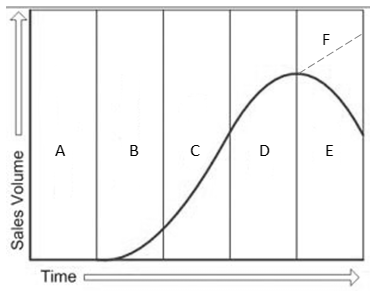
72.
What is happening at point F on the Product Life Cycle?
a)
Introduction
b)
Decline
c)
Maturity
d)
Growth
73.

What is the first stage of the product life cycle?

a)

Growth - product sales increase

b)

Introduction - new product to the market

c)

Maturity - product sales start to slow down

d)

Decline - product sales decrease

74.
What happens to the cash flow of a business at the growth stage of the product life cycle?
a)
The cash flow should become more positive
b)
Cash flow is likely to be negative because money has to be spent on research and development
c)
Sales will fall and cash flow will drop
d)
There may be a need to spend money re-promoting the product. As a result, cash flow may begin to fall.
75.

In this stage:

•Low sales

•High cost per customer acquired

•Negative profits

•Innovators are targeted

•Little competition

a)

Product development

b)

Introduction

c)

Growth

d)

Maturity

e)

Decline

76.

Which stage has the least production costs?

a)

Introduction

b)

Growth

c)

Maturity

d)

Decline

77.

What is the term used for extending a product life cycle?

a)

Extension strategies

b)

Product Sales

c)

Service expansion

d)

Business Growth

78.
Why does a company need to know the life-cycle stages of its products?
a)
To prevent imitators from entering the market
b)
To find new uses for the product
c)
To predict the length of the life cycle
d)
To adapt its marketing strategies