wayground logo

Free Printable Worksheets

Font size

S
M
L
XL
Worksheets

Geologic Laws/Relative Dating

Total questions: 40

Worksheet time: 1hrs 16mins

Name
Class
Date
1.
What is relative dating?
a)
An exact time period with dates
b)
When a mass extinction occurred
c)
An estimate of a time period or age
d)
The age of Dinosaurs
2.
If an igneous intrusion or fault cuts through existing rock layers, the intrusion/fault is:
a)
Older
b)
The same age
c)
Younger
d)
None of the above
3.
Which of the following laws applies when a rock cuts through pre-existing layers?
a)
Law of Original Horizontality
b)
Correlation
c)
Fossilization
d)
Law of Cross-Cutting Relationships
4.
Gaps or missing layers in the rock record often formed by erosion are called:
a)
Superpositions
b)
Carbon films
c)
Unconformities
d)
Relative ages
5.
States that younger rocks lie above older rocks if the layers have not been disturbed
a)
Law of crosscutting
b)
Law of superposition
c)
Relative Dating
d)
Unconformity
6.
A break in the geologic record that is made when rock layers are eroded over a long period of time
a)
Law of Superposition
b)
Law of Crosscutting
c)
Relative Dating
d)
Unconformity
7.
Which of the following is the oldest?
a)
Layer L
b)
Intrusion D
c)
Intrusion H
d)
Layer E
8.
Letter "F" is a....
a)
inclusion
b)
intrusion
c)
fault
d)
unconformity 
9.
The rock formation labeled "P" is a(n)...
a)
fault
b)
intrusion
c)
inclusion
d)
unconformity
10.

What is the most recent event?

a)

E

b)

B

c)

C

d)

D

11.

What rock in the Oldest?

a)

Conglomerate

b)

Shale

c)

Breccia

d)

Sandstone

12.

What is the last event to happen?

a)

Deposition of Breccia

b)

Igneous Intrusion

c)

Faulting

d)

Deposition of Limestone

13.

What is the most recent event to happen?

a)

A

b)

B

c)

C

d)

D

14.
Analyze the seashell found in the white layer.  Which statement is true of the rock layer that contains this fossil?
a)
It could also contain a fossil from the bottom layer.
b)
It is older than the layers below it.
c)
It is younger than the layers above it.
d)
It is older than the layers above it.
15.
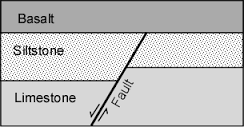
What are the relative ages of the features in order from oldest to youngest?
a)
Limestone, Basalt, Fault, Siltstone
b)
Siltstone, Fault, Basalt, Limestone
c)
Limestone, Fault, Basalt, Siltstone
d)
Limestone, Siltstone, Fault, Basalt
16.
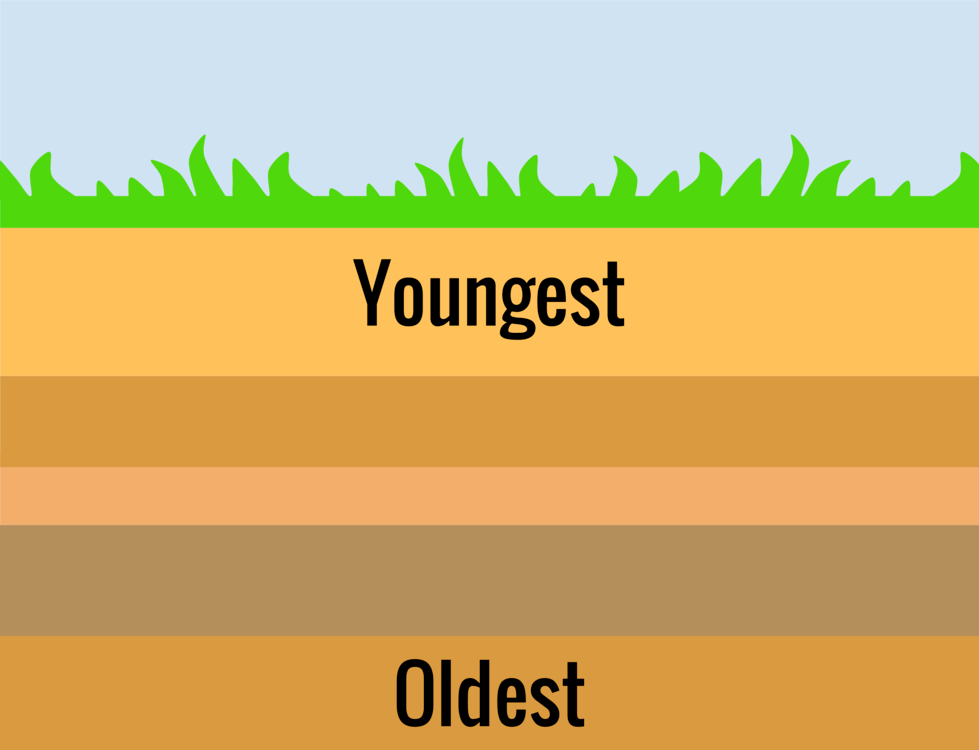
Relative dating of rock layers tells us that the deeper we dig, _______.
a)
the younger the rocks get
b)
the smellier the rocks get
c)
the harder the rocks get
d)
the older the rocks get
17.
The Law of Superposition helps scientists to determine what?
a)
The absolute age of rock layers
b)
The age of fossils
c)
The relative age of rock layers
d)
the super powers of rocks
18.
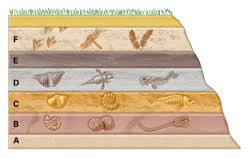
Which rock layer in the diagram seems to be the oldest?
a)
F
b)
E
c)
B
d)
A
19.
According to the law of superposition, which layer is the youngest?
a)
A
b)
B
c)
C
20.
According to the law of superposition, which layer is the youngest?
a)
A
b)
B
c)
C
21.

Which layer is OLDER? Layer M or Intrusion P?

a)

Layer M

b)

Intrusion P

22.

Which layer is OLDER? Layer E or Fault H?

a)

Layer E

b)

Fault H

23.

Which layer is OLDER? Layer E or Intrusion A?

a)

Layer E

b)

Intrusion A

24.

Which layer is OLDER? Fault E or Intrusion D?

a)

Fault E

b)

Intrusion D

25.

Which layer is OLDER? Intrusion M or Layer D?

a)

Intrusion M

b)

Layer D

26.

What geologic principle(or law) is best displayed here?

a)

Superposition

b)

Original horizontality

c)

Cross-cutting relationships

d)

Inclusions

27.
According to the law of superposition, the oldest fossils are found 
a)
At the top of the rock layers
b)
Near the bottom of the rock layers
c)
In the middle of the rock layers
d)
Somewhat near the surface
28.
According to the law of superposition, which layer is the youngest?
a)
A
b)
B
c)
C
29.
Which of the following is the oldest?
a)
Layer L
b)
Intrusion D
c)
Intrusion H
d)
Layer E
30.
Which of the following correctly lists the layers in order from oldest to youngest?
a)
A, B, C, D, E
b)
E, B, C, D, A
c)
E, D, C, B, A
d)
C, B, A, D, E
31.
How does sedimentary rock usually form?
a)
Vertically
b)
Diagonally
c)
Folding
d)
Horizontally
32.
Used to determine whether an object is older or younger than other objects
a)
Superposition
b)
Relative Dating
c)
Fossil
d)
Unconformity
33.
In which type of rock are most fossils found?
a)
igneous
b)
sedimentary
c)
volcanic
d)
metamorphic
34.
Rocks formed when magma or lava cools and hardens
a)
Igneous Rocks
b)
Metamorphic Rocks
c)
Sedimentary Rocks
d)
Minerals
35.
The age of a rock compared to the ages of other rocks is the rock's
a)
absolute age
b)
geologic age
c)
sedimentary age
d)
relative age
36.
Which of the following correctly lists the layers in order from oldest to youngest?
a)
A, B, C, D, E
b)
E, B, C, D, A
c)
E, D, C, B, A
d)
C, B, A, D, E
37.
Which rock layer in the diagram seems to be the oldest?
a)
F
b)
E
c)
B
d)
A
38.

Which is correct from oldest to youngest?

a)

A, B, D, C, E

b)

A, B, C, D, E

c)

E, C, B, D, A

d)

A, E, D, C, B

39.

Which is correct from OLDEST to YOUNGEST?

a)

N, T, G, J, S, A

b)

S, J, G, T, A, N

c)

N, A, T, G, J, S

d)

N, A, T, S, J, G

40.

Which statement is correct?

a)

J is youngest; A is oldest.

b)

L and M are faults.

c)

A happened first, then C then G, then P then fault. L.

d)

All are correct.

e)

None of these are correct.