wayground logo

Free Printable Worksheets

Font size

S
M
L
XL
Worksheets

Atoms and Atomic Structure-Unit Test Review

Total questions: 46

Worksheet time: 46mins

Name
Class
Date
1.

TRUE OR FALSE:

All matter is made of atoms

a)

True

b)

False

2.

Which subatomic particle has a positive charge?

a)

Protons

b)

Neutrons

c)

Electrons

3.

Which subatomic particle has a negative charge?

a)

Protons

b)

Neutrons

c)

Electrons

4.

Which subatomic particle has no charge or a neutral charge?

a)

Protons

b)

Neutrons

c)

Electrons

5.

CHECK ALL THAT APPLY:

The nucleus of an atom is made of what subatomic particle(s)?

a)

Protons

b)

Neutrons

c)

Electrons

6.

Which subatomic particle floats around/outside the nucleus?

a)

Protons

b)

Neutrons

c)

Electrons

7.

FILL IN THE BLANK:

The atomic number tells us how many _____ there are in the atom.

a)

Protons

b)

Neutrons

8.

TRUE OR FALSE:

The atomic mass tells us how many protons and neutrons there are in total.

a)

True

b)

False

9.

How many protons are in an atom with an atomic number of 12?

a)

12

b)

24

c)

6

d)

13

10.

What is the atomic number of an element with eight protons?

a)

8

b)

16

c)

4

d)

10

11.

What does the atomic mass tell us about an atom?

a)

The number of protons

b)

The number of protons and neutrons

c)

The number of protons and electrons

d)

The number of electrons

12.
Most of the volume an atom is made of this
a)
the nucleus
b)
the protons
c)
the neutrons
d)
empty space
13.
Protons and neutrons is so small, they are assigned a mass of 1 in these units 
a)
grams
b)
milligrams
c)
amu (atomic mass unit)
d)
mass number
14.
The mass of neutron
a)
1 x 10 to the -24 amu
b)
1 amu
c)
-24 g
d)
-24 kg
15.
The mass of 1 proton
a)
1 amu
b)
1 x 10 to the -24 amu
c)
-24 g
d)
-24 kg
16.
The mass of this particle is so small that it is not counted.
a)
proton
b)
electron
c)
neutron
d)
quark
17.
The charge of the nucleus of all atoms or ions
a)
positive
b)
negative
c)
neutral
d)
sometimes positive and sometimes negative
18.
The overall charge of all atoms (not ions)
a)
positive
b)
negative
c)
neutral
d)
sometimes positive and sometimes negative
19.
Current model of the atom is called 
a)
Electron Cloud Model
b)
Planetary Model
c)
Plum Pudding Model
d)
Ringed Model
20.
The best images of atoms look fuzzy because of their 
a)
small size 
b)
constant motion
c)
fast-moving electrons
d)
thunder and lightning
21.
The number of these determines which element an atom is.
a)
neutrons
b)
electrons
c)
protons
22.
All atoms of a particular element have the same number of these
a)
electrons
b)
neutrons
c)
protons
23.
The exact location of an ___ is impossible to know at any given time.
a)
electron
b)
proton
c)
neutron
24.
All of an atom's mass is considered to be this
a)
the cloud
b)
the nucleus
c)
the entire atom
25.

A physical model that depicts the atom as a small positively charged nucleus with electrons in orbit at different levels.

a)

Covalent bond

b)

Ionic bond

c)

Bohr Model

d)

Electron dot diagram

26.

A diagram that shows the bonding between atoms of a molecule and the lone pair of electrons that may exists in the molecule

a)

Hydrogen bond

b)

Bohr Model

c)

Electron dot diagram

d)

Element

27.

What is one way Neutrons are different from electrons?

a)

they both are negative

b)

neutrons have no charge, while electrons have a negative charge

c)

Both are in the nucleus( center of atom)

d)

Electrons are inside nucleus and neutrons are outside the nucleus.

28.

How are electrons similar to neutrons?

a)

Both have negative charge

b)

Both are part of a molecule

c)

Both make up parts of an atom

d)

Both are in nucleus

29.

How many neutrons does calcium have?

a)

20

b)

40

c)

60

d)

0

30.

What is the atomic mass of Neon?

a)

10

b)

20

c)

30

31.

How many protons and electrons does this element have?

a)

35

b)

18

c)

17

d)

52

32.

What part of the atom is indicated by the red sphere?

a)

nucleus

b)

electron cloud

c)

electrons

d)

neutrons

33.
This subatomic particle has basically no mass
a)
protons
b)
neutrons
c)
electrons
d)
protons and neutrons
34.
The mass of one proton is greater than the mass of one...
a)
neutron
b)
electron
35.
Which letter represents a proton?
a)
A
b)
B
c)
C
d)
D
36.
Which letter represents a neutron?
a)
A
b)
B
c)
C
d)
D
37.
Which letter represents an electron?
a)
A
b)
B
c)
C
d)
D
38.
Which letter represents the nucleus?
a)
A
b)
B
c)
D
d)
E
39.
The subatomic particles in blue are...
a)
Neutrons
b)
Protons
c)
Electrons
40.
The subatomic particles in green are...
a)
Protons
b)
Neutrons
c)
Electrons
41.
How many neutrons in C-14?
a)
6
b)
7
c)
14
d)
8
42.
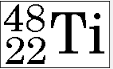
How many protons does this isotope of titanium have?
a)
48
b)
22
c)
26
d)
70
43.
How many neutrons does the isotope of lithium have?
a)
8
b)
3
c)
4
d)
5
44.
In a correctly written symbol what would be located in the "A" position?
a)
number of neutrons
b)
atomic number
c)
number of electrons 
d)
mass number
45.
What quantities vary between isotopes of an element?
a)
protons, electrons, and atomic mass
b)
protons, electrons, and atomic number
c)
neutrons and electrons
d)
neutrons and atomic mass
46.

What is an isotope?

a)

A charged atom

b)

Two atoms of the same element with different amounts of neutrons

c)

Two atoms of the same element with different amounts of protons

d)

A neutral atom