wayground logo

Free Printable Worksheets

Font size

S
M
L
XL
Worksheets

Honors Chemistry 2nd Nine Weeks Test Review

Total questions: 141

Worksheet time: 3hrs 7mins

Name
Class
Date
1.

Which of the following is the correct Lewis structure for a molecule fluorine?

a)

A

b)

B

c)

C

d)

D

2.

What is the correct Lewis structure for NH3?

a)
b)
c)
d)
3.

PF3 has how many lone pairs total?

a)

1

b)

2

c)

10

d)

20

4.

Which is the correct Lewis structure for carbon dioxide?

a)
b)
c)
d)
5.

According to the Octet Rule, atoms of elements react with each other in order to attain ____ electrons in their outermost energy level or shell.

a)

2

b)

4

c)

6

d)

8

e)

10

6.

Which of the following elements LOSES 1 electron in order to attain an octet?

a)

potassium

b)

calcium

c)

helium

d)

boron

e)

fluorine

7.

Which of the following elements GAINS 1 electron in order to attain an octet?

a)

sodium

b)

calcium

c)

helium

d)

boron

e)

chlorine

8.

What is a cation's charge?

a)

positive

b)

negative

c)

neutral

d)

depends on the element

9.

What is an anion's charge?

a)

positive

b)

negative

c)

neutral

d)

depends on the element's charge

10.

What is the charge of iron (III)?

a)

+3

b)

+2

c)

+6

d)

+4

11.

What is the charge of phosphate?

a)

-3

b)

-2

c)

-1

d)

-4

12.

Identify the compound if hydrogen and chlorine are chemically combined.

a)

HCl

b)

HCl7

c)

H1Cl1

d)

H1Cl7

13.

What is the cation charge of chromium (VI)?

a)

+6

b)

-6

c)

+24

d)

-24

14.
What is the correct formula for ammonium ion?
a)
NH⁺₄
b)
NO₂⁻
c)
PO₄³⁻
d)
CN⁻
15.
What is the correct formula for nitrite ion?
a)
NH⁺₄
b)
NO₂⁻
c)
PO₄³⁻
d)
CN⁻
16.
What is the correct formula for phosphate ion?
a)
NH⁺₄
b)
NO₂⁻
c)
PO₄³⁻
d)
CN⁻
17.
What is the correct formula for chlorate ion?
a)
ClO⁻₂
b)
ClO⁻₃
c)
CrO₄²⁻
d)
HCO₃⁻
18.
What is the correct formula for chromate ion?
a)
CO₃²⁻
b)
ClO₂⁻
c)
CrO₄²⁻
d)
HCO₃⁻
19.
Name this ion: OH⁻
a)
hydroxide
b)
peroxide
c)
phosphate
d)
silicate
20.
Name this ion: O₂⁻²
a)
hydroxide
b)
peroxide
c)
phosphate
d)
silicate
21.
Which are the correct formulas for the copper ion?
a)
Cu⁺ & Cu²⁺
b)
Cu²⁺ & Cu³⁺
c)
Cu²⁺ & Cu⁴⁺
d)
Cu³⁺ & Cu⁴⁺
22.
What are the correct formulas for the iron ion?
a)
Fe⁺ & Fe²⁺
b)
Fe²⁺ & Fe³⁺
c)
Fe²⁺ & Fe⁴⁺
d)
Fe³⁺ & Fe⁴⁺
23.
Ionic bonds are between...
a)
Metal and Non-metal
b)
Non-metal and Non-metal
c)
Metal and Metal
24.
How are ionic bonds formed?
a)
Transfer of electrons
b)
Sharing of electrons
25.
Atoms that gain electrons become...
a)
negatively charged
b)
positively charged
c)
remain neutrally charged
d)
21
26.

Why do all bonds form?

a)

so the number of protons equals the number of electrons

b)

so an atom can become unstable

c)

to fill the outermost energy level

27.

Write the correct formula for Sodium Chloride.

a)

SC

b)

SCl

c)

NaCl

d)

NaCl2

28.
This means the particles that make a mineral line up in a pattern that repeats over and over again.
a)
Chemical Composition
b)
Crystal Structure
c)
Fracture
d)
Solid
29.

What is a crystal?

a)

A pure material that can’t be changed.

b)

Material with a regular,repeating arrangement of atoms.

c)

A foggy like material.

30.

means a three-dimensional array of points coinciding with atom positions

a)

Lattice

b)

Amorphous

c)

Unit Cells

d)

FCC

31.

the basic structural unit or building block of the crystal structure and defines the crystal structure by virtue of its geometry and the atom positions within

a)

Lattice

b)

Amorphous

c)

Unit Cells

d)

FCC

32.

The following properties are all characteristics of ionic compounds EXCEPT

a)

high melting and boiling points

b)

soft

c)

crystal lattice structure

d)

conduct electricity when dissolved in water

33.
Which of the following is a property of an ionic compound?
a)
high melting point
b)
soft
c)
malleable
d)
liquid at room temperature
34.

What type of forces hold on an ionic lattice together?

a)

Electrostatic attraction forces

b)

Covalent bond

c)

Metallic bond

d)

Van der Waals forces

35.

Ionic compounds conduct electricity when dissolved in water. Which statement below best explains the property?

a)

Ions are free to move.

b)

Electrons are free to move.

c)

Bonds are strong.

d)

There are weak intermolecular forces of attraction.

36.
The reason that a sodium atom bonds with a chlorine atom is because
a)
Sodium transfers an electron to Chlorine
b)
oppositely charged ions form a strong electrostatic attraction
c)
ions are the same size
d)
the ions have a full outer shell
37.

What is the basis of a metallic bond?

a)

the attraction of neutral metal atoms.

b)

the attraction between protons and neutrons.

c)

the attraction between positive metal ions and interlocking electrons.

d)

the attraction between positive metal ions and free moving electrons.

38.
At room temperature, most metals are
a)
liquid
b)
solid
c)
gas
d)
an alloy
39.
What is the ability of a substance to be pulled into a thin strand?
a)
Malleability
b)
Ductility 
c)
Conductivity
d)
Solubility
40.

Why does the melting point of metals increase across period 3, from Sodium (Na) to Aluminium (AI)?

a)

Size of atoms gets smaller

b)

Attraction force between nuclei and free electron increases

c)

Increased space between the valence electrons in the "sea"

d)

Increased number of valence electrons contributed to the "sea"

41.

Why do metals conduct electricity?

a)

They are shiny

b)

The electrons are delocalised and able to move

c)

The electrons are held tightly within the lattice

d)

The electrons are shared between two metal ions

42.

Which of these are considered properties of metals? (choose ALL that apply)

a)

brittleness

b)

low melting point

c)

luster (shininess)

d)

malleability

e)

ductility

43.
I can hit a metal with a hammer without the metal shattering because of its __________.
a)
Ductility
b)
Malleability
c)
Conductivity
d)
Lustrousness
44.

Steel generally speaking is made of

a)

iron and carbon

b)

copper and iron

c)

tin and carbon

d)

aluminum and nickel

45.

Brass is an alloy made of

a)

copper and zinc

b)

copper and tin

c)

copper and nickel

d)

copper and aluminum

46.

Bronze is an alloy made of

a)

aluminum and magnesium

b)

copper and tin

c)

lead and tin

d)

copper and nickel

47.

Steel can become stainless when alloyed with _____.

a)

chromium and nickel

b)

copper and zinc

c)

tin and lead

d)

iron aand carbon

48.
Ionic bonds are between...
a)
nonmetals and nonmetals
b)
carbon and oxygen
c)
metals and nonmentals
d)
hydrogen and chlorine
49.
Covalent bonds are between...
a)
two or more nonmetals
b)
sodium and chlorine
c)
metals and metals
d)
metals and nonmetals
50.
What kind of chemical bond forms between a metal and a nonmetal?
a)
ionic
b)
covalent
c)
fake
d)
metallic
51.
What kind of bond forms between two nonmetals?
a)
ionic 
b)
covalent
c)
metallic
d)
fake
52.
phosphorus trichloride
a)
KCl3
b)
PCl3
c)
K3Cl
d)
P3Cl
53.
silicon dioxide
a)
SO2
b)
NaO2
c)
SiO2
d)
SiO
54.
diphosphorus pentoxide
a)
P2O5
b)
PO5
c)
P5O2
d)
P2O6
55.
SiCl4
a)
silicon tetrachloride
b)
silicon quadchloride
c)
monosilicon tetrachloride
d)
silicon chloride
56.
CO2
a)
Ionic
b)
Covalent
c)
Polyatomic Ion 
d)
Metallic 
57.
NaCl
a)
Ionic
b)
Covalent
c)
Metallic
d)
Polyatomic Ion 
58.
Which is most likely to form a negative ion?
a)
an element from group 17
b)
a metal
c)
an element from group 1
d)
an element with atoms that have eight valence electrons
59.
Which following is a molecular compound?
a)
SO2
b)
K2O
c)
CaO
d)
BeO
60.
what type of bond is the strongest
a)
single
b)
Double
c)
coordination
d)
triple
61.
How many are shared in a single bond?
a)
2 pairs
b)
4
c)
2
d)
1
62.
How many are shared in a double bond?
a)
2
b)
4 pairs
c)
6
d)
4
63.
How many electrons are shared in a triple bond?
a)
6
b)
3
c)
6 pairs
d)
5
64.
How many valence electrons does oxygen have?
a)
2
b)
3
c)
6
d)
4
65.
How many valence electrons does nitrogen have?
a)
3
b)
2
c)
5
d)
1
66.
What is the correct formula for this molecule?
a)
NH
b)
N3H
c)
NH3
d)
NH4
67.
A molecule with a single covalent bond is....
a)
HCl
b)
SO
c)
CO
d)
SO2
68.
A molecule with a double covalent bond is....
a)
HCl
b)
SO
c)
I2
d)
N2
69.
How many bonds does carbon have to create in order to satisfy the octet rule
a)
1
b)
2
c)
3
d)
4
70.

Which of the following covalent bonds is the most polar?

a)

H-N

b)

H-C

c)

H-H

d)

H-F

71.

If the atoms that share electrons have an unequal attraction for the electrons, the bond is called

a)

dipolar

b)

nonpolar

c)

ionic

d)

polar

72.

According to VSEPR theory, molecules adjust their shapes to keep which of the following as far apart as possible?

a)

electrons closest to the nuclei

b)

pairs of valence electrons

c)

mobile electrons

d)

protons

73.

If the difference in electronegativity between two bonding atoms is less than 1.7 but greater than .03 the bond is

a)

ionic

b)

polar covalent

c)

metallic

d)

nonpolar covalent

74.

What is placed between resonance structures to indicate resonance?

a)

double-headed arrow

b)

single-headed arrow

c)

dots

d)

Lewis structure

75.

When a polar molecule attracts the electron in a nonpolar molecule,

a)

an ionic bond forms

b)

a Lewis structure forms

c)

a crystal lattice forms

d)

a dipole is induced

76.

If two covalently bonded atoms are identical, the bond is

a)

coordinate covalent

b)

polar covalent

c)

dipole covalent

d)

nonpolar covalent

77.

The B-F bond in BF3 (electronegativity for B is 2.0; electronegativity for F is 4.0) is

a)

polar covalent

b)

ionic

c)

nonpolar covalent

d)

metallic

78.
For carbonate ions, what is the bond strength between C and O
a)
C-O (single bond)
b)
C=O (double bond)
c)
C≡O (triple bond)
d)
C-O(between single and double bond)
79.
For carbonate ions, how many resonance structures can be drawn ?
a)
2
b)
3
c)
4
d)
5
80.
How many resonance structures for NO3- ion?
a)
1
b)
2
c)
3
d)
4
81.
What is the bond strength between N and O?
a)
N-O (Single bond)
b)
N=O (double bond)
c)
N Ξ O (Triple bond)
d)
N-O (between single and double bond)
82.

What is the best definition of valence electrons?

a)

The outermost electron NOT involved in chemical reactions

b)

The innermost electrons involved in chemical reactions

c)

The outermost electrons involved in chemical reactions.

d)

The innermost electrons NOT involved in chemical reactions

83.

What is the model that uses electron-dot structures to show how electrons are arranged in molecules?

a)

resonances

b)

Lewis Structures

c)

structural formulas

d)

molecules

84.

What is the name for when more than one valid Lewis structure can be drawn for a molecule?

a)

coordinate covalent bond

b)

resonance

c)

endothermic

d)

structural formula

85.

What is the name when when one atom donates a pair of electrons to be shared with an atom or ion that needs two electrons to become stable

a)

coordinate covalent bond

b)

covalent bond

c)

polar covalent bond

d)

sigma bond

86.

Select the 3 exceptions to octet rule.

a)

Expanded octet

b)

Even number electron

c)

Incomplete octet

d)

odd number electron

87.

What type of octet has SF6 got?

a)

achieved octet

b)

incomplete octet

c)

expanded octet

d)

odd number electrons

88.

What type of octet foes NO2 have?

a)

achieved octet

b)

incomplete octet

c)

expended octet

d)

odd number electrons

89.

The acronym VSEPR stand for

a)

very strong electron pair repulsion.

b)

varied symmetry electrostatic proton reaction.

c)

venomous snakes enjoy pink ribbons.

d)

valence shell electron pair repulsion.

90.

VSEPR theory is used to predict

a)

the number of unshared pairs of electrons in a Lewis structure.

b)

the number of multiple bonds in a Lewis structure.

c)

the three-dimensional geometry of a molecule.

d)

the three-dimensional crystal lattice structure of ionic compounds.

91.

Molecules such as boron trichloride that have three bonded atoms and no unshared pairs have what shape?

a)

trigonal planar

b)

trigonal pyramidal

c)

trigonal bipyramidal

d)

tetrahedral

92.

What molecular geometry would PH3 have?

a)

Trigonal Pyramidal

b)

Trigonal Bipyramidal

c)

Bent

d)

Linear

93.

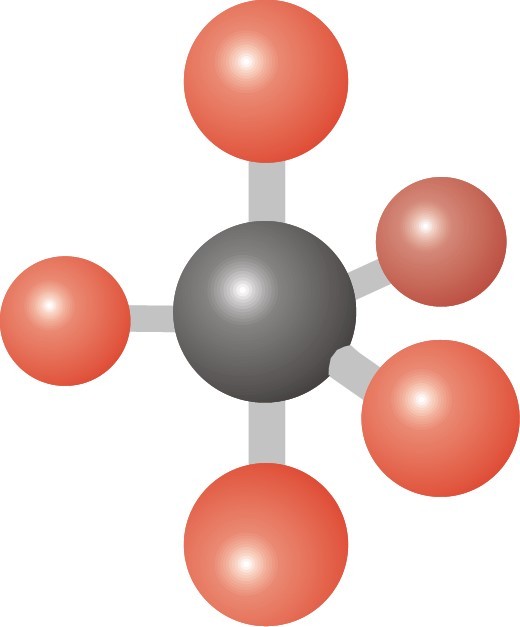
What shape would this have?

a)

Trigonal planar

b)

Pyramidal

c)

Tetrahedral

d)

Bent

94.
What molecular shape is the structure shown here? (BeCl2)
a)
linear
b)
bent
c)
trigonal planar
d)
tetrahedral
95.

What shape is shown here?

a)

Octahedral

b)

Tetrahedral

c)

Trigonal bipyramidal

d)

Seesaw

96.

Identify the molecule structure

a)

Bent

b)

Linear

c)

Trigonal Planar

d)

Pyramidal

97.

Identify the molecule structure

a)

Bent

b)

Linear

c)

Trigonal Planar

d)

Pyramidal

98.

Classify the following molecule.

a)

polar

b)

nonpolar

99.

Classify the following molecule.

a)

polar

b)

nonpolar

100.

Classify the following molecule.

a)

polar

b)

nonpolar

101.

Is the following molecule polar or nonpolar?

a)

polar

b)

nonpolar

102.

Which sample has hydrogen bonding?

a)

H2S

b)

CH4

c)

NH3

d)

HI

103.

Water has an unusually high boiling point for a molecular compound because it has

a)

hydrogen bonding

b)

ion-ion attractions

c)

a high density

d)

a large gram formula mass

104.

Which substance has the weakest intermolecular forces?

a)

Substance A, boiling point of 75 °C

b)

Substance B, boiling point of 105 °C

c)

Substance C, boiling point of 25 °C

d)

Substance d, boiling point of 45 °C

105.

________________________ have the strongest intermolecular forces of attraction.

a)

Dipole- Dipole

b)

Dispersion

c)

Hydrogen Bonds

106.

Intermolecular forces for: CO2

a)

Dispersion Force

b)

Dipole dipole

c)

Hydrogen bonding

107.
London forces are stronger in heavier atoms or molecules, and weaker in lighter atoms or molecules.  Which of these has the strongest London forces?
a)
F2
b)
Br2
c)
I2
d)
Cl2
108.
Rank these in order of strength:
covalent bond
London forces
hydrogen bond
dipole-dipole attraction
a)
dipole-dipole>covalent bond>hydrogen bond>London
b)
London>dipole-diple>hydrogen bond>covalent bond
c)
covalent bond>hydrogen bond>dipole-dipole>London
d)
hydrogen bond>dipole-dipole>London>covalent bond
109.
Which statement is TRUE, based on the diagram provided?
a)
atomic orbital overlap to produce sigma bond
b)
s orbital overlap to produce π bond
c)
s orbital overlap with s orbital to produce sigma bond
d)
p orbital overlap to produce π bond
110.
Diagram below shows
a)
formation of hybrid orbital
b)
atomic orbital overlap to produce hybrid orbital
c)
atomic orbital overlap to form sp hybrid orbital
d)
s orbital overlap with p orbital to form sp hybrid orbital
111.
Which of the statement is TRUE?
a)
s orbital overlap with p orbitals to form sp hybrid orbital
b)
s orbital with two p orbitals to form one sp2 hybrid orbital
c)
s orbital with two p orbitals to form two sp2 hybrid orbital
d)
s orbital with two p orbitals to form three sp2 hybrid orbital
112.
How many sigma bonds does this have? 
a)
1
b)
2
c)
3
d)
4
113.
How many pi bonds does this have? 
a)
1
b)
2
c)
3
d)
4
114.
How many sigma bonds does this have? 
a)
1
b)
2
c)
3
d)
4
115.
How many sigma and pi bonds does this have?
a)
1 sigma and 1 pi
b)
2 sigma and 1 pi
c)
1 sigma and 2 pi
d)
2 sigma and 2 pi
116.
Pi bonds are formed by 
a)
side to side overlap of s orbitals
b)
end to end overlap of s orbitals
c)
side to side overlap of p orbitals
d)
end to end overlap of p orbitals
117.

C4H6

a)

CH

b)

CH3

c)

C2H3

d)

C4H6

118.

Br2O6

a)

BrO3

b)

Br6O2

c)

BrO

d)

Br2O6

119.

Br2O6

a)

BrO3

b)

Br6O2

c)

BrO

d)

Br2O6

120.

C2H4

a)

CH

b)

CH2

c)

C4H2

d)

C2H4

121.

C2F6

a)

CF

b)

C2F6

c)

C6F2

d)

CF3

122.
Which pair has the same empirical formula?
a)
NaCrO4 and Na2Cr2O7
b)
C2H4O2 and C6H12O6
c)
C3H6Oand C2H6O2
d)
CH4 and C2H6
123.
A compound consists of 72.2% magnesium(Mg) and 27.8% nitrogen(N) by mass. What is the empirical formula?
a)
Mg4N3
b)
MgN2
c)
Mg3N
d)
MgN
124.
What is the molecular formula if the empirical formula is CH2O and the molecular molar mass is 180.18?
a)
CH2O
b)
C2H4O2
c)
C4H8O4
d)
C6H12O6
125.
Given the following: 42.07% Na, 18.89% P, and 39.04% O, determine the empirical formula.
a)
 NaPO2
b)
Na2PO3
c)
Na3PO4
d)
NaPO4
126.
What is the empirical formula if you have 81.82% carbon and 18.18% hydrogen?
a)
C3H8
b)
CH4
c)
C2H2
d)
C4H10
127.

Which of the following elements will form a cation?

a)

Arsenic

b)

Copper

c)

Bromine

d)

Fluorine

128.

Which of the following will form an anion?

a)

Titanium

b)

Iron

c)

Calcium

d)

Sulfur

129.

Which of the following will form a cation?

a)

Aluminum

b)

Sulfur

c)

Iodine

d)

Nitrogen

130.

Which of the following will form an anion?

a)

Tin

b)

Lead

c)

Chlorine

d)

Zinc

131.

What is the name for MgF2 ?

a)

magnesium fluoride

b)

manganese Phosphide

c)

magnesium(III) fluoride

d)

magnesium fluoride(II)

132.
Which is a transition metal?
a)
cesium
b)
iron
c)
helium
d)
tellurium
133.
Name the compound CaF2
a)
calcium difluoride
b)
calcium (II) fluoride
c)
calcium fluorite
d)
calcium fluoride
134.
Zn3P2
a)
Zinc Phosphide
b)
Zinc (II) Phosphide
c)
Trizinc Diphosphide
d)
Zinc Phosphate
135.
Name the following compound: SnO2
a)
tin(II) oxide
b)
tin(IV)oxide
c)
tin(II)oxygen 
d)
tin oxide
136.
Name the following ionic compound: Cs2S
a)
cesium sulfide
b)
cesium sulfate
c)
cesium (II) sulfate
d)
cesium (II) sulfide
137.
SeF4
a)
Tetraselenium fluoride
b)
Selenium Fluoride
c)
Selenium tetraflouride
d)
Selenium (IV) Fluoride
138.

What is the name of the following ternary ionic compound:

NaMnO4 ?

a)

Sodium Permangante

b)

Sulfur Permanganate

c)

Sodium Manganese Oxide

139.

What is the name of the following ternary ionic compound:

Zn3(PO4)2?

a)

Zinc Phosphate

b)

Zinc Phosphite

c)

Zinc Phosphide

140.

What is the name of the following ternary ionic compound:

LiBrO3?

a)

Lithium Bromate

b)

Lithium Bromite

c)

Lithium Bromine Oxide

141.

What is the name of the following ternary ionic compound:

KClO4?

a)

Potassium perchlorate

b)

Phosphorus perchlorate

c)

Potassium Chlorine Oxide