
 Worksheets
PRACTICE - Semester 2 Final Exam PRACTICE Questions
Total questions: 145
Worksheet time: 5hrs 34mins
Predict the precipitate when you mix silver nitrate and sodium chloride:
AgNO3
No precipitate
AgCl
NaNO3
When you mix barium nitrate and sodium sulfate
BaSO4
NaNO3
No precipitate
BaNO3
When you mix magnesium nitrate and sodium hydroxide
No precipitate
NaOH
NaNO3
Mg(OH)2
When you mix lithium iodide and silver nitrate
AgI
LiNO3
AgCl
All of the above
AB (aq) + CD (aq) → AD (aq) + CB(s)
Which substance is the precipitate in the reaction above?
AB
CD
AD
CB

Which of the following salts are not aqueous?
NaBr
Ca(NO3)2
AgCl
(NH4)2CO3

Predict the products of a reaction between
Pb(NO3)2 (aq) + Na2(SO4) (aq)
PbSO4 (aq) +NaNO3 (aq)
PbSO4 (s) +NaNO3 (aq)
Pb(SO4)(aq) +Na2(NO3) (aq)
PbSO4 (s) +Na2(NO3)2 (aq)
Which term is incorrectly described?
aqueous = dissolved in water to make a water solution
insoluble = unable to dissolve
precipitate = made from water
soluble = able to dissolve
When solutions of two ionic compounds are combined and a solid forms, the process is called
hydration
solvation
dissociation
precipitation
Which of these results in the formation of a precipitate?
AgNO3(aq) + NaOH(aq)→
Ba(NO3)2(aq) + CaCl2(aq)→
NaNO3(aq) + KOH(aq)→
More than one of these form precipitates
Which of the following best describes a precipitate?
an insoluble solid
a soluble solid
a soluble gas
an insoluble liquid
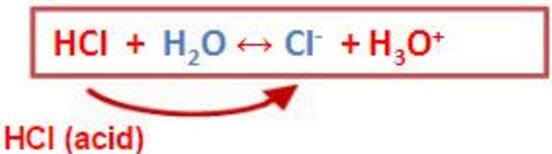


An acid has a pH
higher than 7
lower than 7
7
greater than 14
An Arrhenius base:
donates H+
accepts H+
produces H+
produces OH-
An Arrhenius acid:
donates H+ to another substance
accepts H+ from another substance
produces H+
produces OH-
Bases have a pH of
7
Less than 7
More than 7
Identify the true statement about the following reaction:
F- + H2O --> HF +OH-
H2O is a bronsted lowry base
H2O is not an acid or base according to either model
H2O is a bronsted lowry acid
H2O is an arrhenius acid
Choose the correct statements about HI based on the following reaction (select all that apply):
HI + H2O --> I- + H3O+
HI is an arrhenius acid
HI is an arrhenius base
HI is a bronsted lowry acid
HI is a bronsted lowry base
Which of the following show an acid and its conjugate base pair (in that order)
H2SO4, SO42-
OH-, H2O
NH4+, H2O
H2CO3, HCO3-

Which solution is the most concentrated:
Solution A
Solution B
Solution C
They all have the same concentration

Which solution is the most concentrated:
Solution A
Solution B
Solution C
They all have the same concentration
Which solution is the least concentrated:
Solution A
Solution B
Solution C
They all have the same concentration
The term molar which is used to describe a solution's concentration, is written as?
M
mol
g
g/L
If you have 34 mL of a 0.5 M NaBr solution, what will the concentration be if 56 mL of water is added to it?
.188 M
3.78 M
.389 M
1.76 M
The units "M" can also be written as:
mol/L
moles
g/L
g/mol
40 grams of NaOH = ________ moles
1
2
160
1600
If 1 mole of solute is dissolved in 1 liter of water, what is the molarity?
2M
.5M
1M
It can't be determined unless you know the solute

Which segment of the graph represents a time when both the solid and liquid phases are present?
AB
BC
DE
EF
Which segment of the graph represents a time when both the liquid and gas phases are present?
AB
BC
DE
EF
Which states of matter are present between line segment BC?
Solid and Liquid
Solid and Gas
Liquid and Gas
Solid only
Which segment of the graph represents both melting and freezing?
AB
BC
DE
EF
Which segment of the graph represents both vaporization and condensation?
AB
BC
DE
EF

What is the melting point of the substance?
-60 oC
60 oC
- 100 oC
100 oC
What is the boiling point of the substance?
-60 oC
60 oC
- 100 oC
100 oC

Which will heat up faster?
copper
granite
iron
basalt

Which will heat up slower?
water
lead
granite
iron
Which of the following best explains why the sand at the beach is hotter than the water?
Sand has a higher specific heat than water.
Sand has a lower specific heat than water.
There is more water than sand at the beach.
There is more sand than water at the beach.
The amount of energy required to raise the temperature 1ºC for every gram is called____?
Thermal Energy
Specific Heat
Temperature
Kinetic Energy
The specific heat of platinum is 0.133 J/g°C. How much heat(Q) is released when a 10 g piece of platinum cools from 100°C to 50°C?
66.5 J
665 J
0.0266 J
0.665 J
IF we are using Boyles' law and our Pressure goes UP, what must our volume do?
Go UP
Go DOWN
Stay the same
Wrong law.
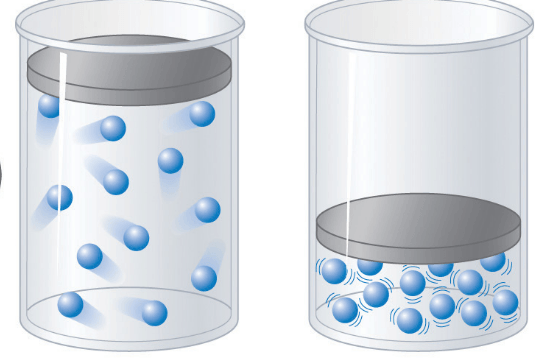
I have added 15 L of air to a balloon at sea level (1.0 atm). If I take the balloon with me to Denver, where the air pressure is 0.85 atm, what will the new volume of the balloon be?
24 L
18 L
32 L
15 L

Which best explains why increasing the pressure on a gas decreases the volume of the gas sample?
Increasing the pressure causes the gas particles to hit the container walls more often.
Increasing the pressure on a gas sample moves the gas particles closer together.
Increasing the pressure on a gas sample causes the kinetic energy to increase.
Define: Calorimeter
In any chemical or physical process, energy is neither created nor destroyed.
the heat absorbed or released by a chemical reaction
a process that loses heat to the surroundings
a device used to measure the amount of heat absorbed or released during chemical or physical change
Define: Specific Heat
the amount of heat that must be added to one unit of mass of the substance in order to cause an increase of one unit in temperature
a process where energy is absorbed by the system from the surroundings
the quantity of heat that raises the temperature of 1 g of pure water 1°C
a process that loses heat to the surroundings
Define: Heat
a process that loses heat to the surroundings
a device used to measure the amount of heat absorbed or released during chemical or physical change
the amount of energy that is transferred from one system to its surroundings because of a temperature difference
the heat absorbed or released by a chemical reaction
Define: Calorie
a process that loses heat to the surroundings
the quantity of heat that raises the temperature of 1 g of pure water 1°C
the heat absorbed or released by a chemical reaction
the amount of energy that is transferred from one system to its surroundings because of a temperature difference
If a 235 g sample of steam at 135 C is cooled to 112C, find the change in heat content of the system.
10.8 kJ
22.6 kJ
-10.8 kJ
-22.6 kJ
In an endothermic reaction, energy is _________.
absorbed
released
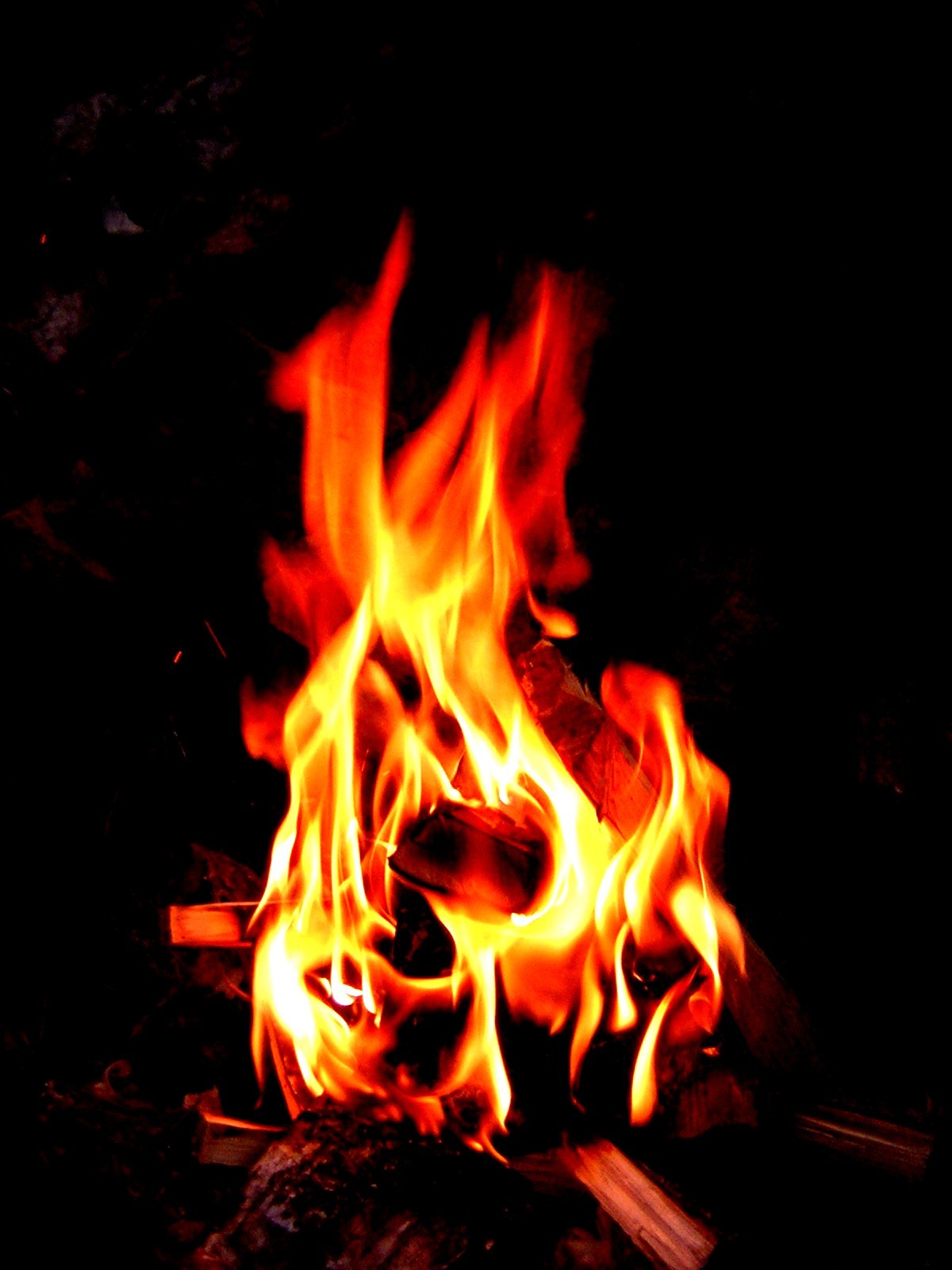
_____ reactions usually feel hot!
endothermic
exothermic
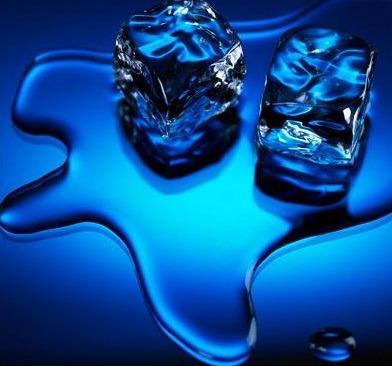
____ reactions usually feel cold.
endothermic
exothermic
Endo means in or _______.
absorbed
released
Exo means out or ________.
absorbed
released

Fireworks are an example of
exothermic
endothermic
both
none

A melting ice cube is an example of
exothermic
endothermic
none
both
12.00 moles of NaClO3 will produce how many grams of O2?
How many grams of potassium chloride (KCl) can be produced from 356 g of potassium bromide (KBr)?
About how many grams of H2O will be produced from 150 grams of Fe2O3?
How many moles of hydrogen are needed to react with 2 moles of nitrogen?
2NaOH(aq) + H2SO4(aq) --> 2H2O(l) + Na2SO4(aq)
How many grams of sodium sulfate will be formed if you start with 200 grams of sodium hydroxide?
How many moles of oxygen are produced when 6.7 moles of KClO3 decompose completely?
I need to add 8 moles of Carbon to the reaction. How many grams of Carbon should I weigh?
151 grams of Al2O3 are produced. How many grams of Al was needed in the reaction? Al + O2 -------> Al2O3 balance first.
79.91 g
22.4 liters
57.8 g
142.8 g
What Mass of sulfur must burn to produce 3.42 L of SO2 @ 273K and 101 kPa?
Use the following Equation : S + O2 --> SO2
2.45 g S
5.00 g S
4.88 g S

What is the ratio of red apples to green apples
7 apples to 3 green
4 red apples to 7 apples
4 red apples to 3 green apples
3 green apples to 4 red apples
Mole Ratios used for conversions are derived from:
the molar mass of the reactants in the balanced chemical equation
the coefficients of the balanced chemical equation
the subscripts of the products in the balanced chemical equation
the group number of each element in the balanced chemical equation
2 C2H6 + 7 O2 → 4 CO2 + 6 H2O
Ethane (C2H6) combusts in the above reaction. What is the mole ratio of ethane to oxygen gas?


2 C2H6 + 7 O2 → 4 CO2 + 6 H2O
Ethane (C2H6) combusts in the above reaction. What is the mole ratio of carbon dioxide to water?


In the equation 2 Al2O3 → 4 Al + 3 O2, what is the mole ratio of aluminum to oxygen?
What is the mole ratio between Nitrogen and Ammonium in the above reaction?
1 moles NH3 / 2 moles N2
3 moles NH3 / 1 moles N2
2 moles N2 / 2 moles NH3
1 moles N2 / 2 moles NH3
2Na + S → Na2S
What is the ratio of Na2S to Na?
1:1
1:2
2:1
2:2
4NH3 + 5O2 → 4NO + 6H2O
What is the mole ratio of water to oxygen?
4/4
4/5
6/4
6/5
1 P4 + 3 O2 → 2 P2O3
What is the mole ratio of P4 to O2?
1:3
1:2
3:2
3:1
3 CaCl2 + 2 Na3PO4 → Ca3(PO4)2 + 6 NaCl
What is the mole ratio of NaCl to Ca3(PO4)2?
1:6
6:1
2:3
3:2
4 FeS + 7 O2 → 2 Fe2O3 + 4 SO2
What is the mole ratio of iron oxide to oxygen gas?
4/7
7/4
2/7
7/2
4 FeS + 7 O2 → 2 Fe2O3 + 4 SO2
What is the mole ratio of iron sulfide to oxygen gas?
4/7
7/4
2/7
7/2
3 Hg(OH)2 + 2 H3PO4 → Hg3(PO4)2 + 6 H2O
What is the mole ratio of Hg3(PO4)2 to H3PO4?
1 to 2
2 to 1
2 to 3
3 to 2
3 Hg(OH)2 + 2 H3PO4 → Hg3(PO4)2 + 6 H2O
What is the mole ratio of Hg(OH)2 to Hg3(PO4)2 ?
1 to 2
2 to 1
3 to 1
1 to 3
4 L = ____ mL
40
400
4,000
40,000
5 kg = ______ g
5
50
500
5,000
Which type of reaction is:
H2 + O2 → H2O
Synthesis
Decomposition
Single Displacement
Double Displacement
Which type of reaction is:
NH3 + HCl → NH4Cl
Synthesis
Decomposition
Single Displacement
Double Displacement
Which type of reaction is:
3Ca + 2AlCl3 --> 3CaCl2 + 2Al
Synthesis
Decomposition
Single Displacement
Double Displacement
In which type of reaction does one element take the place of another element in a compound?
Synthesis
Decomposition
Single Displacement
Double Displacement
In which type of reactions does one compound break down to form two or more simpler substances?
Synthesis
Decomposition
Single Displacement
Double Displacement
In which type of reaction do two or more substances combine to form one new compound?
Synthesis
Decomposition
Single Displacement
Double Displacement
In which type of reaction do the ions of two compounds switch places?
Synthesis
Decomposition
Single Displacement
Double Displacement
What reaction has the following general formula:
AB --> A + B
Combination
Decomposition
Single Replacement
Double Replacement
Combustion
What reaction has the following general formula:
A + CD --> C + AD
Combination
Decomposition
Single Replacement
Double Replacement
Combustion
Define the term soluble.
Can dissolve in water
Cannot dissolve in water
Partially dissolves in water
Define the term insoluble.
Can dissolve in water.
Cannot dissolve in water.
Partially dissolves in water.

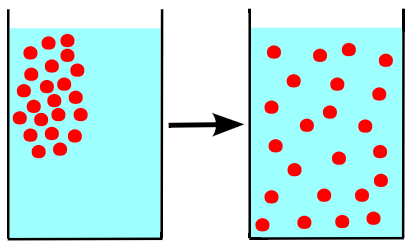
Which factor affecting solubility is shown in the picture?
temperature
height
stirring
particle size

Which factor is shown in the picture?
temperature
particle size
stirring
use of spoon
Why do sugar particles dissolve faster in hot water?
water particles move slow
water particles move fast
water particles settle down
water particles stay on top
How does particle size affect solubility?
bigger particles dissolve faster
smaller particles can occupy the space in water faster
bigger particles spread faster than smaller particles
What are the factors that affect solubility?
rate of stirring
particle size
temperature
all of these
What combination would dissolve a solid solute the fastest?
high temperature, no stirring
no heat, no stirring
sugar cube, no heat
high temperature, stirring



