
 Worksheets
T1-ADV. Chemistry Final Revision Quiz
Total questions: 144
Worksheet time: 3hrs 17mins
What is an example of a homogeneous mixture?
A mixture of oil and water
A mixture of sand and water
A mixture of iron filings and sulfur
A solution of salt and water
Give an example of a heterogeneous mixture.
Milk
Pure water
Sugar
Salad
What are the properties of homogeneous mixtures?
Visible boundaries between the substances
Non-uniform composition
The properties of homogeneous mixtures include uniform composition, even distribution of components, and no visible boundaries between the substances.
Uneven distribution of components
List the properties of heterogeneous mixtures.
Heterogeneous mixtures are always in a gaseous state
The properties of heterogeneous mixtures include the ability to be separated by physical means, such as filtration or settling, and the components do not have a uniform composition throughout the mixture.
The components of heterogeneous mixtures have a uniform composition throughout the mixture
Heterogeneous mixtures cannot be separated by physical means
Name a common homogeneous mixture found in households.
Saltwater
Pepperjuice
Sugarmilk
Mudwater
Identify a heterogeneous mixture commonly found in nature.
Soil
Pure water
Iron
Air
How do the particles in a homogeneous mixture distribute?
Evenly throughout the mixture
Only at the bottom of the mixture
Only at the top of the mixture
In random clumps within the mixture
Explain the distribution of particles in a heterogeneous mixture.
Particles in a heterogeneous mixture are only found in the top layer and cannot be separated by physical means.
Particles in a heterogeneous mixture are evenly distributed and can only be separated by chemical means.
Particles in a heterogeneous mixture are unevenly distributed and can be separated by physical means.
Particles in a heterogeneous mixture are evenly distributed and cannot be separated by physical means.
What are the characteristics of a homogeneous mixture?
Uniform composition and properties throughout
Uneven distribution of substances
Varied appearance and texture
Different composition and properties throughout
Describe the characteristics of a heterogeneous mixture.
A heterogeneous mixture contains only one type of substance and cannot be separated by physical means.
A heterogeneous mixture has no visible differences between substances or phases and cannot be separated by physical means.
A heterogeneous mixture has uniform composition and cannot be separated by physical means.
A heterogeneous mixture has visibly different substances or phases and can be separated by physical means.
What are the physical properties of a homogeneous mixture?
Different composition and inconsistent physical properties throughout the mixture.
Visible separation of components and varying physical properties.
Uniform composition and consistent physical properties throughout the mixture.
Unpredictable composition and unstable physical properties.
What are the physical properties of a heterogeneous mixture?
The physical properties of a heterogeneous mixture are uniform throughout the sample
All substances in a heterogeneous mixture are evenly distributed
Heterogeneous mixtures have consistent color, texture, and density
The physical properties of a heterogeneous mixture can vary throughout the sample, such as different colors, textures, and densities.
Provide an example of a homogeneous mixture in the field of chemistry.
Sand and water
Iron filings and sulfur
Sugar and sand
Salt water
Vinegar and oil
Give an example of a heterogeneous mixture in the field of biology.
Milk
Blood
Salad
Air
How can you separate the components of a homogeneous mixture?
Adding more components to the mixture
Shaking the mixture vigorously
Using a hammer to break the mixture into pieces
Using techniques such as filtration, distillation, chromatography, or evaporation.
The breaking apart of the solute by the solvent is
Dissociation
Hydration
Nonpolar
Solvation
Immiscible
describes two liquids that are soluble in one another
describes two liquids that are not soluble in one another
describes a solid or gaseous solute that can be dissolved
the substance that is doing the dissolving
Insoluble
means a solid or gaseous solute cannot be dissolved in a liquid solvent
means a solid or gaseous solute can be dissolved in a liquid solvent
particles that have no regions of opposite charges
What does Aqueous mean?
dissolved in water
dissolved in oil
insoluble
dissolved in a solid
What does it mean when two liquids are soluble in one another?
Hydration
Solute
Miscible
Solvent
When particles have regions of opposite charges, it said to be...?
Polar
Saturated
Solute
Nonpolar
What is the Universal Solvent?
Corn Syrup
Gasoline
Oil
Water
Unsaturated means
the solution has less than the maximum amount of solute being dissolved
the solution has more than the maximum amount of solute being dissolved
the solution has the maximum amount of solute being dissovled
Particles that have no regions of opposite charges are
bipolar
nonpolar
polar
A solution with the maximum amount of solute dissolved
Saturated
Unsaturated
Supersaturated
Solution
What is solubility ?
The substance being dissolved
The maximum amount of solute that will dissolve in a given amount of solvent at a specific temperature and pressure
The substance doing the dissolving
The minimum amount of solute that will dissolve in a given amount of solvent at a specific temperature and pressure
Solution is...?
The general term for a liquid, homogeneous mixture combined physically
The general term for the process of the solvent surrounding the solute particles
The general term for a liquid, heterogeneous mixture combined physically
Solute is
The substance doing the dissolving
Usually water
The substance that is being dissolved
Solvent is
The substance being dissolved
The substance that is doing the dissolving
When a solid solute that can be dissolved in a liquid, the solute is ...?
nonpolar
polar
insoluble
soluble
A __________mixture is a type of mixture with a uniform composition.
homogenous
heterogenous
hypotonic
hypertonic
It is a type of solution into which gases can spontaneously mix in any proportion.
SOLID SOLUTION
LIQUID SOLUTION
GASEOUS SOLUTION
AQUEOUS SOLUTION
It is a type of solution which are generally called alloys, where two or more metals are present.
SOLID SOLUTION
LIQUID SOLUTION
GASEOUS SOLUTION
AQUEOUS SOLUTION
It is the most common and it can be obtained by the dissolution of a gaseous, liquid, or solid solute.
SOLID SOLUTION
LIQUID SOLUTION
GASEOUS SOLUTION
AQUEOUS SOLUTION
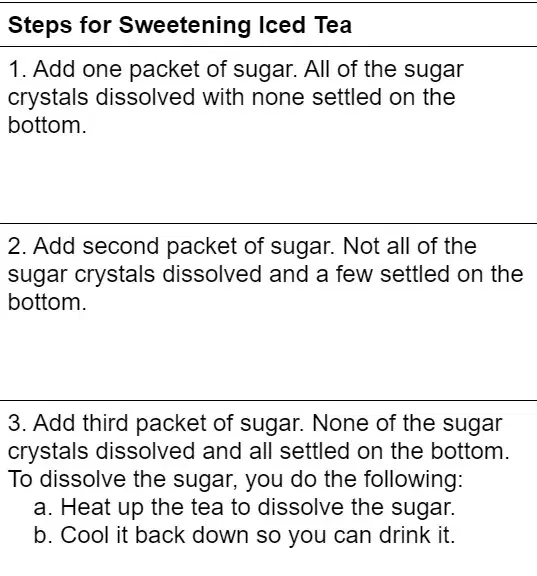
#1
Unsaturated
Saturated
Supersaturated
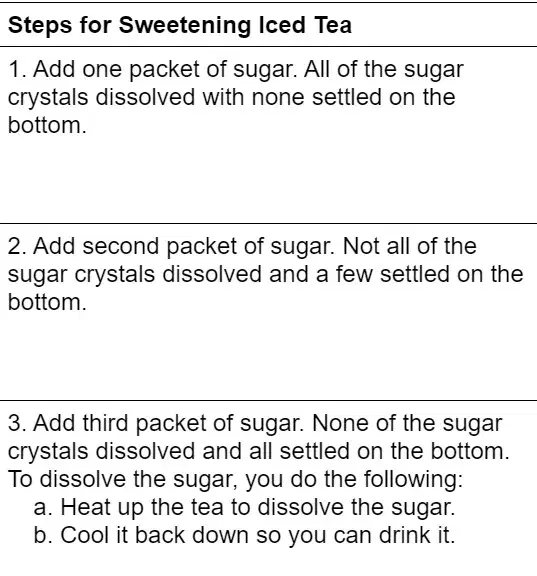
#2
Unsaturated
Saturated
Supersaturated
#3
Unsaturated
Saturated
Supersaturated
When you make a dilution, which of these values remains constant?
The molarity (M)
The total moles of solute
The volume (V)
The concentration
As we dilute a solution.....
The volume increases and the molarity (M) increases
The volume increases and the molarity (M) decreases
The volume decreases and the molarity (M) increases
The volume decreases and the molarity (M) decreases
How many mL of stock solution of 2M NaCl do you need to prepare 100 mL of 0.150M NaCl?
7.5 mL
15 mL
1333 mL
200 mL
Which of the following is the Dilution Formula?
V1M1 = V2M2
M = m/V
V = mT
PV = nRT
Which of the following molarity equations is the correct one for solving for volume
V = M × n
V = M÷ n
V = n ÷ M
V = n × M
You need to make 12.0 L of a 1.7 M solution of sodium bicarbonate, how many moles of sodium bicarbonate would you need for this solution?
0.142 moles NaHCO3
7.96 moles NaHCO3
13.7 moles NaHCO3
20.4 moles NaHCO3
What is the molarity of a solution of HNO3 that contains 0.500 mol of HNO3 and 250 ml of water?
0.002 M
0.5 M
2 M
500 M
What does it mean to dilute a solution?
lower the concentration of solute per solvent
increase the concentration of solute per solvent
increase the amount of solute in solvent
decrease the amount of solvent
none are correct
Calculate the Molarity in a solution containing 40.0 g of NaCl dissolved in 500.0 mL of H2O.
0.08 M
12.5 M
1.37 M
0.74 M
none are correct
How many grams of solute are dissolved in 125.0 mL of 5.00 M NaCl?
0.625 g NaCl
36.52 g NaCl
36.5 g NaCl
0.625 mol NaCl
none are correct

Using the supplied solubility curve diagram, determine the temperature at which KNO3 and NH4Cl have the same solubility.
16°C
39°C
25°C
73°C

Using the supplied solubility curve diagram, determine what type of solution would be present if 50 grams of NH3 was dissolved in 100 grams of water at 30°C.
saturated
unsaturated
supersaturated

Using the supplied solubility curve diagram, determine which compound listed below is least soluble at 70°C.
NH4Cl
NaCl
KCl
KNO3

Using the supplied solubility curve, determine the temperature that Ce2(SO4)3 and KClO3 have the same solubility.
26°C
3°C
57°C
80°C

Using the supplied solubility curve, determine the type of solution that is formed if 80 grams of NaNO3 were dissolved in 100 grams of water at 30°C.
saturated
unsaturated
supersaturated

Using the supplied solubility curve, determine which compound listed below is most soluble at 20°C.
NH3
KCl
KClO3
NaNO3

Using the supplied solubility curve, determine the type of solution formed if 10 grams of Ce2(SO4)3 were dissolved in 100 grams of water at 50°C.
saturated
unsaturated
supersaturated

Using the supplied solubility curve, determine how many grams of KNO3 will need to be dissolved in 100 grams of water at 60°C to make a saturated solution.
103 grams
85 grams
124 grams
140 grams

Using the supplied solubility curve, determine the type of solution formed when 60 grams of NH4Cl are dissolved in 100 grams of water at 80°C.
saturated
unsaturated
supersaturated

The the supplied solubility curve shows that when 79 grams of NaNO3 is dissolved in 100 grams of water at 10°C, that a saturated solution will be formed.
True
False
___________ refers to the amount of solute dissolved in a given amount per volume of solution
Concentration
Dilution
Precipitation
None of the above
What is the percent by mass of a solution made by dissolving 20.0 g of NaCl into 180.0 g of water?
10.0 %
11.1 %
80.0 %
20.0 %
What mass of water should be added to 22.0 g of KCl to make 5.50% by mass solution?
400 g
40 g
0.25 g
25 g
What is the percent concentration of sugar in pink lemonade if 28 g of sugar is added to 209 g of water?
14.7 %
5.14 %
13.4 %
8.47 %
11.8 %
How many grams of NaNO3 are needed to prepare 100 g of 15.0 % by mass NaNO3 solution? (MM = 85 g/mol)
15 g
1275 g
12.75 g
150 g
What is the molarity of 0.068 mol of NaCl in 3.8 L of solution?
0.018 M
0.0011 M
1.052 M
0.062 M
How many grams of solute are dissolved in 0.125 L of 5.00 M NaCl (MM = 58.45)?
0.625 g NaCl
625 g NaCl
36.5 g NaCl
0.04 mol NaCl
Calculate the molarity of the following solution: 1.0 mole of KCl in 0.750 L of solution.
0.750 M
99 M
1.3 M
2.0 M
What is the molarity of a solution made by adding 1.565 moles of PbNO3 to 0.5 L?
300. M
31.3 M
3.13 M
1.56 M
As you put in more solute in the solution, the concentration of the solution will...
increase
decrease
stay the same
As you remove solvent (evaporate the water) from the solution, the concentration (M) will...
increase
decrease
stay the same
What would be the final volume of a solution if you dissolved 2.5 mol of solute to make 7.5 M solution?
0.33 Liter
18.75 Liter
3 Liter
180.18 g/mol
180.12 g/mol
180.24 g/mol
180.06 g/mol
Fe2O3(s) + 3H2(g) → 2Fe(s) + 3H2O(l)
How many moles of iron can be made from 6 moles H2?
How many moles of hydrogen are needed to react with 2 moles of nitrogen?
6 mol H
2 mol H
3 mol H
1 mol H
How many moles of water can be produced if 8 moles H2 are used?
12.00 moles of NaClO3 will produce how many grams of O2?
What mass of O2 will be needed to burn 36.1 g of B2H6?
How many grams of aluminum sulfate would be formed if 250g H2SO4 completely reacted with aluminum?
How many moles of HCl are consumed in the production of 7.5 moles of MgCl₂?
CaC₂(s) + H₂O(l) --> C₂H₂(g) + Ca(OH)₂(aq)
how many grams of Ca(OH)₂ would be formed with 3.20 moles of CaC₂?
NaIO3(aq) + 6HI(aq) --> 3I2(s) + NaI(aq) + 3H2O(l)
How many moles of iodine can be made from 6.55 moles of NaIO3?
4NH3(g) + 5O2(g) --> 4NO(g) + 6H2O(l)
How many grams of oxygen gas are needed to react with 56.8 grams of ammonia?
When KCl (potassium chloride) is dissolved in water, how many particles are in solution?
1
2
3
4
6
When CaBr2 is dissolved in water, how many particles will be in solution?
1
2
3
4
5
When CH3OH is dissolved in water, how many particles are in solution?
1
3
4
5
6
The vapor pressure of a pure solvent is ___________ that of a solution
more than
less than
equal to

Which one of the following diagrams has the lowest vapor pressure?
1
2
3
4
5
Which of the following solutions will have the lowest freezing point? (Hint: who makes the most particles when dissolved?)
1.0 M C12H22O11
1.0 M LiCl
1.0 M Na3P
1.0 M MgF2
Which of the following compounds will be most effective in melting the ice on the roads when the air temperature is below zero?
sodium iodide (NaI)
magnesium sulfate (MgSO4)
potassium bromide (KBr)
all will be equally effective
Which sample, when dissolved in 1.0 liter of water, produces a solution with the lowest freezing point?
0.1 mol of C2H5OH
0.1 mol of LiBr
0.2 mol of C6H12O6
0.2 mol of CaCl2
Compared to the freezing point and boiling point of water at 1 atmosphere, a solution of a salt and water at 1 atmosphere has a
lower freezing point and a lower boiling point
lower freezing point and a higher boiling point
higher freezing point and a lower boiling point
higher freezing point and a higher boiling point
Compared to the freezing point of 1.0 M KCl(aq) at standard pressure, the freezing point of 1.0 M CaCl2(aq) at standard pressure is
lower
higher
the same
Compared to a 0.1 M aqueous solution of NaCl, a 0.8 M aqueous solution of NaCl has a
higher boiling point and a higher freezing point
higher boiling point and a lower freezing point
lower boiling point and a higher freezing point
lower boiling point and a lower freezing point
Which solution has the highest boiling point at standard pressure?
0.10 M KCl(aq)
0.10 M K2SO4(aq)
0.10 M K3PO4(aq)
0.10 M KNO3(aq)

The table above gives information about four aqueous solutions at standard pressure.
Which list of solutions is arranged in order from highest boiling point to lowest boiling point?
A, B, D, C
A, C, B, D
C, D, B, A
D, B, C, A
Which one of the following diagrams has the highest boiling point?
1
2
3
4
5
Which solution below has the highest boiling point?
NaCl 1 M
CaCl2 1 M
C6H12O6 1 M
AlCl3 1 M
While making homemade ice cream, you add rock salt to the ice. Which choice below provides the best explanation for why this is done?
Adding salt to the ice will lower the freezing point by creating a solution that's freezing point is lower than just the ice.
Adding salt to the ice will lower the freezing point by creating a solution that's freezing point is higher than just the ice.
Adding salt to the ice will raise the freezing point by creating a solution that's freezing point is lower than just the ice.
Adding salt to the ice will raise the freezing point by creating a solution that's freezing point is higher than just the ice.
2Ca(s) + O2(g) → 2CaO(s), calcium is...
CuCl2(aq) + NaOH(aq) → Cu(OH)2(s) + NaCl(aq)
Which is the correct net ionic equation for the reaction of:
AgNO3 (aq) + CaCl2 (aq) -> AgCl (s) + Ca(NO3)2 (aq)
CuCl2(aq) + NaOH(aq) → Cu(OH)2(s) + NaCl(aq)
What is the correct net ionic equation for the reaction between HBr(aq) and LiOH(aq) that produces LiBr(aq) and H2O(l)?
2 H+(aq) + O2-(aq) → H2O(l)
2 H2 (aq) + O2(aq) → 2 H2O(l)
2 H2 (g) + O2(g) → 2 H2O(l)
H+(aq) + OH-(aq) → H2O(l)
What is the net ionic equation for the reaction between K3PO4 (aq) and CuSO4 (aq) that produces K2SO4 (aq) and Cu3(PO4)2 (s)?
2 K+(aq) + SO42-(aq) → K2SO4 (s)
K+(aq) + SO42-(aq) → KSO4 (s)
2 Cu2+(aq) + 3 PO43-(aq) → Cu3(PO4)2 (s)
Cu2+(aq) + PO43-(aq) → CuPO4 (s)
Which is the correct net ionic equation for this reaction?
3KOH(aq) + FeCl3(aq) → 3KCl(aq) + Fe(OH)3(s)
3K+ (aq) + 3Cl- (aq) → 3KCl (s)
Fe3+ (aq) + 3OH- (aq) → Fe(OH)3 (s)
Fe3+ (aq) + Cl- (aq) → Fe(OH)3 (s)
3K+ (aq) + 3OH- (aq) + Fe3+ (aq) + 3Cl- (aq) → Fe(OH)3 (s)
How many moles of particles (what is "i") for the substance Na2CO3?
(a)
Molality is
the moles of solute in 1g of solvent
the moles of solute in 1g of solution
the moles of solute in 1kg of solvent
the moles of solute in 1kg of solution
What is the molality of a solution containing 2.35g of NaCl in 0.55Kg of water?
0.0731
4.27
0.427
7.31
When KCl (potassium chloride) is dissolved in water, how many particles are in solution for each unit?
1
2
3
4
6
When CH3OH is dissolved in water, how many particles are in solution for each unit?
1
3
4
5
6
What type of substance dissolves in water but does not form ions or conduct electricity?
electrolyte
nonelectrolyte
saturated
insoluble
Which one of the following diagrams has the lowest vapor pressure?
1
2
3
4
5
Which one of the following diagrams has the highest boiling point?
1
2
3
4
5
While making homemade ice cream, you add rock salt to the ice. Which choice below provides the best explanation for why this is done?
Adding salt to the ice will lower the freezing point by creating a solution that's freezing point is lower than just the ice.
Adding salt to the ice will lower the freezing point by creating a solution that's freezing point is higher than just the ice.
Adding salt to the ice will raise the freezing point by creating a solution that's freezing point is lower than just the ice.
Adding salt to the ice will raise the freezing point by creating a solution that's freezing point is higher than just the ice.
How many grams of pyrazine (C4H4N2) would have to be dissolved in 1.50 kg of carbon tetrachloride to lower the freezing point by 4.4 °C? The freezing point constant for carbon tetrachloride is 30. °C/m.
16.7 g
17.6 g
14.8 g
8.3 g
When 0.258 g of a molecular compound, benzoic acid, was dissolved in 40.0 g of benzene, the freezing point of the solution was lowered to 5.23 °C. What is the molecular weight of the benzoic acid?
120 g/mol
122 g/mol
16.4 g/mol
112 g/mol
If 90.0 g of nonionizing C6H12O6, are dissolved in 255 g of H2O, what will be the boiling point of the resulting solution?
101.1 °C
100.1 °C
112.3 °C
102.2°C
What is the osmotic pressure developed by seawater at 25 ◦C. Assume that seawater is a 0.53 M solution of NaCl.
24.3 atm
25.2 atm
25.9 atm
92.25 atm
The colligative property of a solution is
Vapour pressure
Osmotic pressure
Boiling point
Freezing point
The measurement of osmotic pressure can also be used to determine
molecular weights of compounds
atomic weights of compounds
empirical formula of compound
chemical formula
A membrane which only allows solvent molecules to flow through it is called
permeable membrane
transparent membrane
elastic membrane
semipermeable membrane
What is the formula for calculating osmotic pressure?
π=MRT
π=RTM
π=MRT
π=M+RT
In the osmotic pressure formula π=MRT , what does R represent?
Reaction rate
Gas constant
Rate of diffusion
Molar mass
If the osmotic pressure of a solution is 5 atm at 300 K, what is the molarity of the solution? (Assume R = 0.0821 L atm / (mol K))
0.203 M
2.03 M
0.0203 M
20.3 M
What is the osmotic pressure of a 0.5 M NaCl solution at 298 K? (Assume R = 0.0821 L atm / (mol K) and that NaCl fully dissociates into Na+ and Cl-)
12.3 atm
24.6 atm
49.2 atm
6.15 atm
How would the osmotic pressure change if the molarity of the solution is doubled?
It would double
It would halve
It would quadruple
It would remain the same
If the osmotic pressure of a solution is 10 atm at 273 K, what will be the osmotic pressure at 546 K, assuming the molarity remains constant?
5 atm
10 atm
20 atm
40 atm
Given the osmotic pressure ( π ) of a solution, the gas constant (R), and the temperature (T), how can you calculate the molarity (M) of the solution?
M=RTπ
M=πRT
M=πRT
M=π+RT
What is the effect of increasing the temperature on the osmotic pressure of a solution, assuming the molarity remains constant?
Increases the osmotic pressure
Decreases the osmotic pressure
No effect on the osmotic pressure
Initially increases then decreases the osmotic pressure
Which of the following statements is true regarding osmotic pressure?
Osmotic pressure is independent of the nature of the solute.
Osmotic pressure decreases with increase in solute concentration.
Osmotic pressure is a colligative property that depends on the number of solute particles.
Osmotic pressure can be calculated using the formula π=RTM .

