Worksheets
Titration Indicators and Buffer Solution
Total questions: 56
Worksheet time: 56mins
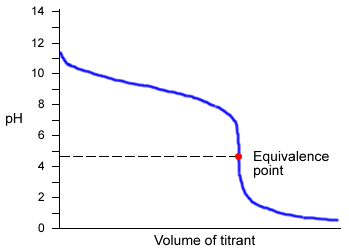
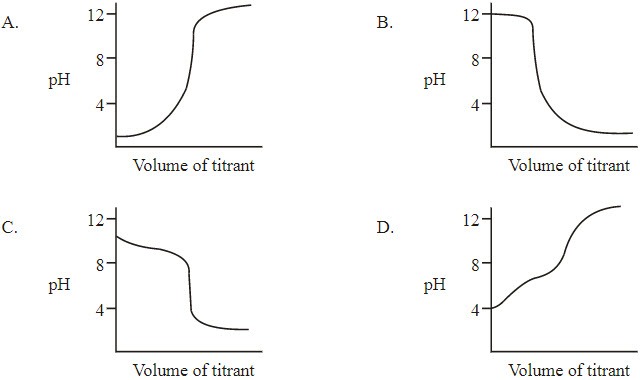
Which curve is produced by the addition of a 0.1 molL-1 strong acid to a 0.1 molL-1 weak base?
A
B
C
D
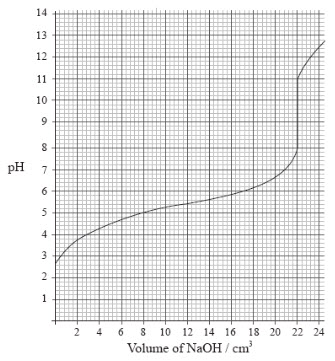
CH3COOH is titrated with NaOH. Name the salt produced and its pH at the equivalence point.
CH3COONa, pH at 5
CH3COONa, pH at 7
CH3COONa, pH at 9
NaCH3COO, pH at 9

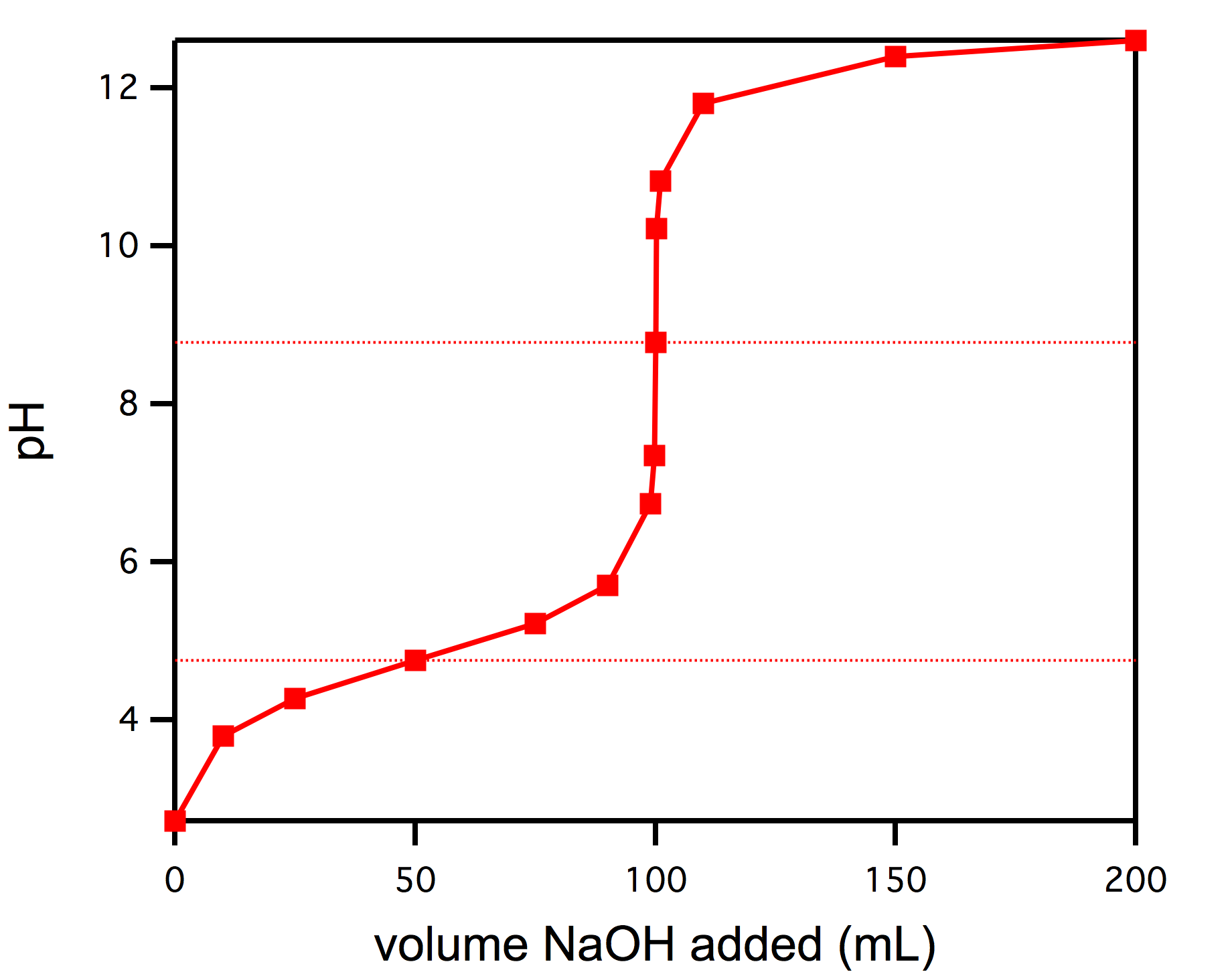
The pH of the solution when the buffer solution in the flask contains equal concentrations of weak acid and conjugate base is
2.86
4.75
8.77
12.01


what is mean by equivalence point
a point which complete neutralisation occur where indicator change colour
a point which complete neutralisation occur where volume of H+ is equal to volume of OH-
a point where pH is equal to pKa
what is the initial pH value when ethanoic acid was added into sodium hydroxide?
13.0
11.0
3.5
2.0

A buffer solution is prepared by mixing equal volumes of 0.50 M weak acid with 1.0 M of its conjugate base. Based on the data given in the table above, which of the following pairs of chemical solutions should be used to prepare the buffer solution so that the pH will be between 4 and 7?
CH3COOH and NH3
CH3COOH and CH3COONa
H2CO3 and NH3
H2CO3 and Na2CO3
In the titration of a weak acid of unknown concentration with a standard solution of a strong base, a pH meter was used to follow the progress of the titration. Which of the following is true for this experiment?
The [H+] at the equivalence point equals the ionization constant of the acid.
The pH at the equivalence point depends on the indicator used.
The graph of pH versus volume of base added rises gradually at first and then much more rapidly.
The graph of pH versus volume of base added shows no sharp rise.
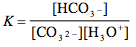
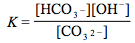
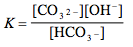
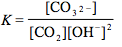
Which of the following is the correct equilibrium expression for the hydrolysis of CO3 2– ?
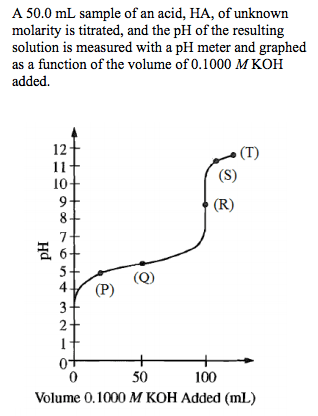
Which point on the titration curve corresponds to the point at which the moles of the added strong base are equal to the moles of the weak acid initially present?
Q
R
S
T
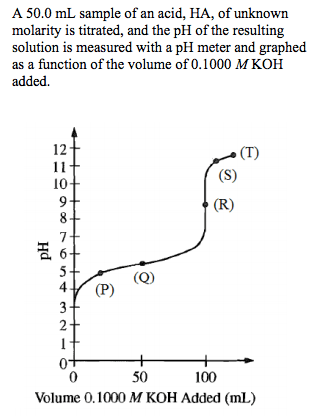
At point P in the titration, which of the following species has the highest concentration?
HA
A–
H3O+
OH–
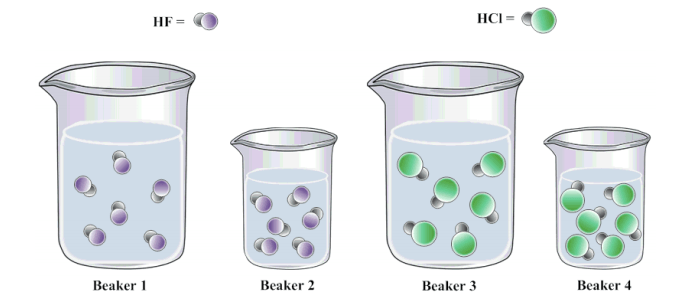
Equal moles of the indicated acids are dissolved in the amounts of water shown in the beakers below. In which solution will the percent ionization of the acid be the lowest?
Beaker 1
Beaker 2
Beaker 3
Beaker 4
HSO4¯ + H2O ↔ H3O+ + SO4 2¯ In the equilibrium represented above, the species that act as bases include which of the following?
HSO4-
H2O
SO4 2¯
H2O and SO4 2¯
Equal volumes of 0.10-molar H3PO4 and 0.20-molar KOH are mixed. After equilibrium is established, the type of ion in solution in largest concentration, other than the K+ ion, is
H2PO4 –
HPO4 2–
PO4 3–
OH-
Which of the following aqueous solutions containing 1:1 mole ratios of the following pairs of substances at 1 M concentrations will have the lowest pH?
NH3 and NH4Cl
H3PO4 and NaH2PO4
HCl and NaCl
NaOH and NH3
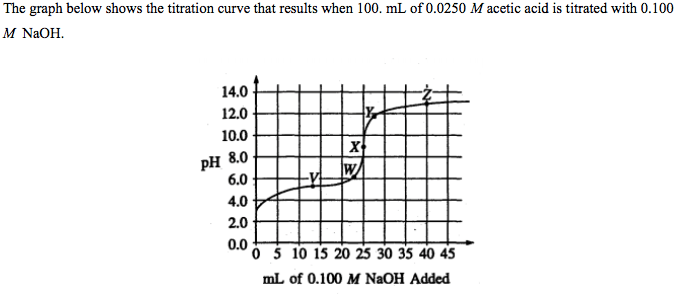
What part of the curve corresponds to the optimum buffer action for the acetic acid/acetate ion pair?
Point V
Point Z
Along all of section WY
Along all of section YZ
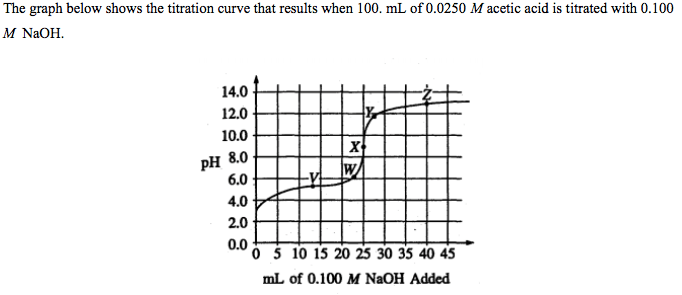
Which of the following indicators is the best choice for this titration?
Methyl orange (pH range of color change is 3.2 - 4.4)
Methyl red (pH range of color change is 4.8 - 6.0)
Bromothymol blue (pH range of color change is 6.1 - 7.6)
Phenolphthalein (pH range of color change is 8.2 - 10.0)

Which of the following best approximates the Ka value for this weak acid?
1 x 10⁻³
1 x 10⁻⁴
1 x 10⁻⁵
1 x 10⁻⁶
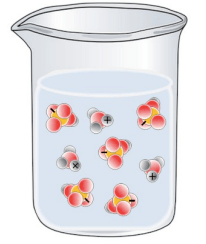
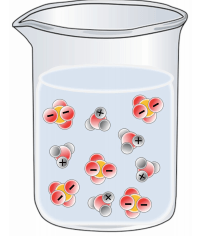
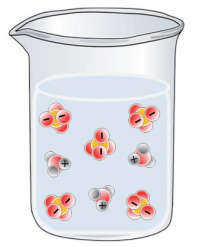
Which of the following best represents a 0.100-molar solution of H2SO4 in water?
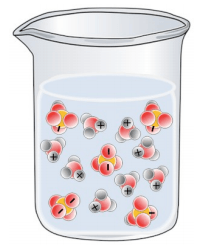
Mixtures that would be considered buffers include which of the following?
0.10 M HCl + 0.10 M NaCl
0.10 M HF + 0.10 M NaF
0.10 M HBr + 0.10 M NaBr
0.10 M HI + 0.10 M NaI
What is the role of an indicator in a reaction?
To help reactants react successfully.
To bind to the analyte to form a products.
To show when the reaction has reached or past the equivalence point.
To provide a surface for the reaction to occur.

The buffer solution is able to maintain pH by some events, except . . .
The addition of a little acid
The addition of a little base
Dilution
Addition of water
The addition of excess acid
The following mixture of solutions that form a buffer solution is . . .
50 mL CH3COOH 0.2 M and 50 mL NaOH 0.1 M
50 mL CH3COOH 0.2 M and 100 mL NaOH 0.1 M
50 mL HCl 0.2 M and 100 mL NH4OH 0.1 M
50 mL HCl 0.2 M and 50 mL NH4OH 0.1 M
50 mL HCl 0.2 M and 100 mL NaOH 0.1 M


What statements CAN BE TRUE about acidic buffer?
(you may choose more than one answer)
It's made of a mixture of weak acid and salt of its conjugate base
Concentration of H+ ions in acidic buffer is greater than concentration of OH- ions which is present in the solution
Dilution of buffer by adding small amount of water doesn't change the pH of buffer solution
acidic buffer usually works effectively at pH range of above 7
What statement is true about basic buffer?
basic buffer usually works effectively at pH range of above 7
It's made of a mixture of strong base and salt of its conjugate acid
adding small amount of strong acid to the solution of basic buffer can significantly alter the pH of the buffer solution
diluting solution of basic buffer cause pH of that solution to change drastically
a buffer solution is made of mixture of aqueous methanoic acid, HCOOH, with aqueous sodium methanoate, NaHCOO.
the equilibrium reaction takes place in buffer solution is :
HCOOH ↔ HCOO- + H+
small amount of NaOH is then added to that buffer solution.
What reaction take places at the buffer solution to resist change of pH caused by addition of base?
HCOOH + H+ → HCOOH2
HCOO- + H+ → HCOOH
HCOOH + OH- → HCOO- + H2O
HCOO- + OH- → COO2- + H2O
a buffer solution is made of mixture of aqueous ethanoic acid, CH3COOH, with aqueous potassium ethanoate, KCH3COO.
the equilibrium reaction takes place in buffer solution is :
CH3COOH ↔ CH3COO- + H+
small amount of HCl is then added to that buffer solution.
What reaction take places at the buffer solution to resist change of pH caused by addition of acid?
CH3COO- + H+ → CH3COOH
CH3COO- + OH- → CH2COO2- + H2O
CH3COOH + H+ → CH3COOH2
CH3COOH + OH- → CH3COO- + H2O
a buffer solution is made by mixing HA, a weak acid, with salts containing A- ions.
HA ↔ H+ + A-
a formula that can be used for the calculation of the pH of this buffer solution is


Equilibrium reaction of carbon dioxide (CO2) and hydrogencarbonate (HCO3-) ions in blood is one of the important buffer system that contribute to stabilise pH of the blood
CO2(aq) + H2O(l) ↔ H+(aq) + HCO3-
Which one take place on the buffer system when blood are slightly acidic than it would be normally ?
equilibrium of the buffer system shifts to the right
more hydrogencarbonate (HCO3-) ions are consumed in reaction with excess acid to produce more dissolved CO2
more dissolved CO2 are consumed from the blood to remove excess acid and produce more hydrogencarbonate (HCO3-) ions
No shift of the equilibrium take place on the buffer system