
 Worksheets
Week 1 - Yr 9
Total questions: 76
Worksheet time: 2hrs 55mins

3 LiOH + H3PO4 →
What allows us to know when the end point has been reached?
Bubbles
Feels warm
indicator changing color
Turns to a solid
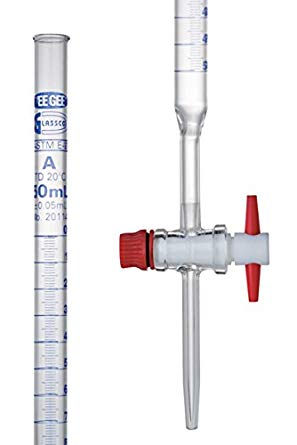
What is this piece of apparatus called
Pipette
Burette
Janette
Cuvette
What is the color of the light that potassium compounds give off?
Yellow-orange
Lavender (Violet)
Pinkish red
Green
Flame tests are most useful for
blood testing
watching fireworks
identification of elements
none of the above
What color flame does copper produce?
Lavender/Purple
Red/Orange
Green
Magenta
An unknown salt produces a red flame during in a flame test. What cation does it contain?
chloride
lithium
copper
calcium
A light blue precipitate formed when sodium hydroxide is added to an unknown solution indicates the presence of.....
barium
calcium
copper
iron(II)
A green precipitate formed when sodium hydroxide is added to an unknown solution indicates the presence of.....
iron(III)
calcium
copper
iron(II)
An orange-brown precipitate formed when sodium hydroxide is added to an unknown solution indicates the presence of.....
iron(III)
calcium
copper
iron(II)
Dilute sodium hydroxide can be added to an unknown solution to indicate the presence of....
iron(II)
iron(III)
copper
all of the above
Cations are ions with what kind of charge?
positive
negative
neutral
Ions are charged particles.
True
False
A pupil suspects an unknown salt contains ammonium NH4+ ions. They place some red litmus paper at the top of a test tube to test for ammonia gas but see no change. What steps did they forget for the test?
Add some sodium hydroxide solution
Heat the tube gently
Putting the red litmus paper into the solid
Nothing, the unknown salt must not have ammonium ions
An unknown salt produces an orange/yellow flame. What cation does it contain?
sodium
lithium
potassium
calcium
copper
A light blue precipitate formed (insoluble in excess) when sodium hydroxide is added to an unknown solution indicates the presence of.....
barium
calcium
copper
iron(II)
What is a positive test for a carbonate ion? (Choose all that apply)
limewater turns cloudy
limewater goes clear
A yellow precipitate is formed
Effervescence
Silver nitrate and nitric acid are used to test for....
metals
noble gases
halogens
metal oxides

A powder is placed into a bunsen burner flame. The colour of the flame is orange-yellow. The ion is
Na+
Li+
Cu2+
K+

Silver nitrate and Nitric acid were mixed with an unknown solution. A cream ppt formed. The formula of the ion present is
I-
Br+
Br-
Cl+

Silver nitrate and Nitric acid were mixed with an unknown solution. A yellow ppt formed. The formula of the ion present is
I2
I+
I-
Br-

KClO3 --> KCl + O2
2Na + Cl2 --> 2NaCl
6MgF2


reaction.

Which of the following 2 are chemical reactions?
sugar dissolving in water
water turning into steam
burning wood
mixing baking soda and vinegar
tearing paper
Which of the following 2 are chemical reactions?
sugar dissolving in water
water turning into steam
burning wood
mixing baking soda and vinegar
tearing paper
A chemical change is different than a physical change because in a chemical change
chemicals are used
molecules do not physically touch
a new substance is formed and in a physical no new substance is formed
the change can be seen but in a physical change it cannot

How many Carbons are present on the reactant side?
1
2
3
4

How many Hydrogens are on the product side of this chemical equation?
1
2
3
4

How many Oxygens are on the product side of this chemical equation?
1
2
3
4

Why are chemical equations always balanced? Select ALL that apply.
Matter cannot be created.
Matter cannot be destroyed.
Matter can only be rearranged/conserved.
Matter doesn't matter.

In a chemical reaction, if the reactants are heated, the reaction usually happens
slower
faster
at the same rate
in a smaller volume

Some chemical reactions require a substance called a catalyst. The purpose of a catalyst is
to warm up the reaction
to speed up the reaction
to create more reactants
to stop the reaction
What does it mean for a reaction to be exothermic? Choose 2 of the following.
When two substances react, the temperature of the mixture decreases.
When two substances react, the temperature of the mixture increases.
There is less energy going into the reactant to break the bond than there is energy leaving the product.
There is more energy going into the reactant to break the bond than there is energy leaving the product.
The amount of energy entering and leaving is the same.

Is this chemical equation balanced? Why or why not? Choose the BEST answer.
Yes, the amount of atoms for each element are equal on both the reactant and product side.
No, the carbons are not the same number on both the reactant and product side.
No, neither the carbons or hydrogens are the same amount on both the reactant and product side.
No, none of the elements (carbon, hydrogen, or oxygen) are the same amount on both the reactant and product side.
In a chemical reaction, no new atoms are created, and no atoms are destroyed.


__K + __Br2 --> __KBr
__HNO2 + __O2 --> __HNO3

