wayground logo

Free Printable Worksheets

Font size

S
M
L
XL
Worksheets

Practice Midterm Exam

Total questions: 84

Worksheet time: 1hrs 22mins

Name
Class
Date
1.

Changing the temperature of a gas has no effect on the volume of the gas.

a)

True

b)

False

2.

Pressure in a gas-filled container is caused by gas particles hitting the walls of the container.

a)

True

b)

False

3.

The elements to the right of the zigzag line on the periodic table are called.

a)

metals

b)

nonmetals

c)

metalloids

d)

transition metals

4.

Most metals are

a)

solid at room temperature

b)

bad conductors of electricity

c)

dull

d)

not malleable

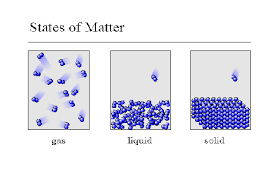
5.

10 m = _____ mm

a)

10,000 mm

b)

100 mm

c)

1 mm

d)

1,000 mm

6.

987 mm = _____ cm

a)

98.7 cm

b)

9,870 cm

c)

9.87 cm

d)

0.987 cm

7.

8,400 mL = _____ L

a)

840 L

b)

84 L

c)

0.84 L

d)

8.4 L

8.

345 cm = _____ m

a)

3.45 m

b)

0.345 m

c)

34.5 m

d)

3,450 m

9.

Look at this picture of Argon off the periodic table. Which of the following is true for this element?

a)

18 protons

b)

40 protons

c)

22 protons

d)

21.9 protons

10.

Look at this picture of Argon off the periodic table. Which of the following is true for this element when it is neutral?

a)

18 electrons

b)

40 electrons

c)

22 electrons

d)

21.9 electrons

11.

Look at this picture of Argon off the periodic table. Which of the following is true for this element?

a)

18 neutrons

b)

40 neutrons

c)

22 neutrons

d)

21.9 neutrons

12.

Which part of an atom is used to identify it?

a)

number of protons

b)

number of neutrons

c)

number of electrons

13.

When you two atoms with different masses, Carbon-12 and Carbon-13 for example, what type of atom do you have?

a)

Neutral atom

b)

Ion

c)

Isotope

14.

When you two isotopes of an atom, Carbon-12 and Carbon-13 for example, what has changed in the atomic structure?

a)

Number of protons

b)

Number of neutrons

c)

Number of electrons

15.

When you have an ion of an atom, O-2 for example, what has changed in the atomic structure?

a)

Number of protons

b)

Number of neutrons

c)

Number of electrons

16.
The mass of one proton is equal to the mass of one...
a)
neutron
b)
electron
17.
The two subatomic particles that make up the mass of the atom are the _____ and the _____.
a)
proton, neutron
b)
proton, electron
c)
neutron, electron
d)
electron, energy levels
18.
Which letter represents an electron?
a)
A
b)
B
c)
C
d)
D
19.
Which letter represents the electron cloud?
a)
A
b)
B
c)
D
d)
E
20.
Using your Periodic Table, identify the element that is represented by this model. 
a)
Beryllium
b)
Oxygen
c)
Fluorine
d)
Boron
21.
What is the atomic mass of the atom pictured? 
a)
9
b)
10
c)
18
d)
19
22.
What is the atomic number of the atom pictured? 
a)
9
b)
10
c)
18
d)
19
23.
What is the element name of the atom pictured? 
a)
Fluorine
b)
Neon
c)
Argon
d)
Potassium
24.

The table provided shows the masses and volumes of four rocks. Which rock has the greatest density?

a)

Rock 1

b)

Rock 2

c)

Rock 3

d)

Rock 4

25.

A piece of metal has a mass of 16.52 g and a volume of 2.26 cm 3 . Which set of data below correctly identifies the type of metal information by using the density equation?

a)

D = 16.52 g, M = 2.26 cm^3, V = D/M

b)

M = 16.52 g, D = 2.26 cm^3, V = M/D

c)

M = 16.52 g, V = 2.26 cm^3, D= M/V

d)

D = 16.52 g, V = 2.26 cm^3, M = D/V

26.

What is the density of 1 gallon of water?

a)

1 gallon

b)

1 g/mL

c)

1 g

d)

1 mL

27.

What is the density of 1 drop of water?

a)

1 drop

b)

1 g/mL

c)

1 g

d)

1 mL

28.

The provided table shows the properties of 3 different sample materials. One of these materials is cork, a type of wood that floats on water (density of water = 1.00 g/cm 3 ). What is the density of cork in g/cm 3 ?

a)

0.23 g/cm^3

b)

1.19 g/cm^3

c)

1.73 g/cm^3

29.

TRICKY QUESTION!!!


It’s really hot outside so Sanda decides to get a glass of ice water. What is MORE DENSE… the liquid water or the frozen water (ice cubes)? Why?

a)

The ice is more dense because it floats

b)

The water is more dense because the ice floats in it

c)

They have the same density because they are the same thing

30.

If a sample of an element has a mass of 27 g and a volume of 9 cm 3 , which of the following is the sample element?

a)

Gold

b)

Copper

c)

Aluminum

d)

Iron

31.

Mendeleev arranged the elements by

a)

density

b)

melting point

c)

appearance

d)

increasing atomic mass

32.

Which one of the following tells the physical state of an element at room temperature?

a)

the atomic number

b)

the color of the chemical symbol

c)

the atomic mass

d)

the element name

33.

The vertical column of elements on the periodic table is called a(n)

a)

period

b)

semiconductor

c)

atomic mass

d)

group

34.

How could you describe most metal?

a)

They are easily shattered

b)

They are bad conductors of electric current

c)

They are dull

d)

They can be drawn into thin wires

35.

What are the left to right rows on the periodic table?

a)

periods

b)

families

c)

properties

d)

groups

36.

The smallest particle into which an element can be divided and still be the same substance is called a(n)

a)

nucleus

b)

electron

c)

atom

d)

neutron

37.

What particle did JJ Thomson discover?

a)

neutron

b)

electron

c)

atom

d)

proton

38.

Where are electrons likely to be found?

a)

the nucleus

b)

electron clouds

c)

mixed throughout an atom

d)

paths, or energy levels

39.

An atom of Au (Gold) with 79 protons, 79 electrons and 118 neutrons would have a mass of ?

a)

39

b)

158

c)

197

d)

276

40.
How many neutrons would Fe-56 have?
a)
56
b)
26
c)
30
d)
33
41.
If an atom of nickel has a charge of +3, how many electrons does the atom have?
a)
28
b)
25
c)
26
d)
31
42.
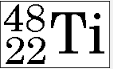
How many protons does this isotope of titanium have?
a)
48
b)
22
c)
26
d)
70
43.
How many neutrons does the isotope of lithium have?
a)
8
b)
3
c)
4
d)
5
44.
In a correctly written symbol what would be located in the "A" position?
a)
number of neutrons
b)
atomic number
c)
number of electrons 
d)
mass number
45.
How many neutrons does the isotope below have?     89 36Kr
a)
53
b)
36
c)
89
d)
125
46.

In a solid, the particles

a)

overcome the strong attraction between them

b)

vibrate in place

c)

slide past one another

d)

move independently of one another

47.

Crystalline solids

a)

include glass and rubber

b)

may also be liquids

c)

have particles that are not in a special arrangement

d)

have particles in a repeating pattern of rows

48.

A gas

a)

has a definite volume but no definite shape

b)

has a definite shape but no definite volume

c)

has fast-moving particles

d)

has particles that are always close together
49.
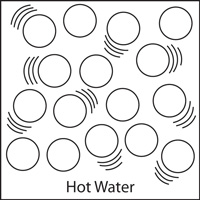
At higher temperatures
a)
particles in an object have less energy
b)
particles in an object move faster
c)
a gas contracts
50.
The speed of the molecules determines the _____.
a)
volume
b)
density
c)
pressure
d)
temperature
51.

Letter "C" represents which state of matter on the phase change diagram shown.

a)

Solid

b)

Liquid

c)

Gas

52.

Is energy being added or removed in the following phase change diagram?

a)

energy is being added

b)

energy is being removed

53.

Analyze the phase change diagram shown. Is energy being added or removed for this phase change diagram?

a)

Energy is being added

b)

Energy is being removed

54.
What two types of measurements make up DENSITY
a)
Mass and Volume
b)
Temperature and Mass
c)
Grams and Centimeters
d)
Volume and Weight
55.
Look at this image.  Which object has the LOWEST density in water? How
a)
The Ping Pong Ball because it floats to the top 
b)
The bolt because it has sunk to the bottom
c)
The soda cap because it is not just full of air like the Ping Pong ball
56.
Jack has a rock. The rock has a mass of 14g and a volume of 2cm3. What is the density of the rock?
a)
7 mL
b)
7 g/cm3
c)
28 g/cm3
d)
1/7 g/cm3
57.
Why do the liquids form different layers?
a)
They have different densities.  
b)
They have different masses.  
c)
They have different volumes.  
d)
They are different temperatures.  
58.
True or False: Gases can be compressed. 
a)
True
b)
False
59.
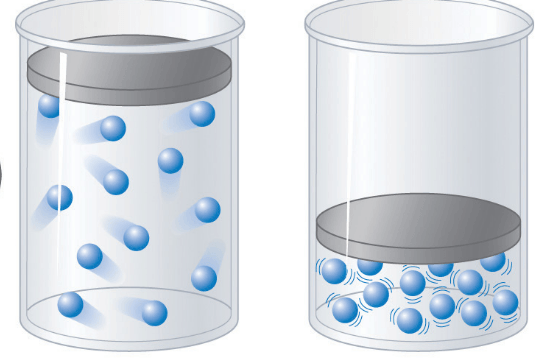
Which container will have a lower pressure?
a)
left
b)
right
c)
they both have the same pressure
d)
I don't know
60.

Boyle's' Law explains the relationship between volume and pressure for a fixed amount of

a)

a solid

b)

a liquid

c)

a gas

d)

any type of matter

61.
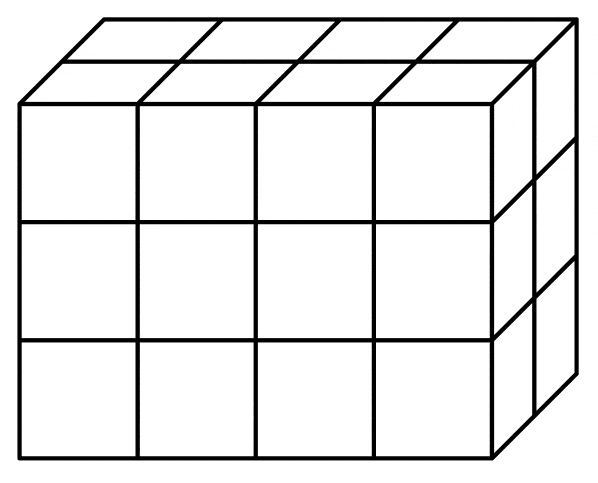
What is the volume of this rectangular prism?
a)
26 cubic units
b)
24 cubic units
c)
24 square units
d)
26 square units
62.
What is the volume of this rectangular prism?
a)
27 cubic units
b)
18 cubic units
c)
9 cubic units
d)
3 cubic units
63.
Which formula can be used to find the volume of a rectangular prism?
a)
length x width
b)
length x width x height
c)
height x length
d)
length + width + height
64.
Calculate the Volume
a)
84 cm3
b)
420 cm3
c)
60 cm3
d)
144 cm3
65.
A rectangular prism has a base of 15 cm2 and a height of 6 cm, what's it's volume?
a)
21 cm3
b)
9 cm3
c)
90 cm3
d)
75 cm2
66.

Which of the following statements is true about an object's weight but not its mass?

a)

It varies depending on location

b)

its a measure of the amount of matter in an object

c)

is measured in Kg or g

d)

same on the moon as it is on Earth

67.
Is water melting a physical or chemical change?
a)
Physical
b)
Chemical
68.
Is sour milk a physical or chemical change?
a)
Physical
b)
Chemical
69.
Is steam a physical or chemical change?
a)
Physical
b)
Chemical
70.
Is melting butter a physical or chemical change?
a)
Physical
b)
Chemical
71.

Which is a chemical property of matter?

a)

solubility

b)

volume

c)

density

d)

reactivity

72.

__________ is the amount of matter in an object. It does not change regardless of location

a)

Weight

b)

Mass

73.

______________ is how heavy an object is. It is determined by the pull of gravity

a)

Weight

b)

Mass

74.

We use a ________________ to measure the weight and mass of an object.

a)

Thermometer

b)

Scale/Balance Scale

c)

Clock

d)

Ruler/Yard Stick

75.

Which unit is most appropriate when measuring the weight of a paperclip?

a)

Ounces

b)

Pounds

c)

Grams

d)

Milligrams

76.
A scientist performs an experiment to see if acids have an effect on the health of a particular type of plant. Three sets of plants were treated with acidic solutions of known pH while the control set was treated with a solution of neutral pH 7.Which is the best conclusion for this experiment?
a)
Acid has no effect on the health of this type of plant.
b)
B. High acidity is helpful to this type of plant.
c)
C. Low acidity is harmful to this type of plant.
d)
High acidity is harmful to this type of plant.
77.
What is the first thing you do when performing the scientific method?
a)
Make a conclusion
b)
make an observation
c)
solve a problem
d)
experiment
78.
Why is it important to collect data?
a)
because
b)
it gives you busy work
c)
They are magically delicious
d)
in order to share your results with others
79.
What do you do after you come up with your hypothesis?
a)
Conclude
b)
Test your hypothesis
c)
Do a victory dance
d)
Tell your teacher
80.
What comes after your conclusion?
a)
reflect on your work
b)
make a hypothesis
c)
test your hypothesis
d)
make an observation
81.
An educated guess is
a)
an observation
b)
question
c)
hypothesis
d)
experiment
82.
This step should be done more than once to ensure accurate results. 
a)
Conduct an experiment
b)
conclude
c)
record data
d)
clean up after an investigation
83.

What does every scientific experiment begin with?

a)

a hypothesis

b)

a conclusion

c)

procedures

d)

a question or problem

84.
Why would we use the metric system?
a)
It's based on the number 10
b)
Scientists, engineers, and the rest of the world uses it
c)
We are not used to it.
d)
Both a & b