Wayground logo

Free Printable Worksheets

Font size

S
M
L
XL
Worksheets

Chemical Bonding and Nomenclature

Total questions: 40

Worksheet time: 38mins
Name
Class
Date
1.
What type of bond forms when electrons are transferred from one atom to another?
a)
ionic bond
b)
atomic bond
c)
covalent bond
d)
metallic bond
2.
The bond between Na & F.   Ionic or covalent?
a)
Ionic
b)
Covalent
3.
The bond between N & H.   Ionic or covalent?
a)
Ionic
b)
Covalent
4.
Which of the following gives the correct chemical formula for the compound Magnesium Phosphide?
a)
Mg2P3
b)
MgP
c)
Mg3P2
d)
MgP2
5.
Which of the following gives the correct chemical formula for the compound Dinitrogen Monoxide?
a)
NO
b)
N2O
c)
N2O2
d)
O2N2
6.
What is the correct chemical name for the ionic compound:  Na2O
a)
Sodium oxide
b)
Sodium (II) oxide
c)
Disodium monoxide
d)
Disodium oxide
7.
What is the correct chemical name for the ionic compound: Fe3N2
a)
Iron nitride
b)
Iron (III) nitride
c)
Iron (II) nitride
d)
TriIron dinitride
8.
What is the correct chemical name for the molecular compound:  CS2
a)
Carbon Sulfide
b)
Carbon diSulfide
c)
diCarbide diSulfide
d)
Carbon (II) Sulfide
9.
What is the correct chemical name for the ionic compound: CuS
a)
copper sulfide
b)
copper (I) sulfide
c)
copper (II) sulfide
d)
copper monosulfide
10.
What is the correct chemical name for the molecular compound:  SF4
a)
Sulfur Fluoride
b)
Sulfur TetraFluoride
c)
TetraSulfide Fluoride
d)
Sulfur (IV) Fluoride
11.
What type of atoms make a covalent bond?
a)
only Nonmetals
b)
Metal and a Nonmetal
c)
only Metals
d)
only Noble Gases
12.
Ionic bonds are between...
a)
Metal and Non-metal
b)
Non-metal and Non-metal
c)
Metal and Metal
13.
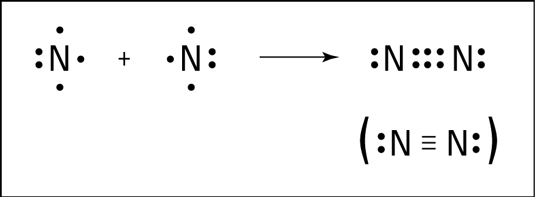
Given the picture, what type of bond is  holding the atoms together in this molecule?
a)
polar covalent bond
b)
nonpolar covalent bond
c)
ionic bond
d)
metallic bond
14.
Which of the following gives the correct chemical formula for the compound Dinitrogen Monoxide?
a)
NO
b)
N2O
c)
N2O2
d)
O2N2
15.
What is the chemical formula when Al+3  and   PO4-3 bond?
a)
Al(PO3)4
b)
AlPO4
c)
Al(PO4)3
d)
Al3(PO4)3
16.
Co+2  combines with NO2-  to form
a)
Co2(NO2)
b)
Co(NO2)2
c)
NO(Co)2
d)
Co(NO)3
17.
A(n) _________ is an ion with a positive (+) charge.
a)
anion
b)
cation
c)
ion
d)
solute
18.
Magnesium bromide is an ionic compound with the chemical formula MgBr₂.  What does the "2" tell you?
a)
There are 2 bromide ions for every magnesium ion
b)
Bromide has a 2- charge
c)
Bromide has a 2+ charge
d)
There are 2 magnesium ions to every bromide ion
19.
In the chemical formula for an ionic compound, which item is written first?
a)
positive ion
b)
negative ion
c)
subscript
d)
the female
20.
Elements in Group 1 lose one electron to form ions with a _________________ charge.
a)
1+
b)
2+
c)
0
d)
1-
21.
A charged particle that has gained at least one electron is called a(n) _____.
a)
Anion
b)
Cation
c)
Anonion
d)
chemistry cat
22.
What is the formula of Sodium oxide?
a)
Na2O
b)
NaO2
c)
Na2O2
d)
Na2O
23.
A Nitrogen molecule (N2) has one triple bond. How many electrons do the nitrogen atoms share?
a)
1
1
b)
3
c)
4
d)
6
24.
How do covalent bonds form?
a)
Donating & receiving valence e- between atoms.
b)
Opposite slight charges attract each other between compounds.
c)
Scientists are still not sure how they form.
d)
Sharing valence e- between atoms.
25.
Which of the following is NOT formed by a covalent bond?
a)
K2S
b)
H2O
c)
I2
d)
CO2
26.
The name of Mg₃N₂ is
a)
manganese nitride
b)
magnesium nitride
c)
magnesium (III) nitride
d)
trimagnesium dinitride
27.
When adding a subscript to a polyatomic ion, you should...
a)
multiply any subscripts on the polyatomic ion by the subscript you are adding
b)
put parentheses around the polyatomic ion before adding a subscript
c)
write the new subscript next to any subscripts on the polyatomic ion
d)
put the polyatomic ion in square brackets before adding the subscript
28.

What is the formula for calcium carbonate?

a)

Ca3(CO2)

b)

Ca(CO)2

c)

Ca(CO3)

d)

Ca2(CO3)2

29.

What is the formula for Lead (II) phosphate?

a)

Pb2(PO3)4

b)

Pb3(PO4)2

c)

Pb2PO4

d)

Pb3P

30.
The chemical formula of sulfur hexabromide is
a)
SBr₆
b)
S₆Br
c)
S(VI)Br
d)
S6Br
31.

Potassium chlorate has the formula

a)

KCl

b)

K(ClO)

c)

K(ClO2)

d)

K(ClO3)

e)

K(ClO4)

32.

The substance (ClO3)– is best described as

a)

a molecule

b)

a polyatomic ion

c)

a polyatomic molecule

d)

a mixture

33.

The name for Al(OH)3 is

a)

aluminum(III) hydroxide

b)

aluminum trihydroxide

c)

aluminum hydroxide

d)

monaluminum trihydroxide

e)

aluminum(I) hydroxide

34.

Titanium(IV) oxide has the formula

a)

Ti4O

b)

TiO4

c)

Ti(IV)O

d)

TiO2

e)

Ti4O2

35.

The correct name for P2O5 is

a)

phosphorus(II) oxide

b)

phosphorus(V) oxide

c)

diphosphorus oxide

d)

diphosphorus pentoxide

e)

phosphorus pentoxide

36.

Given that "Du" and "J" are imaginary nonmetals named dudium and jinxy, respectively. Name this covalent compound: Du3J

a)

tridudium monjinxy

b)

trijinxy monodudium

c)

tridudium jinxy

d)

dudium trijinxy

37.

Imaginary element "Z" can form the same ions as ruthenium (+3 or +4). Imaginary element "Yo" has the same charge as sulfide. Which is a possible formula of this ionic compound?

a)

Yo2Z3

b)

Z2Yo3

c)

Z3Yo

d)

ZYo4

38.

Imaginary element "Q" has the same charge as nitrogen and imaginary element "Ax" has the same charge as strontium. What is the correct chemical formula for this ionic compound?

a)

Ax2Q

b)

QAx

c)

Ax3Q2

d)

Q3Ax2

39.
Why do elements bond?
a)
To be friends
b)
To create a new element
c)
To become stable
40.

How many Aluminum atoms are in Al2O3?

a)

3

b)

5

c)

2

d)

1