wayground logo

Free Printable Worksheets

Font size

S
M
L
XL
Worksheets

Cells CSA

Total questions: 40

Worksheet time: 31mins

Name
Class
Date
1.
Which of the following are NOT found in animal cells
a)
chloroplasts and cytoplasm
b)
chloroplasts and cell wall
c)
cell wall and cell membrane
d)
mitochondria and nucleus
2.

Which of the following converts food into energy for the cell?

a)

vacuole

b)

mitochondria

c)

cytoplasm

d)

cell membrane

3.
What do vacuoles do? 
a)
They actually do not have an important role
b)
They protect the cell
c)
They are the brain of the cell
d)
storage area for cells; water storage in plants 
4.
Who was the first  person to see cells under the microscope and give them their name?
a)
Mattias Schleiden
b)
Robert Hooke
c)
Theordor Schwann
d)
Anton van Leeuwenhoek
5.
He discovered that all plants are made of cells:
a)
Anton van Leeuwenhoek
b)
Theordor Schwann
c)
Robert Hooke
d)
Mattias Schleiden
6.
Which of the following is not part of the cell theory?
a)
cells must contain DNA 
b)
all living things are made from cells
c)
cells can only come from other cells
d)
cells are the basic unit of life
7.

What type of cell lacks a nucleus?

a)

eukaryotic

b)

prokaryotic

c)

human

d)

animal

8.

A cell in which the genetic material is enclosed within a nucleus is a

a)

eukaryotic cell

b)

prokaryotic cell

c)

human cell

d)

animal cell

9.
Endocytosis is defined as
a)
the movement of large molecules from the inside of the cell to the outisde of the cell using channel proteins. 
b)
the movement of large molecules from the inside of the cell to the outisde of the cell membrane vesciles. 
c)
 the movement of large molecules from the outside of the cell to the inside of the cell using membrane vesciles.
d)
the movement of large molecules from the outside of the cell to the inside of the cell using channel proteins. 
10.
Exocytosis is the movement of
a)
any type of substance from outside the cell to the inside of the cell. 
b)
very large substances from outside the cell to the inside of the cell. 
c)
any type of substance from inside the cell to the outside.
d)
very large substances from inside the cell to the outside.
11.
Active transport _______ and is the movement of a substance from _____ to _____ concentration
a)
requires energy, high to low
b)
requires no energy, low to high
c)
 requires no energy, high to low
d)
 requires energy, low to high
12.
Passive transport
a)
 always occurs slowly
b)
 does not require energy
c)
requires energy
13.
In this image, the cell is using which type of molecular transport?
a)
Osmosis
b)
Diffusion 
c)
Endocytosis
d)
Exocytosis 
14.
Large particles being encased in a vesicle and brought into the cell.
a)
endocytosis
b)
exocytosis
c)
passive transport
d)
active transport
15.
Moving particles while using a cell's energy
a)
Osmosis
b)
Diffusion
c)
Photosynthesis
d)
Active Transport
16.
What is the term that means "a condition in which the concentration of a substance is equal throughout a space"?
a)
equilibrium
b)
exocytosis
c)
endocytosis
d)
phospholipid
17.
Which of the following is not a type of passive transport?
a)
Osmosis
b)
Diffusion
c)
Endocytosis
d)
Facilitated Diffusion
18.
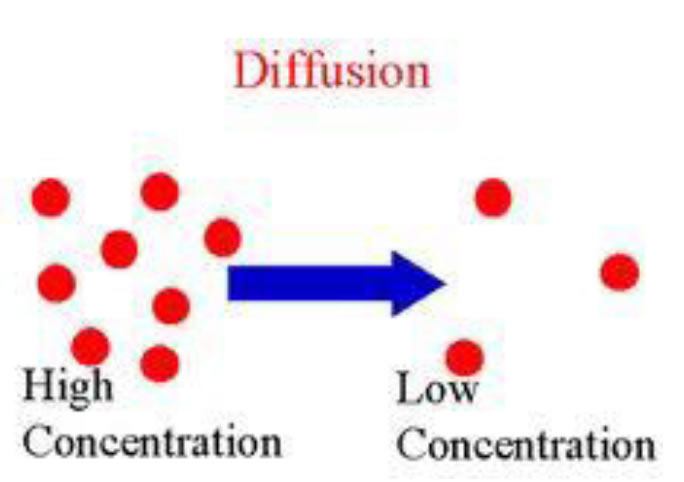
The movement of molecules from an area of HIGHer Concentration TO an area of LOWer Concentration
a)
Diffusion
b)
Osmosis
c)
High Low
d)
Alay wa?
19.
Movement of particles from high to low concentration. 
a)
Passive Transport
b)
Active Transport
20.
Osmosis is the movement of _____ across a membrane.
a)
food
b)
energy
c)
oxygen
d)
water
21.
The cell below is in a _________ solution.
a)
Hypotonic
b)
Hypertonic
c)
Isotonic
22.
The cell below is in a _____________ solution.
a)
Hypertonic
b)
Hypotonic
c)
Isotonic
23.
A cell in an isotonic solution will
a)
swell
b)
shrink
c)
stay the same size
d)
impossible to tell
24.
Something is ___________ ____________
when some molecules can cross the membrane while others cannot. 
a)
Selectively (or Semi) Permeable 
b)
Totally Transparent
c)
Liquid Licorice 
d)
Heavily Patrolled 
25.
What three substances make up the cell membrane?
a)
lipids, starches, nucleic acids
b)
lipids, fats, sugars
c)
lipids, sugars, proteins
d)
lipids, proteins, carbohydrates
26.

What type of microscope requires light passing through a specimen?

a)

TEM

b)

Light

c)

SEM

d)

NBA

27.
Which microscope has a magnification range between 40X-1000X?
a)
Compound Light
b)
Transmission Electron
c)
Dissecting
d)
Scanning Electron
28.
Which microscope would you use to see a bed bug in 3D, with a magnification of about 500,000X?
a)
Compound Light
b)
Scanning Electron
c)
Dissecting
d)
Transmission Electron
29.
Which electron microscope provides details of a cell's internal structures?
a)
Scanning Electron Microscope (SEM)
b)
Transmission Electron Microscope (TEM)
c)
Light Microscope
d)
Dissecting Microscope
30.
Which microscope took a 3D image of this fly's head?
a)
Compound Light
b)
Transmission Electron
c)
Dissecting
d)
Scanning Electron
31.

What is a group of cells that are alike and work together?

a)

a cell team

b)

a tissue

c)

a cell family

32.

A group of tissues that work together is a(n) ______________________.

a)

cell

b)

organ

c)

organ system

33.

Organs that work together are part of a(n) ________________________.

a)

cells

b)

tissue

c)

organ system

34.

A specialized cell is a cell that has ...

a)

the ability to divide

b)

a specific role to do

c)

no specific function in the bod

35.

Microscopes can be used to explore cells. Which of the following types of microscopes can produce a three-dimensional image of the surface of a cell?

a)

simple light microscope

b)

compound light microscope

c)

scanning electron microscope

d)

transmission electron microscope

36.

All cells contain cell membranes. Which of the following describes the composition of cell membranes?

a)

Cell membranes are composed of carbohydrate chains, which allow all materials to enter and leave the cell.

b)

Cell membranes are composed of cellulose, which provide rigidity for the cell.

c)

Cell membranes are composed of cytoplasm, which allows proteins to be excreted by the cell.

d)

Cell membranes are composed of lipid molecules, which provide a flexible structure.

37.

In eukaryotic cells, a number of organelles allow the cell to produce and distribute proteins. Where are proteins modified, sorted, and packaged?

a)

Golgi apparatus

b)

ribosome

c)

rough endoplasmic reticulum

d)

smooth endoplasmic reticulum

38.

Which are examples of active transport across the cell membrane?

a)

osmosis and diffusion

b)

diffusion and facilitated diffusion

c)

osmosis and chemiosmosis

d)

endocytosis and exocytosis

39.

The pancreas produces enzymes that aid in digestion. By what process are these digestive enzymes excreted from pancreas cells?

a)

osmosis

b)

exocytosis

c)

endocytosis

d)

diffusion

40.

Which organelles allow plants to support heavy structures such as leaves and flowers?

a)

the cell membranes because they regulate what enters and leaves the cells

b)

the vacuoles because they are filled with fluid, which provide rigidity

c)

the chloroplasts because they convert sunlight into chemical energy

d)

the Golgi apparatus because it packages proteins for storage in the cells