wayground logo

Free Printable Worksheets

NEW

Font size

S
M
L
XL
Worksheets

Reflection and Refraction

Total questions: 45

Worksheet time: 30mins
Name
Class
Date
1.

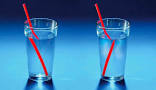
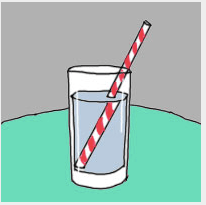
Why does the straw appear to be bent?

a)

light is reflected

b)

light is absorbed

c)

light is turned

d)

light is refracted

2.

What do we call a material that light can travel through?

a)

air

b)

water

c)

medium

d)

pathway

3.
What is a repeating disturbance or vibration that transfers or moves energy from place to place?  
a)
Medium
b)
Wave
c)
Compression
d)
Rarefaction
4.
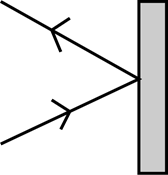
The illustration shows a light ray striking an object.
In the illustration, the light ray striking the object is-
a)
absorbed
b)
stopped
c)
reflected
d)
refracted
5.
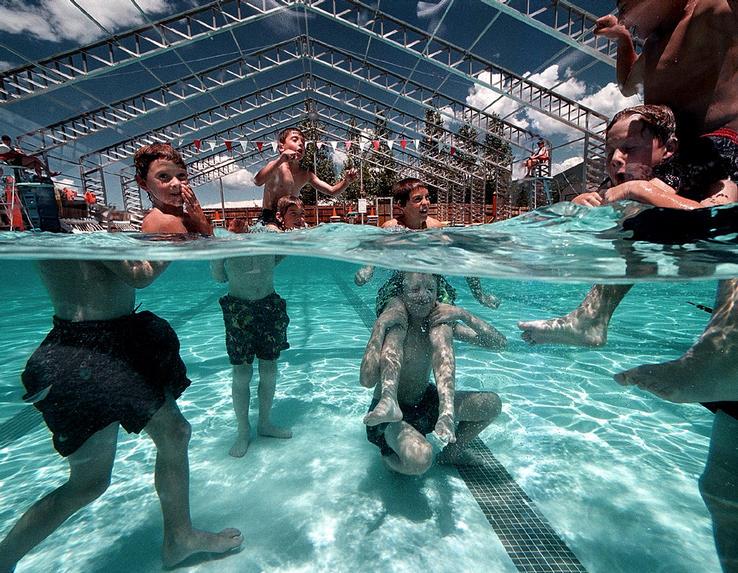
Why does the lower part of the child appear so much different in size from the upper part?
a)
The light rays that travel through water and then into air are refracted.
b)
The light rays that travel through water and then into air are enlarged.
c)
The light rays that travel through air and then into water are reflected.
d)
The light rays that travel through air and then into water are reduced.
6.

What is the angle of reflection equal to?

a)

The angle of refraction

b)

The angle of incidence

c)

The angle of absorption

d)

The angle of light

7.

What might explain why light travels in a straight line?

a)

If there is nothing to interfere with light waves, they should travel in a straight line.

b)

Light waves will always travel in a straight line, even if they come into contact with another object.

c)

Light waves don't travel in a straight line.

d)

Light waves travel in a straight line because sound waves travel in a straight line.

8.

What is the angle of incidence?

a)

The angle at which light bends in water.

b)

The angle at which light hits a surface.

c)

The angle at which light is absorbed by an object.

d)

The angle at which light bounces off a surface.
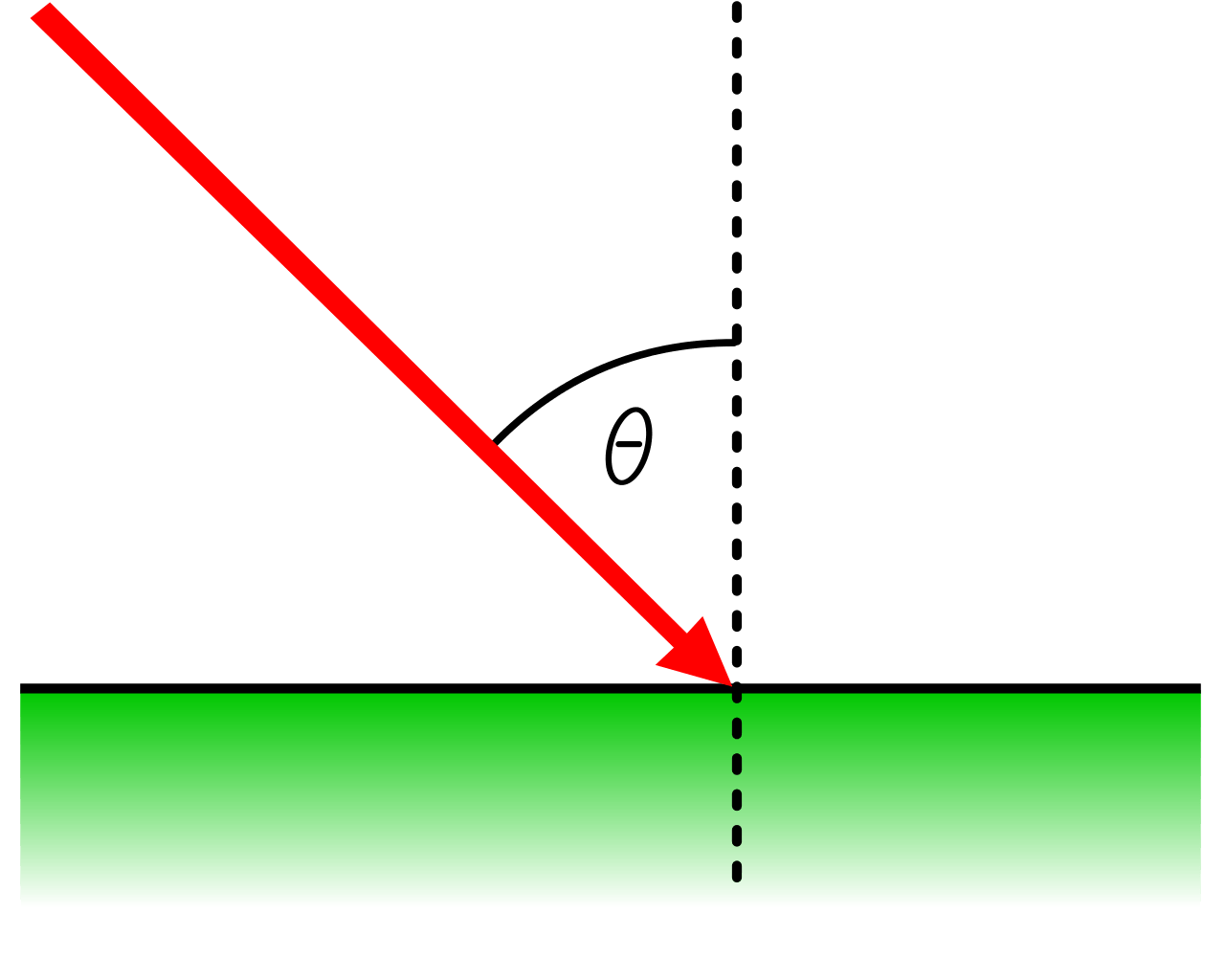
9.
According to the Law of reflection, a light ray striking a mirror
a)
continues moving through the mirror in the same direction
b)
moves into the mirror at a slightly different angle
c)
bounces off the mirror toward the direction it came from
d)
bounces off the mirror at the same angle it hits.
10.
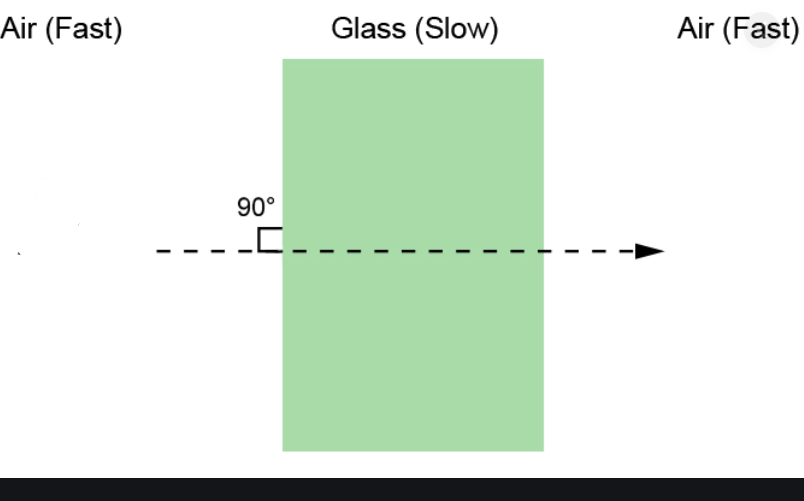
Glass has a _____________ index of refraction than air.
a)
Equal
b)
Greater
c)
Less
d)
Impossible to say
11.

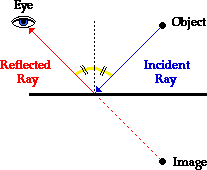
What is the angle of reflection (θr) in the image?

a)

56o

b)

90o

c)

124o

d)

34o

12.
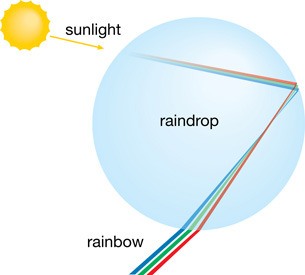
Light bending as it passes through a rain drop is an example of...
a)
Refraction
b)
Reflection
13.

A beam of light bends when it passes from air into water, and more when it passes from water into glass. What can you conclude from this fact?

a)

Air is denser than glass

b)

Water is denser than glass

c)

Glass is denser than water

d)

Air is denser than water

14.

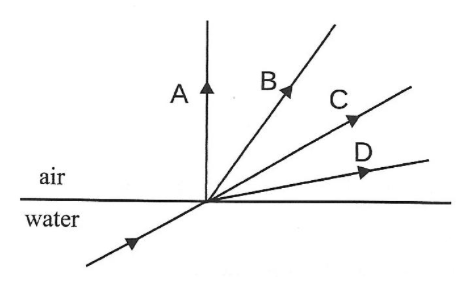
A light ray is incident from water to air. Which of the refracted rays is correct?

a)

A

b)

B

c)

C

d)

D

15.

The line 90 degress through the refracting or reflecting surface is called?

a)

Medium

b)

Normal

c)

Incidence

d)

Reflection

16.

Reflection is when light...

a)

Bends

b)

Bounces

c)

Absorbs

d)

transmits

17.

Refraction is when light...

a)

Bounces

b)

Transmits

c)

Bends

d)

Absorbs

18.

___________ travels in a straight line until something changes its path

a)

Medium

b)

Refract

c)

Reflect

d)

Light

19.

What is happening in this picture?

a)

Reflection

b)

Refraction

20.

What is happening in this picture?

a)

Reflection

b)

Refraction

21.

Which word best describes how light reacts when passing from air through water?

a)

refraction

b)

reflection

c)

reconstroction

d)

retraction

22.
Refraction is the bending of a wave disturbance as it passes from one _________ into another.
a)
glass
b)
medium
c)
area
d)
boundary
23.

When light hits an area and bounces back it is called:

a)

echo

b)

refraction

c)

reflection

d)

absorbing

24.

Light travels through air, water, glass and many other materials. What path does it travel to get from one place to another?

a)

sideways

b)

back and forth

c)

straight

d)

up and down

25.
soak up
a)
absorb
b)
reflect
c)
refract
26.
All waves carry
a)
energy
b)
light 
c)
matter
d)
particles
27.
Why would a wave change direction?
a)
Because it kept traveling through the same medium
b)
Because it went from one medium to another
c)
the amplitude was too large
d)
the frequency was too small
28.
What particles make up light?
a)
Photons
b)
Neutrons
c)
Protons
29.
Light behaves like both a particle and a ______.
a)
Mass
b)
Wave
c)
Current
30.
What color has the shortest wavelength, or the highest frequency?
a)
yellow
b)
blue
c)
red
d)
violet
31.
The full spectrum of light energy is called the__________
a)
broad spectrum
b)
electromagnetic spectrum
c)
helium spectrum 
d)
natural light spectrum
32.

What is the earth's primary source of light energy?

a)

moon

b)

sun

c)

waves

d)

fire

33.
EM waves have the same speed but different:
a)
frequency & medium 
b)
wavelength & frequency
c)
medium & wavelength
d)
color & medium
34.
When the surface of a mirror curves inward, like the inside of a bowl, it is called a
a)
Plane Mirror
b)
Convex Mirror
c)
Concave Mirror
d)
Diffuse Mirror
35.
The point where the rays meet is known as....
a)
Fire
b)
the focal point
c)
refraction
d)
Plane of the lens
36.

When light waves move from passing through air to passing through a glass lens when happens to them?

a)

They slow down and change direction

b)

They speed up and change direction

c)

They maintain the same speed and change direction

d)

They maintain their same speed and direction

37.
What does the word "converging" mean?
a)
to separate
b)
to come together
c)
parallel 
d)
perpendicular
38.
What does the word "diverging" mean?
a)
to spread apart
b)
to come together
c)
parallel
d)
perpendicular
39.
Which part is the colorful part of the eye?
a)
pupil
b)
iris
c)
cornea
d)
eyeball
40.

If you were to accidentally scratch the outermost part of your eye, which part would you damage?

a)

The cornea

b)

The lens

c)

The retina

d)

The pupil

41.

What do the lens and cornea have in common?

a)

They both send messages to the brain.

b)

They can both change shape.

c)

They both contain photoreceptive cells.

d)

They both bend light into a focused beam.

42.

Order the following: A) The optic nerve transmits signals; B) An image is projected onto the retina; C) Rods and cones transform an image into electrical impulses

a)

B, A, C

b)

C, A, B

c)

A, C, B

d)

B, C, A

43.

What role does your brain play in the process of seeing?

a)

It puts blurry images into focus.

b)

It turns black-and-white images into color.

c)

It flips upside-down images rightside-up.

d)

It flips backwards images over so you see them the correct way.

44.
 ________ are light-sensitive cells in the retina that show the colors black and white. 
a)
Cones
b)
Rods 
c)
Bars
d)
Corneas 
45.
 ________ are light-sensitive cells in the retina that help us see color.
a)
 Rods 
b)
Cones 
c)
Image 
d)
Bars