
NEW
Font size
 Worksheets
PS Study Module 6 Quizizz
Total questions: 50
Worksheet time: 37mins
What reaction has the following general formula:
AB --> A + B
Combination
Decomposition
Single Replacement
Double Replacement
Combustion
What reaction has the following general formula:
AB + CD --> CB + AD
Combination
Decomposition
Single Replacement
Double Replacement
Combustion
What reaction has the following general formula:
A + B --> AB
Combination
Decomposition
Single Replacement
Double Replacement
Combustion
What reaction has the following general formula:
CxHy + O2 −>CO2 + H2O
Combination
Decomposition
Single Replacement
Double Replacement
Combustion
What is the general reaction scheme for a single replacement reaction?
A + B --> AB
AB --> A + B
A + CD --> C + AD
AB + CD --> CB + AD
CxHy+O2 −> CO2+H2O
What is the general reaction scheme for a combination reaction?
A + B --> AB
AB --> A + B
A + CD --> C + AD
AB + CD --> CB + AD
CxHy+O2 −> CO2+H2O
What reaction has the following general formula:
A + CD --> C + AD
Combination
Decomposition
Single Replacement
Double Replacement
Combustion
What is the general reaction scheme for a double replacement reaction?
A + B --> AB
AB --> A + B
A + CD --> C + AD
AB + CD --> CB + AD
CxHy+O2 −> CO2+H2O
What is the general reaction scheme for a decomposition reaction?
A + B --> AB
AB --> A + B
A + CD --> C + AD
AB + CD --> CB + AD
CxHy+O2 −> CO2+H2O
What is the formula for sodium bromide?
NaBr
NaBr2
Na2Br
SoBr
What is the formula for diphosphorus pentoxide?
P2O5
PO5
P5O2
Po2O5

What is the name for BrO3?
bromine oxide
monobromine trioxide
bromine trioxide
bromide trioxide
What is the chemical formula for an ionic compound of potassium and oxygen?
KO
K2O
K2O2
KO2
Which of the following is NOT an ionic compound:
CaO
Na2O
BaCl2
Br2
An ionic compound forms between a _______ and _______.
metal and non-metal
two metals
two non-metals
Ionic bonds are made up of
metals
2 nonmetals
a metal and a nonmetal
none of these
Covalent bonds are made up of
metals
2 nonmetals
a metal and a nonmetal
none of these
A metallic bond is made up of
metals
2 nonmetals
a metal and a nonmetal
none of these
A cation is a ________________ ion.
positive
negative
neutral
An anion is a ________________ ion.
positive
negative
neutral
Which type of bond has a high melting/boiling point, does not conduct electricity as a solid, does conduct electricity as a liquid, is brittle, and is usually white.
Ionic bond
Covalent bond
Metallic bond
Which type of bond is a good conductor of electricity as a solid and a liquid, is malleable, ductile, has high tensile strength, and is lustrous.
Ionic bond
Covalent bond
Metallic Bond
Which type of bond is always a poor conductor of electricity, has a low melting/boiling point, and can be a solid, liquid, or gas at room temperature?
Ionic bond
Covalent bond
Metallic bond
2 atoms share 1 pair of electrons
single bond
double bond
triple bond
ionic bond
2 atoms share 2 pairs of electrons
single bond
double bond
triple bond
ionic bond
2 atoms share 3 pairs of electrons
single bond
double bond
triple bond
ionic bond
2 atoms do NOT share electrons, but transfer electrons from one atom to the other
single bond
double bond
triple bond
ionic bond
Cations are positive because they ___________ electrons.
gain
lose
none of these
Anions are negative because they ____________ electrons.
gain
lose
none of these
An alloy is a mixture of ____________.
ions
nonmetals
metals
none of these
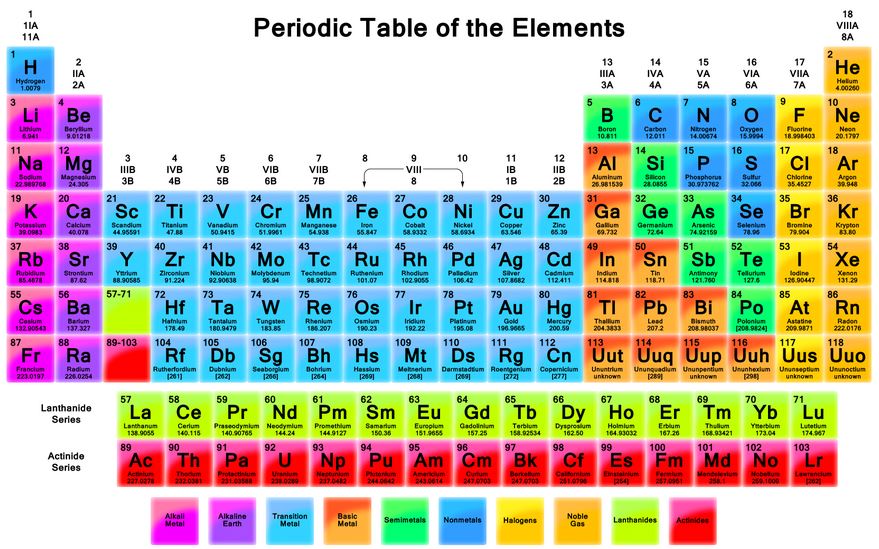
The chemical bond between a non-metal and another non-metal will be a ________ bond.
metal
ionic
covalent
polar
The chemical bond between a metal and a non-metal will be a _____ bond.
metal
ionic
covalent
polar
Nitrogen and Oxygen will make a ____________ bond
ionic
covalent
metallic
Sodium and Bromine will make a _____ bond.
ionic
covalent
metallic
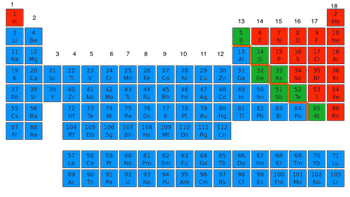
What color shows where metals are located on the periodic table?
blue
green
red
the colors do not indicate metals
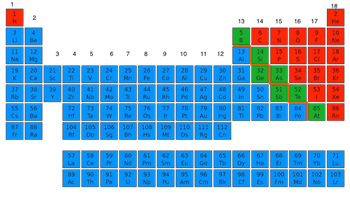
What color indicates the nonmetals?
blue
red
green
the colors do not indicate nonmetals

