Worksheets
Taxonomy Review
Total questions: 50
Worksheet time: 1hrs 7mins
Two different species of reptile would be most related if they share which level of classification?
Domain
Phylum
Family
Class
When writing an organism's scientific name, what is the correct order?
Genus first, species second
Species first, genus second
Domain first, species second
Species first, kingdom second

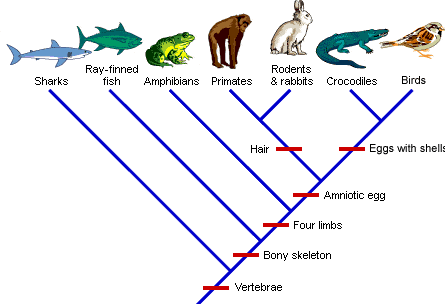
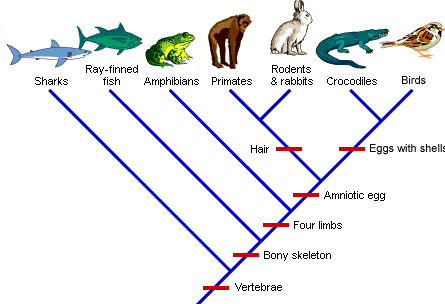
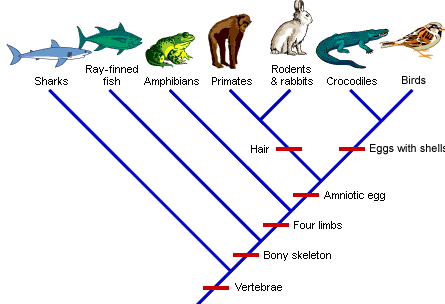
Which organism is most closely related to the rodents & rabbits?
primates
amphibians
crocodiles
sharks
Which of the following levels is the largest?
Phylum
Class
Family
Species
Which of the following is a grizzly bear's correct scientific name?
Ursus Arctos
ursus arctos
Ursus arctos
Ursus arctos
A cladogram shows...
relatedness between organisms
genetic material differences
the parents/family of organism
geographic distribution of organisms
Which of the following does NOT belong in the domain Eukarya?
Bacteria
Animals
Plants
Fungi
Clostridium tetani is a type of bacteria that causes tetanus. Which of the following organisms is most closely related to this bacteria?
Tetanus tocani
Clostridium botulinum
Streptobacillus clostridium
None of the choices
How can you tell two organisms are closely related?
The organisms share more levels of classification in common
The organisms share fewer levels of classification in common

According to this chart, which two organisms are most closely related?
Snail and triceratops
Human and snail
Human and triceratops
None are related to each other

According to the dichotomous key below, what is the name of the pink creature?
1a. mouth open………….go to 2
1b. mouth not open……..go to 4
2a. Arms…………………….go to 3
2b. No arms….Alienus quadlegicus
3a. Hairy……………..Alienus haircus
3b. Not hairy…..Alienus tritoothicus
4a. No horns………………..go to 5
4b. Horns…………...Alienus stripicus
5a. No legs…….…..Alienus biobicus
5b. Legs………………Alienus fuzzicus
Alienus quadalegicus
Alienus tritoothicus
Alienus stripicus
Alienus fuzzicis
Which of the following domains contain organisms that have nucleus and other membrane bound organelles?
Bacteria
Archae
Eukarya
Domain

Which of the following is the most recent common ancestor of a Hippo and Whale?
A
B
C
D
E

Which of the following organisms is least related to the crocodile?
Sharks
Amphibians
Rodents
Birds

According to this chart, which two organisms are most closely related?
Cat and Wolf
Cat and Fly
Wolf and Fly


Which organisms pictured on the cladogram are tetrapods?
prosimians only
prosimians, humans, birds, and amphibians
humans, fish, and insects
prosimians, fish, and insects
The 2 kingdoms that make up Prokaryotes are?
Animals and Plants
Protists and Fungi
Archea and Bacteria
Protists and Plants
What kingdom's organisms often live in super harsh environments?
Archeabacteria
Animalia
Eubacteria
Protista
I am prokaryotic, cause diseases, and can be found everywhere. What kingdom do I belong in?
Plantae
Animalia
Eubacteria
Archaebacteria
Scientists around the world use a standardized taxonomic system. Why would scientists want to use a taxonomic system that is standardized?
In order to avoid confusion with the identification of organisms
Because Linnaeus established the system
So that Latin names can be applied for a practical purpose
In order to place organisms in different groups

Which 2 organisms would be able to reproduce and produce fertile offspring?
2 organisms in the same class
2 organisms in the same family
2 organisms in the same genus
2 organisms in the same species

If two organisms are in the same phylum, they must also be in the same
class
species
family
kingdom
A wolf's scientific name is Canis rufus. Which genus does it belong to?
Canis
rufus
wolf
animal
You find a species that seems to be unicellular and is eating smaller cells around it. It has organelles and a nucleus. Which kingdom is it MOST likely a part of?
Fungi
Bacteria
Protists
Plants
What do protists, plants, fungi, and animals have in common?
All multicellular
Eukaryotic
Prokaryotic
Heterotrophic consumers

Use the key to identify Bird D.
Black skimmer
Dunlin
Baird's sparrow
Osprey
Simplest cells with no nucleus.
Prokaryote
Eukaryote
Multicellular
Unicellular

The grizzly bear is most related to the
squirrel
snake
fox
sea star

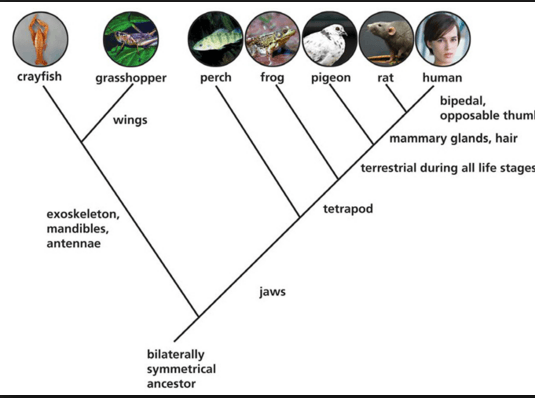
Which traits do humans have, according to the cladogram?
jaws
mammary glands & hair
hair
jaws, bipedal terrestrial during all life stages, mammary glands & hair & opposable thumbs