wayground logo

Free Printable Worksheets

Font size

S
M
L
XL
Worksheets

Biology EOC 2020

Total questions: 85

Worksheet time: 4hrs 15mins

Name
Class
Date
1.
Name the photosynthesizing organelle of the plant cell.
a)
G
b)
B
c)
J
d)
C
2.
Name the process in the picture.
a)
transcription
b)
mitosis
c)
translation
d)
replication
3.
Which letter is the active cycle of the virus?
a)
A
b)
B
4.
Which number contains the nucleic acid?
a)
1
b)
2
c)
3
5.
What process is occurring in the picture?
a)
DNA replication
b)
mitosis
c)
protein synthesis
d)
meiosis
6.
Name M.
a)
light dependent cycle
b)
Carbon dioxide
c)
glucose
d)
Calvin cycle
7.
Name B.
a)
phosophate
b)
glucose
c)
deoxyribose
d)
nitrogen base
8.
What type of punnett square?
a)
codominance
b)
incomplete dominance
c)
complete dominance
d)
sex linked recessive
9.
Widow's peak is dominant to straight hair line. Cross a heterozygous widow's peak female with a heterozygous widow's peak male. What is the genotype ratio?
a)
1:2:1
b)
3:1
c)
1:1
d)
1:0
10.
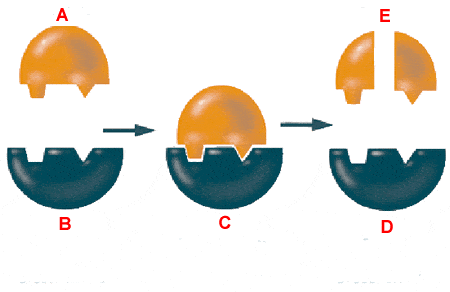
Enzymes catalyze reactions by ___________ Activation Energy.
a)
Increasing
b)
Decreasing
11.
The amount of energy that usually transfers from one trophic level to the next...
a)
10%
b)
20%
c)
80%
d)
50%
12.

Which of the following converts food into energy for the cell?

a)

vacuole

b)

mitochondria

c)

cytoplasm

d)

cell membrane

13.
Active transport does not require energy.
a)
True 
b)
False 
14.
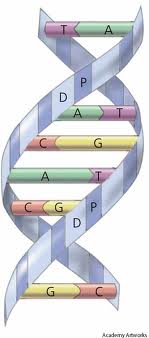
Which 2 molecules forms the sides (backbone) of the DNA ladder?
a)
deoxyribose and adenine
b)
deoxyribose and a hydrogen bond
c)
sugar and the nucleus
d)
deoxyribose (sugar) and phosphate
15.
In this image, the cell is using which type of molecular transport?
a)
Osmosis
b)
Diffusion 
c)
Endocytosis
d)
Exocytosis 
16.
According to the diagram, when did the common ancestor of giant pandas and spectacled bears exist? 
a)
5-10 mya
b)
10-15 mya
c)
15-20 mya
d)
20-25 mya
17.
Prokaryotes used to be classified as a single kingdom. New technology allowed them to be split into...
a)
Protista and Prokaryota
b)
Protista and Bacteria
c)
Eubacteria and Archaea
d)
Archaea and Eukarya
18.
Movement of materials down the concentration gradient through a protein channel is an example of 
a)
facilitated diffusion
b)
active transport
c)
respiration
d)
osmosis 
19.
Which of the following statements vest describes the cell cycle? 
a)
Interphase is the reproductive phase, mitosis is the growth phase
b)
Interphase is the growth phase, mitosis is the reproductive phase
c)
Cytokinesis is the growth phase, S-phase is the reproductive phase
d)
Cytokinesis is the reproductive phase, S-phase is the growth phase
20.
Which best describes the function of enzymes?
a)
to speed up chemical reactions in a cell
b)
to produce cellular energy
c)
to produce proteins
d)
to speed up cell division
21.
What are the products of photosynthesis? 
a)
glucose and oxygen
b)
glucose and carbon dioxide
c)
glucose and water
d)
water, carbon dioxide, and energy
22.
Which process uses ATP to move materials across the plasma membrane against the concentration gradient?
a)
passive transport
b)
active transport 
c)
facilitated diffusion
d)
osmosis
23.
Which statement best describes how the use of antibiotics on certain bacteria affects natural selection? 
a)
Natural Selection is altered because bacteria are killed
b)
The rate of selection is decreased because antibiotics kill only young bacteria
c)
Antibiotics alter natural selection by causing bacterial DNA to mutate 
d)
The rate of selection is increased because antibiotics do not kill bacteria that are naturally resistant to them. 
24.
What type of growth is shown by the human population? 
a)
Carrying capacity
b)
Logistical
c)
Exponential
d)
Stabilizing 
25.
Which method would be most helpful in preventing eutrophication of lakes and waterways?
a)
recycling aluminum
b)
conserving fossil fuels 
c)
reducing run-off from farms 
d)
using less pesticide 
26.
Which statement describes how complementary strands of DNA are linked?
a)
each sugar in one strand is paired with a complementary base in the other strand. 
b)
Each sugar in one strand is pained with a complementary phosphate in the other strand
c)
Each phosphate in one strand is paired with a complementary phosphate in the other
d)
Each base in one strand is paired with a complementary base in the other 
27.
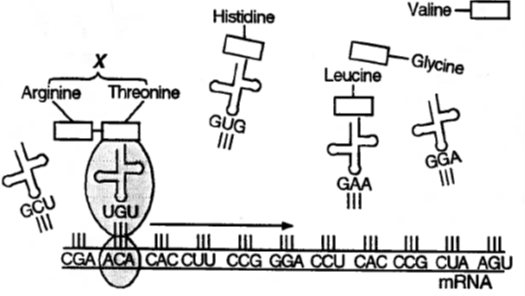
What process is going on in this photo? 
a)
Transcription 
b)
Translation 
c)
Replication 
d)
All the above 
28.
This picture represents which type of cellular transport?
a)
passive transport
b)
endocytosis
c)
exocytosis
d)
osmosis
29.
The cell below is in a _________ solution.
a)
Hypotonic
b)
Hypertonic
c)
Isotonic
30.
What two products does a plant make during photosynthesis?
a)
Water and Glucose
b)
Oxygen and Glucose
c)
Oxygen and Water
d)
CO2 and Glucose
31.

In the graph to the right, what is the population of deer at the carrying capacity of the environment?

a)

3

b)

7

c)

70

d)

40

32.
Fruit fly body cells have 8 chromosomes. After mitosis, you would expect a resulting fruit fly daughter cell to have ...
a)
16 chromosomes.
b)
46 chromosomes.
c)
8 chromosomes.
d)
4 chromosomes.
33.

Is the following cell diploid or haploid?

a)

Diploid

b)

Haploid

34.
Replicate the following strand of DNA: 
AATCATGGA
a)
AATCATGGA
b)
TTAGTACCT
c)
UUAGUACCU
d)
GGATAUCUA
35.
What is another name for natural selection?
a)
survival of the smartest
b)
survival of the fastest
c)
survival of the biggest
d)
survival of the fittest
36.
What is a change in an organism that allows for it to survive in its environment?
a)
homologous
b)
vestigial
c)
variation
d)
adaptation
37.
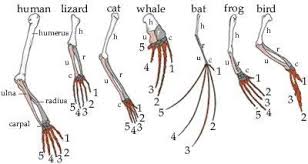
What is this an example of?
a)
vestigial structures
b)
embryology
c)
homologous structures
d)
fossil record
38.

This is a structure that was inherited but has lost most of its original function

a)

homologous

b)

analogous

c)

vestigial

d)

homozygous

39.

These structures are similar from common ancestry

a)

homologous

b)

analogous

c)

vestigial

d)

homozygous

40.

Natural selection is the ability to:

a)

live longer and reproduce

b)

evolve and survive

c)

mutate and grow

d)

meditate and relax

41.
What type of cell is shown?
a)
Eukaryotic because it has a nucleus
b)
Eukaryotic because it lacks a nucleus
c)
Prokaryotic because it has a nucleus
d)
Prokaryotic because it lacks a nucleus
42.
What type of cell is shown?
a)
eukaryotic
b)
prokaryotic
c)
bacterial
d)
protist
43.
What is the name and importance of the molecule shown in the picture?
a)
fatty acid tail; makes up the fat found in butter
b)
phospholipid; makes up cellular membranes
c)
triglyceride; makes up animal lard
d)
cellulose; makes up the cell walls of plants
44.

Name the phase

a)

Prophase

b)

Telophase

c)

Metaphase

d)

Anaphase

45.

Name this phase?

a)

Anaphase

b)

Telophase

c)

Prophase

d)

Interphase

46.

DNA is replicated during the ______ phase of the cell cycle

a)

G1

b)

G2

c)

Synthesis

d)

Cytokinesis

47.

Meiosis makes sperm and egg cells. In humans, sperm and egg cells each have _____ chromosomes. Therefore a fertilized human egg cell (sperm and egg cell combined) would create a cell with _____ chromosomes.

a)

23,46

b)

46,23

c)

2,4

d)

50,100

48.

What is one of the advantages, why is it better to reproduce sexually versus asexually?

a)

survival of the fittest

b)

genetic variation

c)

overproduction

d)

cloning

49.

Which of the statements below is true?


A. Bacteria Cell and B. Animal Cell

a)

Figure A is a eukaryotic cell and B is a prokaryotic cell.

b)

Figure A and B are both eukaryotic cells.

c)

Figure A is a prokaryotic cell and B is a eukaryotic cell.

d)

Figure A and B are both prokaryotic cells.

50.
Which best describes the process shown?
a)
mutation in which the DNA content of the gene is ltered
b)
segregation of sister chromatids
c)
condensation and segregation of the alleles
d)
crossing-over which alleles are exchanged
51.
Which is the correct order?
a)
C,D, B, A, F, E
b)
D,A,F,C,E,B
c)
B,E,C,F,A,D
d)
C,B,D,A E,F
52.
In a trophic level, ____ always have the most energy and the most biomass.  ____ level consumers always have the least energy.  Decomposers are located on the ____ of the trophic level diagram.
a)
producers, top, side
b)
top level consumers, primary, bottom
c)
producers, primary consumers, side
d)
top level consumers, producers, bottom
53.
Only ___ of energy is given to the next trophic level.  ___ is eliminated as waste heat.
a)
10%, 90%
b)
90%, 10%
c)
25%, 75%
d)
75%, 25%
54.
The process of breaking down glucose in the presence of oxygen is called _____ respiration. this takes places in the _____ and produces more ATP than ______.
a)
aerobic, mitochondria, anaerobic 
b)
anaerobic, cytoplasm, aerobic
c)
aerobic, cytoplasm, anaerobic
d)
anaerobic, mitochnodria, aerobic
55.
What process best explains how a nerve cell and a muscle cell can both develop from the same fertilized egg?
a)
differentiation
b)
natural selection
c)
selective breeding
d)
genetic engineering
56.
During strenuous exercise, body temperature increases. The body responds to the increase in temperature by sweating, which helps to reduce the body temperature. Which is demonstrated in this situation?
a)
excretion
b)
metabolism
c)
homeostasis 
d)
synthesis
57.

This diagram shows DNA fingerprints for a child and four adults.

Which adult is most likely a parent of the child?

a)

Adult 1

b)

Adult 2

c)

Adult 3

d)

Adult 4

58.

Which technique would most likely be used by forensic scientists?

a)

gene cloning

b)

gene therapy

c)

DNA fingerprinting

d)

karyotyping

59.
The scientific name for an organism is made from the:
a)
class and family
b)
genus and species
c)
domain and kingdom
d)
kingdom and phylum
60.
The 8 levels of classification, most broad to most specific.
a)
Domain, Genus, Family, Order, Class, Phylum, Kingdom, Species
b)
Domain, Species, Kingdom, Genus, Phylum, Family, Class, Order
c)
Domain, Kingdom, Phylum, Class, Order, Family, Genus, Species
d)
Order, Kingdom, Species, Domain, Phylum, Family, Class, Genus
61.
Answer the question on the figure.
a)
A
b)
B
c)
C
d)
D
62.
In addition to observing living organisms, Darwin studied the preserved remains of ancient organisms called
a)
fossils
b)
adaptations
c)
homologies
d)
vestigial structures
63.
Darwin's observation that finches of different species on the Galapagos have many similar physical traits supports the hypothesis that these finches
a)
have the ability to interbreed
b)
acquired traits through use and disuse
c)
all eat the same type of food
d)
descended from a common ancestor
64.
Who first proposed binomial nomenclature as a way of classifying organisms?
a)
Carolus Linnaeus
b)
Aristotle
c)
Charles Darwin
d)
Louis Pasteur
65.
What is the most primitive organism shown on the cladogram?
a)
chimp
b)
perch
c)
hagfish
d)
salamander
66.
Which organisms pictured on the cladogram have hair?
a)
prosimians only
b)
prosimians and humans
c)
humans only
d)
prosimians and birds
67.
A class is made up of a bunch of ___________________
a)
Phylum
b)
Order
c)
Genus
d)
Species
68.
Which of the following is not one of the 3 main Domains are 
a)
Protists
b)
Archaeae
c)
Bacteria
d)
Eukarya
69.
Charles Darwin called the ability of an organism to survive and reproduce in its specific environment 
a)
diversity.
b)
evolution
c)
adaptation. 
d)
 fitness.
70.
Which type of evidence is illustrated in this picture
a)
fossil evidence
b)
molecular
c)
anatomical
d)
embryological
71.
The theory of evolution by natural selection means that what is changing over time?
a)
The inherited traits of a population.
b)
The acquired traits of a population.
c)
Hair color and eye color
d)
Attractive features.
72.
A reduction in the genetic diversity of a population caused by a reduction in its size is called:
a)
a bottleneck effect
b)
the founder effect
c)
genetic drift
d)
mutation
73.
Which is the correct order of The Levels of Taxonomy?
a)
Kingdom, Phylum, Class, Order, Family, Genus, Species
b)
Kingdom, Phylum, Order, Class, Family, Genus, Species
c)
Kingdom, Phylum, Family, Class, Order, Genus, Species
d)
Species, Genus, Family, Class, Order, Phylum, Kingdom
74.
Occurs when two or more species evolve to be more and more different over time
a)
divergent evolution
b)
convergent evolution
c)
parallel evolution
d)
co-evolutaion
75.
Occurs when two or more populations evolve at the same time
a)
Divergent evolution
b)
convergent evolution
c)
adapative radiation
d)
co-evolution
76.
The emergence of a new species
a)
Binomial nomenclature
b)
divergent evolution
c)
phylogeny
d)
speciation
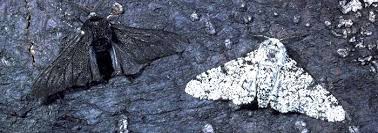
77.
Predict which moth would increase in population
a)
light 
b)
dark
78.
The finches on the Galapagos island were similar in form except for variations of their beaks. Darwin observed that these variations were useful for:
a)
 attracting a mate
b)
 defending territory
c)
 building nests
d)
 gathering food
79.
Which of the three graphs shows stabilizing selection?
a)
A
b)
B
c)
C
80.
What type of selection?
a)
Directional 
b)
Stabilizing
c)
Disruptive
81.

Having freckles is dominant over not having freckles. If two individuals heterozygous for freckles have a child, what is the probability the child will have freckles?

a)

75%

b)

50%

c)

25%

d)

0%

82.

Identical twin girls are separated at birth and cared for by two different families.

After twenty years, the twins have different heights and weights. What is most likely the cause of these differences?

a)

The proteins made by one twin were different than the proteins made by the other twin.

b)

Each twin was provided a different diet and physical activities.

c)

The DNA of one twin was different from the DNA of the other twin.

d)

One twin had a genetic condition that prevented her from growing tall.

83.
A reduction in which of these would lead to a decrease in all other populations?
a)
Coyote
b)
Grass
c)
Grasshoppers 
d)
Squirrel 
84.
In a certain insect, round wings (R) are dominant to pointed wings (r). Which cross will produce the greates number of genotypic and phenotypic variations?
a)
rr X rr
b)
Rr X Rr
c)
Rr X RR
d)
RR X RR
85.

This diagram shows a red blood cell in a beaker that contains a solution with a higher salt concentration than that inside the red blood cell. What will happen to the red blood cell in this environment?

a)

The size of the red blood cell will remain constant

b)

The red blood cell will swell at first and then shrink.

c)

The red blood cell will swell from absorbing salt molecules.

d)

The red blood cell will shrink from losing water molecules.