wayground logo

Free Printable Worksheets

Font size

S
M
L
XL
Worksheets

Environmental Science Midterm Review #1

Total questions: 78

Worksheet time: 1hrs 13mins

Name
Class
Date
1.

A step in the movement of energy through an ecosystem; an organism's feeding status in an ecosystem

a)

trophic level

b)

energy pyramid

c)

photosynthesis

2.

A diagram that shows the amount of energy that moves from one feeding level to another in a food web

a)

trophic level

b)

energy pyramid

c)

photosynthesis

3.

Scientific study of our environment, as well as our role in it.

a)

Environmental Science

b)

Sustainability

c)

Ecology

d)

Ecological Footprint

4.

Which of the following in a natural resources?

a)

Water

b)

Food

c)

Sunlight

d)

All of the above

5.

Sunlight is an inexhaustible resources:

a)

True

b)

False

6.

The amount of land and water needed to supply an individual or a population with renewable resources

a)

Environmental Science

b)

Sustainability

c)

Ecology

d)

Ecological Footprint

7.

The capacity of Earth's natural systems that support life to maintain stability or to adapt to changing environmental conditions indefinitely

a)

Environmental Science

b)

Sustainability

c)

Ecology

d)

Ecological Footprint

8.

The tendency of a shared, limited resource to become depleted because people act from self-interest for short-term gain

a)

Environmental Science

b)

Tragedy of the Commons

c)

Ecology

d)

Ecological Footprint

9.

Which of the following is a nonrenewable resource

a)

Water

b)

Wind

c)

Food

d)

Fossil Fuels

10.

Which of the following is the NOT a scientific factors of sustainability:

a)

Solar Energy

b)

Biodiversity

c)

Economics

d)

Nutrient Cycling

11.

Nutrient Cycling is the most important ecosystem services

a)

True

b)

False

12.

Pollution is the contamination of the environment by any chemical agent at levels considered harmful to the health, survival, or activities of organisms

a)

True

b)

False

13.

Which of the following is considered a natural pollutant?

a)

Forest fire

b)

Volcanic Eruption

c)

Power plant

d)

Car Exhaust

14.

Which of the following is considered a cause for environmental issues

a)

Overpopulation

b)

Prices of Goods (supply and demand)

c)

Nature's Deficit Disorder

d)

Agriculture practices

e)

Poverty and / or Affluence

15.
A relationship between two species where one benefits while the other is harmed.
a)
Mutualism
b)
Commensalism
c)
Parasitism
d)
Naturalism
16.
A tapeworm and a cat have this type of relationship.
a)
mutualism
b)
parasitism
c)
commensalism
d)
competition
17.
A frog eats a fly. The frog and fly are demonstrating ________.
a)
mutualism
b)
competition
c)
predator/prey
d)
parasitism
18.
A tick and a dog have this type of relationship.
a)
mutualism
b)
commensalism
c)
neutralism
d)
parasitism
19.
A relationship between two organisms in which one organism benefits and the other is unharmed
a)
Mutualism 
b)
Competition
c)
Parasitsm 
d)
Commensalism 
20.
A relationship between two organisms in which both organisms benefit. 
a)
Mutualism 
b)
Competition
c)
Parasitsm 
d)
Commensalism 
21.
Barnacles create home sites by attaching themselves to whales. This neither harms nor benefits the whales.  What kind of relationship is this?
a)
Mutualism 
b)
Parasitism 
c)
Commensalism 
22.
The crocodile and bird have a _______________ relationship.  The crocodile benefits by having its teeth cleaned.  The bird benefits by gaining food and protection.  Both animals benefit from this relationship.
a)
parasitism
b)
predator and prey
c)
mutualism
d)
commensalism
23.
a relationship between two organisms in which one organism benefits and the other is unaffected
a)
camouflage
b)
parasite
c)
host
d)
commensalism
24.
a relationship between two species in which one species, the parasite, benefits from the other species, the host, which is harmed
a)
parasitism
b)
symbiosis
c)
predation
d)
hunting
25.
a relationship between two species in which both species benefit
a)
mutualism
b)
commensalism
c)
symbiosis
d)
camouflage
26.
Name the species interaction: A decorator crab camouflages itself with sponges. Sponges are unaffected. 
a)
competition 
b)
predation
c)
commensalism
d)
mutualism 
27.
Evidence shows that some grasses benefit from being grazed. Which of the following terms would best describe this plant-herbivore interaction?
a)
Mutualism
b)
Commensalism
c)
Parasitism
d)
Competition
28.

What is the relationship between a host and another species which feeds off of it, detrimental to the host.

a)

Predation

b)

Parasitism

c)

Allelopathic

d)

Commensalism

29.

When one species consume another through hunting.

a)

Parasitism

b)

Commensalism

c)

Predation

d)

Allelopathic

30.

Cattle egrets and livestock are an example of what kind of relationship?

a)

Commensalism

b)

Parasitism

c)

Predation

d)

Intraspecies competition

31.

Big horn sheep sparring is an example of this time of relationship.

a)

Commensalism

b)

Intraspecies Competition

c)

Interspecies Competition

d)

Mutualism

32.
When multiple organisms seek the same limited resource, this is referred to as?
a)
Tolerence
b)
Competetion
c)
Predation
d)
Parasitism
33.
Which of the following is an interaction in which both organisms are harmed?
a)
Parasitism
b)
Predation
c)
Competition
d)
Commensalism
34.
Currently sharks are on a rapid decline due to overfishing. If sharks go extinct will this affect the biodiversity of the ocean?
a)
No, sharks are not important.
b)
No, sharks will only affect the seal populations.
c)
Yes, it will disrupt the entire food chain in the ocean.
d)
Yes, but only a little.
35.

Which biome or ecosystem has the most biodiversity?

a)

Desert

b)

Sand

c)

Tundra

d)

Rainforest

36.
What is this biome?
a)
Arctic Tundra
b)
Desert
37.
What is this biome?
a)
Grassland
b)
Desert
38.
What is this biome?
a)
Desert
b)
Arctic Tundra
c)
Tropical Rainforest
39.
What is this biome?
a)
Deciduous Forest
b)
Tropical Rainforest
40.
A large area where different plants and animals live is called a _______?
a)
school
b)
biome
41.
Which biome is pictured below?
a)
ocean
b)
freshwater
c)
coral reef 
d)
wetland
42.
What aquatic biome is characterized by flowing fresh water?
a)
Lakes/Ponds
b)
Mangroves Swamps
c)
Rivers/Streams
d)
Coral Reefs
43.
Fresh water referrers to which of the following
a)
oceans, rivers, lakes
b)
ponds, rivers, oceans
c)
lakes, ponds,  streams
d)
streams, lakes, oceans
44.
To which biome do all the ecosystems shown in the figure belong?
a)
continental shelf
b)
wetlands
c)
open ocean
d)
sea floor
45.
What are the two main groups of aquatic biomes?
a)
saltwater and freshwater
b)
marine and freshwater
c)
marine and estuarine
d)
oligotrophic and eutrophic
46.
What do you call the non-living parts of an environment?
a)
biotic
b)
abiotic
c)
biome
d)
aquatic
47.
In a body of water, the colder area with more nutrients but little to no light is called the:
a)
Benthic Zone
b)
Source Zone
c)
Floodplain Zone
d)
Pelagic Zone
48.

What converts nitrogen gas into a usable form for plants and animals?

a)

bacteria

b)

rain

c)

fungi

d)

car exhaust

49.

The process in which nitrogen circulates and is recycled is called

a)

The nitrogen cycle

b)

The carbon cycle

c)

The water cycle

d)

The phosphorus cycle

50.

Organisms that need nitrogen to survive.

a)

only plants

b)

only animals

c)

only bacteria

d)

all living things

51.

How is nitrogen "fixed" into a usable form for plants?

a)

Through action of bacteria only

b)

Through lightning only

c)

Through action of bacteria and lightning

d)

Through photosynthesis

52.

How do animals get the nitrogen they need?

a)

From the air they breathe

b)

From the water they drink

c)

From the food they eat

d)

From the sun

53.

How do animals get the nitrogen they need?

a)

From the air they breathe

b)

From the water they drink

c)

From the food they eat

d)

From the sun

54.

Gas that makes up 78% of our atmosphere.

a)

Oxygen

b)

Nitrogen

c)

Hydrogen

d)

Carbon Dioxide

55.

What is the process of combining nitrogen gas with other elements to make nitrogen into usable compounds?

a)

nitrogen composition

b)

nitrogen fixation

c)

ammonia

d)

denitrification

56.

What is the formula for atmospheric nitrogen?

a)

N

b)

N2

c)

NH3

d)

NO3

57.

What process occurs when dead plant and animal matter decomposes and nitrogen is released back into the atmosphere?

a)

Assimilation

b)

Fixation

c)

Ammonification

d)

Denitrification

58.

Plants and animals cannot use nitrogen directly from the air.

a)

True

b)

False

59.

Bacteria fix nitrogen from the atmosphere into a form plants can use.

a)

True

b)

False

60.

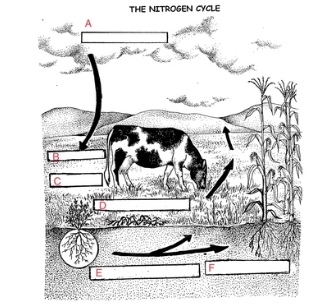
In the nitrogen cycle, what does label A in the diagram represent?

a)

Gas

b)

Clouds

c)

Carbon dioxide in the atmosphere

d)

Nitrogen in the atmosphere

61.

Plants and animals need nitrogen to make __________.

a)

DNA

b)

Carbohydrates

c)

Lipids

d)

Minerals

62.
When humans burn fossil fuels, most of the carbon quickly enters the                       as carbon dioxide.
a)
Water
b)
Atmosphere
c)
Sun
d)
Air
63.
What does not produce carbon dioxide?
a)
Photosynthesis
b)
Burning Fossil Fuels
c)
Animal respiration
d)
Plants decaying
64.
How do living organisms return carbon to the atmosphere in the carbon cycle?
a)
respiration and photosynthesis
b)
 decomposition and respiration
65.
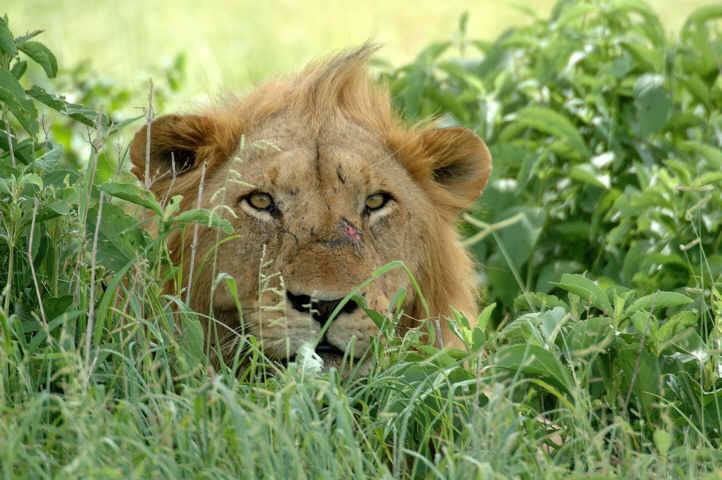
How does the carbon in grass become part of a lion?
a)
The lion eats the grass
b)
Carbon from grass doesn't end up in a lion. 
c)
The carbon ends up in the lion's food chain. 
d)
The lion breathes in carbon given out by the plant
66.
All of the carbon in existence is continually recycled in the carbon cycle
a)
True
b)
False
67.
Which of the following removes carbon from the atmosphere?
a)
Combustion
b)
Respiration
c)
Photosynthesis
d)
Death
68.
Organisms that do not decompose can be buried and become what?
a)
water
b)
nutrients
c)
air
d)
fossil fuels
69.
If the plant population decreased, the amount of carbon would _________.
a)
Stay the same
b)
Increase
c)
Decrease
70.

Which is a true statement?

a)

Humans depend on oxygen, plants depend on carbon dioxide

b)

Plants produce carbon dioxide

c)

Humans depend on carbon dioxide, plants depend on oxygen

d)

Humans don't depend on plants for the air they need

71.
Combustion is another word for __________.
a)
Transportation
b)
Respiration
c)
Fossil Fuels
d)
Burning
72.
Carbon can be found in...
a)
The atmosphere
b)
Soil
c)
Fossil fuels
d)
All of the above
73.
Respiration is the process by which animals take in _____ and release _____. 
a)
photosynthesis, air
b)
carbon, oxygen
c)
oxygen
d)
oxygen, carbon dioxide
74.
What is deforestation?
a)
Clearing Earth's forests on a massive scale
b)
Eating too much vegetables
c)
Going to a forest and pulling weeds
d)
Clearing the five trees in my backyard
75.
Why does cutting down trees increase global warming?
a)
trees soak up carbon dioxide
b)
trees provide shade which counteracts global warming
c)
trees absorbs the sun's energy without radiating back into the atmosphere
d)
trees drain greenhouse gases like methane from soil
76.

The image shows various stages in the water cycle. During which stage does water flow back towards the sea as runoff?

a)

W

b)

X

c)

Y

d)

Z

77.

What is another name or synonym for the water cycle?

a)

Geologic cycle

b)

Hydrologic cycle

c)

Geosphere

d)

Carbon cycle

78.

What is precipitation?

a)

Sweat from our bodies on hot days

b)

Warm rain but not cold snow or sleet

c)

Gas that we use in furnaces or ovens

d)

Any form of water that falls from the sky