wayground logo

Free Printable Worksheets

Font size

S
M
L
XL
Worksheets

Molecular and Genetics Review

Total questions: 75

Worksheet time: 1hrs 15mins

Name
Class
Date
1.
The different forms of a gene
a)
heredity
b)
genetics
c)
gene
d)
alleles
2.
This trait always shows up in an organism when the allele is present
a)
dominant allele
b)
codominance
c)
probability
d)
recessive allele
3.
This trait is hidden whenever the dominant allele is present
a)
dominant allele
b)
codominance
c)
recessive allele
d)
Punnett Square
4.
An organism's physical appearance or visible traits
a)
fertilization
b)
genotype
c)
phenotype
d)
homozygous
5.
An organism's genetic makeup, or allele combination
a)
fertilization
b)
genotype
c)
phenotype
d)
heterozygous
6.
An organism that has two identical alleles for a trait (purebred)
a)
genotype
b)
phenotype
c)
homozygous
d)
heterozygous
7.

Of the chromosomes in your cells, how many are sex chromosomes?

a)

1

b)

2

c)

3

d)

4

8.

How many copies of each gene do you have?

a)

1

b)

2

c)

3

d)

4

9.

Which of the following base pairings is correct?

a)

T-T, C-A

b)

A-T, C-C

c)

A-T, C-G

d)

C-G, C-C

10.
Gregor Mendel is known as the father of _________
a)
Modern Medicine
b)
Father of the Green Revolution
c)
Father of Genitics
d)
The Pea Plant Man
11.
What is the shape of DNA?
a)
Double helix
b)
Triple helix
c)
Flat, bilayer
d)
Three-pronged rigid ladder
12.
Which sequence of DNA bases would pair with this partial strand
CAT TCA CTG
a)
ATG TGA CAG
b)
TAC ACT GTC
c)
GTA AGT GAC
d)
CAT TCA CTG
13.

Having two different colored eyes

a)

Genotype

b)

Phenotype

14.

Having Down Syndrome

a)

Genotype

b)

Phenotype

15.
The physical appearance of an organism based on traits
a)
Genotype
b)
Phenotype
c)
Meiosis
d)
Genetics
16.

A haploid cell from a male camel has 35 chromosomes. What type of cell is this? Choose all that apply

a)

Sperm

b)

Egg

c)

Heart Cell

d)

Muscle Cell

17.
Mitosis produces cells with haploid or diploid number of chromosomes?
a)
Haploid
b)
Diploid
18.
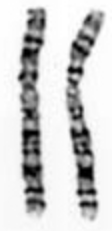
Determine the sex of the individual whose karyotype is displayed in the image.
a)
female
b)
male
19.
Nondisjunction can result in 
a)
trisomy conditions
b)
monosomy conditions
c)
additional sex chromosomes
d)
all of these
20.
A pair of identical chromosomes shown in a karyotype, one inherited from mom, and one inherited from dad are called
a)
sister chromotids
b)
centromeres
c)
homologous chromosomes
d)
autosomes
21.
What makes this individual's karyotype not normal?
a)
An extra sex chromosome
b)
An extra autosome
c)
A missing sex chromosome
d)
A missing autosome
22.
What does DNA stand for?
a)
Deoxyribonucleic acid
b)
Denitrogenous acid
c)
Deribonucleic acid
d)
Diribonucleic acid
23.
What are the three components of a nucleotide?
a)
sugar, hydrogen, nitrogen base
b)
sugar, oxygen, nitrogen base
c)
sugar, phosphate, nitrogen base
d)
sugar, phosphate, protein
24.

How many alleles (letters) does a child get from each parent?

a)

1

b)

2

c)

3

d)

4

25.
If B = brown hair and b = blonde hair, what is the probability of brown hair?
a)
25%
b)
50%
c)
0%
d)
75%
26.
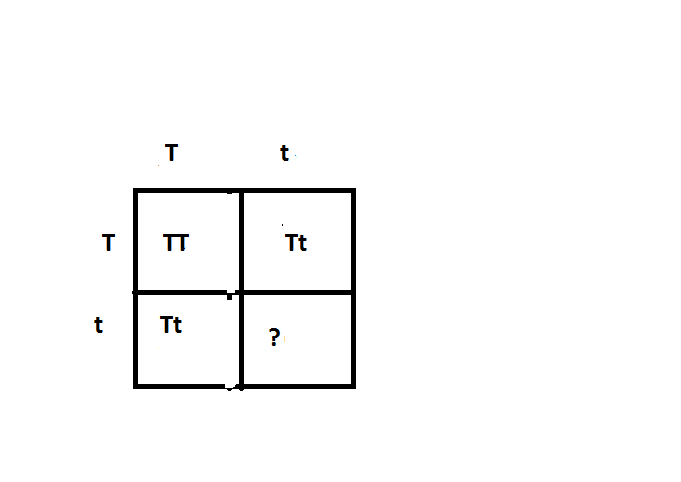
T - tall and t = short
In the punnett square below, what belongs in the missing square
a)
tt
b)
Tt
c)
Bb
d)
TT
27.
In a pedigree, what shape represents a male?
a)
circle
b)
square
c)
triangle
d)
diamond
28.
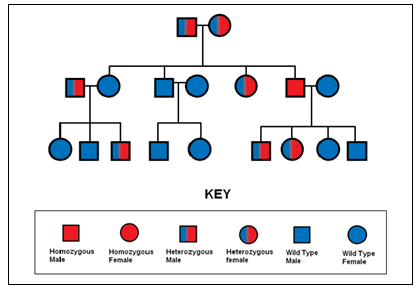
What do half colored symbols represent?
a)
The individual is a carrier (heterozygous).
b)
The individual expresses the trait.
c)
The individual has both recessive alleles.
d)
The individual has both dominant alleles.
29.
Give the genotype for person III-3
a)
GG
b)
Gg
c)
gg
30.

If this pedigree shows a recessive disorder, what MUST the genotype of individual 4 be?

a)

HH

b)

Hh

c)

hh

31.
A heterozygous long-tusked elephant is crossed with a homozygous recessive short-tusked elephant. What is the probability of the offspring having short tusks?
a)
0%
b)
25%
c)
50%
d)
75%
32.
Dominant alleles are represented by a:
a)
Male gene
b)
lowercase letter
c)
recessive trait
d)
capital letter
33.
Aa, DD, bB, yy are all examples of
a)
genotypes
b)
phenotypes
34.
In humans, mitosis produces____ chromosomes and _____ chromosomes after Meiosis
a)
46, 46
b)
92, 46
c)
46, 23
d)
23, 23
35.
What chromosome is affected by Down's Syndrome?
a)
23
b)
18
c)
13
d)
21
36.
Which of the following would be considered a Gamete cell?
a)
Egg Cell
b)
Sperm Cell
c)
Both of these
d)
None of these
37.
The X and Y chromosomes are known as the ___ chromosomes.
a)
sex
b)
autosome
c)
biological
d)
genetic
38.
Females have ____ and males have _____ chromosomes.
a)
XX, XY
b)
XY, XX
c)
XX, XX
d)
XY, XY
39.
Cells spend 90% of their time in this stage of the cell cycle. This is the reason you would see most cells in this stage if viewed under a microscope.
a)
Prophase
b)
Metaphase
c)
Anaphase
d)
Interphase
40.
Which of the following is the correct acronym for the stages of the cell cycle?
a)
IPMATC
b)
MPIATC
c)
CAPMIT
d)
IMATCP
41.
Cell division occurs to allow for 
a)
Growth
b)
Reproduction
c)
Repair
d)
All of the above
42.
The sister chromatids of each chromosome are separated (come apart) and move to opposite ends of the cell. Name that Stage!
a)
Prophase
b)
Metaphase
c)
Anaphase
d)
Telophase
43.
DNA is copied in the S part of this stage. Name that Stage!
a)
Interphase
b)
Prophase
c)
Metaphase
d)
Anapahse
44.
The chromosomes start to line up in the middle of the cell.
a)
Prophase
b)
Metaphase
c)
Anaphase
d)
Telophase
45.

CROSSING OVER INCREASES

a)

LIFE SPAN

b)

GENETIC VARIATION

c)

THE NUMBER OF OFF-SPRING

d)

ALL ARE TRUE

46.

CROSSING OVER TAKES PLACE DURING

a)

PROPHASE II

b)

PROPHASE I

c)

INTERPHASE

d)

METAPHASE I

47.

WHAT TYPE OF CELLS STORE THE GENETIC INFORMATION THAT IS PASSED TO OFF-SPRING

a)

BODY CELLS

b)

MITOSIS

c)

EGG

d)

SPERM

e)

EGG AND SPERM

48.
Identify the phase:
a)
Metaphase I
b)
Metaphase II
c)
Anaphase I
d)
Anaphase II
49.
The fertilized egg is termed a/an _____.
a)
gamete
b)
allele
c)
homolog
d)
zygote
50.

Is the following cell diploid or haploid?

a)

Diploid

b)

Haploid

51.
The cells produced via meiosis are called:
a)
sex cells
b)
somatic cells
c)
body cells
d)
skin cells
52.
This picture shows which process? 
a)
mitosis
b)
meiosis
c)
the cell cycle
53.
What causes genetic variation in meiosis?
a)
chromosomes lining up
b)
crossing over of chromosomes
c)
separation of chromosomes
d)
chromosomes pulling apart
54.

What is the primary cause of genetic variation during meiosis?

a)

chromosomes lining up

b)

"crossing over" of chromosomes

c)

separation of chromosomes

d)

chromosomes pulling apart

55.

The failure of one or more pairs of homologous chromosomes or sister chromatids to separate "normally" during meiosis is called _____________________.

a)

nondisjunction

b)

anaphase I

c)

nondiploidy

d)

karyotype

56.
In RNA, Uracil pairs with ______. 
a)
cytosine
b)
adenine
c)
guanine
d)
thymine
57.
The mRNA leaves the ________ to find the ribosome to make proteins.
a)
cell
b)
nucleotide
c)
nucleus
58.

DNA holds the code for making

a)

lipids

b)

carbohydrates

c)

proteins

d)

sugars

59.

Choose the sequence of the mRNA strand that would be match up with to the following strand:

GTAGTCA

a)

UATUAGA

b)

ACGACTG

c)

CAUCAGU

d)

CATCAGT

60.
The main function of tRNA is to...
a)
carry a message that, when translated, forms proteins
b)
form a portion of ribosomes
c)
string together complementary RNA and DNA strands
d)
bring amino acids from the cytoplasm to the ribosomes
61.
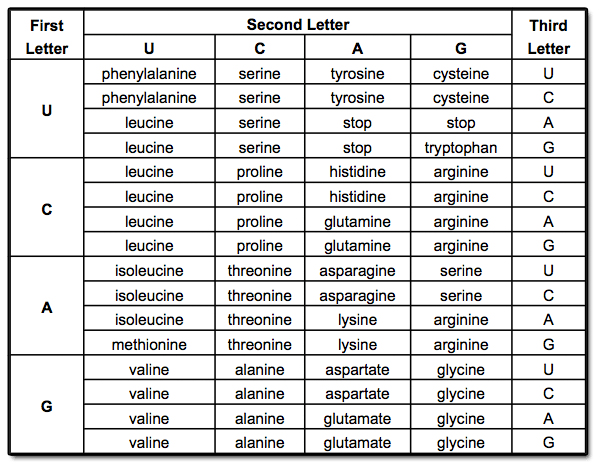
What amino acid is represented by the codon UUA?
a)
Phenylalanine
b)
Tyrosine
c)
Leucine
d)
Stop codon
62.

What is the correct amino acid sequence for the mRNA code AUGCCAGUAUGA

a)

Met-Pro-Ala-Val

b)

Met-Pro-Val

c)

Tyr-Gly-His

d)

Tyr-Gly-Arg-His

63.

Which is the mRNA molecule that would be created from this DNA template:

TGGCAAGTACGT

a)

ACCGTTCATGCA

b)

UGGCAAGUACGU

c)

UCCGUUCUUGCU

d)

ACCGUUCAUGCA

64.
Contains the bases adenine, uracil, cytosine and guanine
a)
DNA
b)
RNA
c)
Both
65.
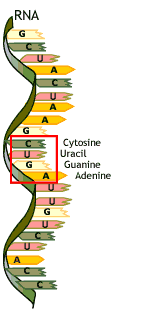
What part of protein synthesis does this diagram represent?
a)
mRNA
b)
tRNA
c)
rRNA
d)
RNA
66.
How does RNA differ from DNA?
a)
RNA contains uracil and deoxyribose
b)
RNA contains ribose and thymine
c)
RNA contains uracil and ribose
d)
RNA contains adenine and ribose
67.

What is the correct order to make a protein?

a)

Protein, DNA, RNA

b)

RNA, DNA, Protein

c)

DNA, RNA, Protein

d)

Protein, RNA, DNA

68.
What is the process of turning DNA into mRNA?
a)
Central Dogma
b)
Transcription
c)
Translation
d)
Trapezoid
69.
Every three letters (example: ATC) in DNA codes for what??
a)
Amino Acid
b)
Nucleotide
c)
Lipid
d)
Carbohydrate
70.
DNA is turned to RNA and then to Protein is called what?
a)
Central Dogma
b)
DNA
c)
RNA
d)
Theory of Everything
71.

where is the site of translation ?

a)

ribosomes

b)

telomerase

c)

helicase

d)

primase

72.
What are 3 types of RNA?
a)
mRNA, tRNA, rRNA
b)
aRNA, fRNA, mRNA
c)
TRNA, MRNA, RRNA
d)
MRNA, ARNA, FRNA, MRNA
73.

Messenger RNA travels out of the nucleus to ribosomes

and is used as a template to assemble a protein.

a)

Translation

b)

Transcription

c)

Replication

d)

Homeostasis

74.
What is the term for a three-nucleotide sequence that codes for an amino acid?
a)
base
b)
codon
c)
amine
d)
serine
75.
Does the order of amino acids in a protein matter?
a)
YES!
b)
NO!