

wayground logo

Free Printable Worksheets

Font size

S
M
L
XL
Worksheets

Biology 2 Review

Total questions: 54

Worksheet time: 1hrs 17mins
Name
Class
Date
1.
Humans are made up of different cells that preform different functions. From which cells do nerve cells develop? 
a)
Muscle cells
b)
Stem cell
c)
Sperm cells
d)
White blood cells 
2.
Which of the following statements vest describes the cell cycle? 
a)
Interphase is the reproductive phase, mitosis is the growth phase
b)
Interphase is the growth phase, mitosis is the reproductive phase
c)
Cytokinesis is the growth phase, S-phase is the reproductive phase
d)
Cytokinesis is the reproductive phase, S-phase is the growth phase
3.
Which statement best describes how the use of antibiotics on certain bacteria affects natural selection? 
a)
Natural Selection is altered because bacteria are killed
b)
The rate of selection is decreased because antibiotics kill only young bacteria
c)
Antibiotics alter natural selection by causing bacterial DNA to mutate 
d)
The rate of selection is increased because antibiotics do not kill bacteria that are naturally resistant to them. 
4.
Which statement describes how complementary strands of DNA are linked?
a)
each sugar in one strand is paired with a complementary base in the other strand. 
b)
Each sugar in one strand is pained with a complementary phosphate in the other strand
c)
Each phosphate in one strand is paired with a complementary phosphate in the other
d)
Each base in one strand is paired with a complementary base in the other 
5.
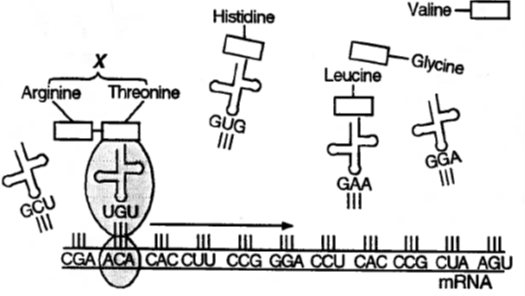
What process is going on in this photo? 
a)
Transcription 
b)
Translation 
c)
Replication 
d)
All the above 
6.
Which of these is not a way in which biotechnology can benefit agriculture?
a)
increase crop population
b)
reducing the loss of crops to insects
c)
producing better-tasting fruits
d)
improving farm machinery
7.
An offspring will receive how many alleles from each parent to determine a specific trait?
a)
one
b)
two
c)
three
d)
five
8.
What process is occurring in the picture?
a)
DNA replication
b)
mitosis
c)
protein synthesis
d)
meiosis
9.

What are the three main parts of a nucleotide?

a)

carbon, hydrogen, and oxygen

b)

phosphate, sugar, and nitrogen base

c)

phosphate, sulfate, and nitrate

d)

adenine, thymine, and uracil

10.

In DNA, adenine pairs with _______, while guanine pairs with _______.

a)

uracil / cytosine

b)

thymine / uracil

c)

thymine / cytosine

d)

adenine / guanine

11.

Which nitrogen base does RNA have instead of thymine?

a)

adenine

b)

cytosine

c)

guanine

d)

uracil

12.

The process in which a section of DNA is used to produce a copy of mRNA is called:

a)

transcription

b)

translation

c)

mutation

d)

inheritance

13.

Use the chart to find to amino acid that corresponds to the codon GGA:

a)

Alanine

b)

Glutamic Acid

c)

Lysine

d)

Glycine

14.

What type of mutation is shown in the diagram?

a)

substitution

b)

insertion

c)

deletion

d)

no change

15.

The image represents the changes in a population of bacteria over time. This is an example of _________________, because the gene frequency of the most fit organism increases over time.

a)

artificial selection

b)

natural selection

c)

monohybrid crosses

d)

dihybrid crosses

16.

In a population of giraffes, some have long necks and some have short necks. A fire destroys the low shrubs in the area. The giraffes with long necks are still able to feed on the tall trees, while the giraffes with short necks struggle to find food. Over time, the population of giraffes only contains individuals with long necks. What is the best explanation for this?

a)

The short-necked giraffes stretched so all the neck lengths were the same.

b)

All of the giraffes were able to feed equally

c)

The long-necked giraffes mated with the short-necked giraffes.

d)

The long-necked giraffes were better suited for their environment and were able to survive and reproduce.

17.

If scientists wanted to determine the evolutionary relationship between two groups of organisms, which of the following would provide the best evidence?

a)

fossil record and DNA comparison

b)

a food web

c)

migration data for one of the groups

d)

records of interactions between individuals in one of the groups

18.

Which of the following provides the best evidence that two organisms might share a common ancestor?

a)

Finding their fossils in the same location

b)

Similar mating behaviors

c)

Similar feeding habits

d)

Similar DNA sequences

19.
What type of cells undergo mitosis?
a)
Sex Cells
b)
Gametes
c)
Egg cells
d)
Somatic Cells
20.
What type of cells undergo meiosis?
a)
Somatic Cells
b)
Plant Cells
c)
Sex Cells
d)
Body Cells
21.
What does crossing over during meiosis lead to?
a)
2 Diploid daughter cells
b)
Trisomy
c)
Monosomy
d)
Genetic Variation
22.
Which cell would not come from direct result of mitosis?
a)
Sperm Cell
b)
Muscle Cell
c)
Nerve Cell
d)
Root Cell
23.
Mitosis results in . . .
a)
4 identical haploid daughter cells
b)
2 identical diploid daughter cells
c)
4 different haploid daughter cells
d)
2 different diploid daughter cells
24.
Meiosis includes two rounds of cell division. How many times does the DNA replicate during meiosis?
a)
Once 
b)
Twice
25.
Which process and type of resulting cells are represented?
a)
mitosis, gametes
b)
mitosis, body cells
c)
meiosis, gametes
d)
meiosis, body cells
26.
How many amino acids are coded for by this sequence of nucleotides:
ATG GGA ACT CCA
a)
4
b)
2
c)
6
d)
12
27.
The white feathers of a snowy owl allow it to blend in with its environment during the winter months (snow). This is an example of ________________
a)
Species
b)
Environmental Change
c)
Adaptation
d)
Variation
28.
Which of the following would result in a frameshift mutation?
a)
Insertions only
b)
Substitution only
c)
Deletion only
d)
Insertions and Deletions
29.

A mutation in which only one nucleotide is altered is called a:

a)

Frameshift Mutation

b)

Deletion Mutation

c)

Point Mutation

d)

Insertion Mutation

30.

The rearrangement of whole blocks of genes.Involve changes to a triplet resulting in a different amino acid.

a)

translocation

b)

gene mutation

c)

deletion

d)

missive substitution

31.

A mutation is defined as:

a)

A change in the cell's structure

b)

Anything that changes in an embryo

c)

Any change in the physical features of a human

d)

A change in the DNA sequence

32.
Why are insertion and deletion (frameshift) mutations so harmful?
a)
They change all of the codons from the mutation on down the line, which changes the amino acid sequence
b)
They insert things that an organism doesn't need.
c)
They often delete things that organisms need.
d)
Insertion and deletions are not any more harmful than substitution mutations.
33.
The survival of a species depends on its ability to adapt to changes in the environment. Which statement correctly describes a way that mutations increase the likelihood that a species will survive in a changing environment?
a)
Mutations are a source of variation in the species
b)
Mutations are the cause of disease in the species
c)
Mutations are not harmful when they occur in somatic cells
d)
Mutations are always passed on to subsequent generations
34.

Genetic mutations can be...

a)

beneficial, harmful, or neutral

b)

beneficial only

c)

harmful only

d)

neutral only

35.

Would a mutation in the DNA of a skin cell be passed on to an organism's offspring?

a)

Yes, because any change to the DNA is passed on to the offspring

b)

Maybe. Sex cells only use half of the body's genetic code. It might get the copy of a gene that wasn't mutated.

c)

No. Only mutations that occur in the gametes (sex cells) are passed on to the offspring

d)

Without knowing the animal, it would be hard to tell whether or not the mutation would be passed on.

36.
An abnormal mass of cancer cells is called a 
a)
tumor
b)
cyst
c)
lesion
d)
polyp
37.
Any substance that is known to cause cancer is called a
a)
carcinogen
b)
nicolyte
c)
pathogen
d)
retrovirus
38.
Cancer creates abnormal cells by disrupting
a)
the cell cycle
b)
red blood cell formation
c)
DNA replication
d)
ATP synthesis
39.
Cancer is
a)
a premature stop in the cell cycle.
b)
uncontrolled mitosis.
c)
programmed cell death.
40.

These are examples of:

  • chemicals in cigarette smoke
  • radiation
  • nitrates in processed foods
  • artificial sweeter
  • Heavy metals such as mercury and lead
a)

Carcinogens

b)

Predispositions

c)

Mutations

d)

Tumors

41.

In human beings, mitosis is necessary for:

a)

growth and repair of tissues

b)

formation of the gametes, or sex cells

c)

reproduction of another individual

d)

reducing the number of chromosomes

42.

A patient is using an experimental treatment that was originally done on Dogs, what is the social issue(s) in this above scenario?

a)

Social, Testing on animals

b)

Economic Experimental Treatment

c)

Economic, Testing on animals

d)

Social, Experimental treatment

43.

There is a new drug that has been released to patients but can cause short term memory loss. The Federal Drug and Food Administration(FDA) has declared it safe for use, but it cost 5,000 a bottle. What is the ethical issue?

a)

Economic, The FDA is regulating the drug

b)

Economic, Expensive drugs

c)

Political, Expensive drugs

d)

Political, The FDA is regulating the drug

44.

Genetic engineering is the process of enhancing or correcting a gene. This can be giving an individual a gene they never had or making the gene better. We use this to treat many illnesses. This can cause many issues in society and can be quite expensive. We also do not have many laws to regulate this process. Why is this such an ethical topic?

a)

Social, Playing god

b)

Political, No rules/law

c)

Economic, This cost a lot of money

d)

All of the above

45.
Biotech foods look and taste the same as traditional foods and crops. The only difference is that biotech food has
a)
fewer calories.
b)
the addition of specific minerals.
c)
genes with traits that improve something about the plant.
d)
a better chance of surviving a frost during the growing season.
46.
What is plant biotechnology?
a)
Adding chemicals to foods to preserve them.
b)
Making synthetic foods using artificial, man-made proteins.
c)
Inserting a gene or genes with beneficial traits into a plant cell.
d)
Taking immature plants and adding steroids to make them grow bigger and stronger.
47.

An argument in favor of food biotechnology is that it

a)

provides foods that cure viral diseases.

b)

provides more food to feed a growing population.

c)

provides a cash crop for low income nations.

d)

biotech foods are not controversial

48.

What is a GMO?

a)

An organism that has had its DNA modified by humans

b)

An organism missing a chromosome

c)

Epigenetics

d)

A genetically identical organism

49.
What are genetically modified (GM) organisms and GM foods?
a)
Foods or organisms with better taste
b)
Foods or organisms grown in the USA, only
c)
Foods or organisms with DNA modified in a way that doesn't occur naturally
d)
Food and organisms that have been injected with hormones
50.
Advantages of genetically modified crops include(s)
a)
insect resistance
b)
drought/freeze resistance
c)
higher yield
d)
all of these are reasons for using GMOs
51.
Concerns about genetically modified organisms include(s)
a)
risk to human health
b)
may be harmful to ecosystems
c)
seed/pollen drift to organic farms
d)
all of these are valid concerns
52.

A mutation that causes a change in the protien would directly affect the (a)   ?

53.

In the advancement of science, families can create their idea of a perfect baby. This process is called In vitro fertilization (IVF). Parents can pick specific traits they wish that child to display, this can range from phenotypes (physical characteristics) to the removal of genetic diseases within the DNA. This practice is considered controversial as many feel _____________.

a)

This practice is only available to the elite, or upper-class, as this process can be very expensive.

b)

This practice potentially stops genetic diseases from being passed from parent to offspring.

c)

Parents should have the right to pick whatever traits they want for their future child and not leave it up to chance.

54.

Guadalupe was offered a treatment for her leukemia (blood cancer), why might she be skeptical about using an experimental treatment for her cancer?

a)

Experimental treatments do not always work and can be painful.

b)

Experimental treatments have not been approved/accepted by the FDA.

c)

Some experimental treatments are also tested on animals.
