wayground logo

Free Printable Worksheets

Font size

S
M
L
XL
Worksheets

12/11 Tropisms Test

Total questions: 50

Worksheet time: 46mins

Name
Class
Date
1.

Which statement was NOT included in cell theory?

a)

All living things are composed of cells.

b)

Living cells come only from other living cells.

c)

Each cell contains a cell membrane, cytoplasm, nucleus, mitochondria, and endoplasmic reticulum.

d)

Cells are the smallest structure of living things that can perform the functions necessary for life.
2.

All living things are made up of...

a)

cells

b)

tissues

c)

organ

d)

organ systems

3.

What is the basic structural and functional unit of all living things?

a)

atom

b)

cell

c)

bacteria

d)

animalcules

4.

All cells -----

a)

come from other dead cells

b)

come from other living cells

c)

crystallize out of the air

5.

Which is not true of the cell theory?

a)

All living organisms are composed of cells.

b)

All cells have a nucleus, which acts like a brain of the cell.

c)

All cells come from preexisting cells.

6.
Which of the following is the correct order of organization in living things from most basic (simple) to most complex?
a)
a.  Organism, cell, tissue, organ, organ system
b)
a.  Organ system, organ, tissue, cell, organism
c)
a.  Cell, tissue, organ, organ system, organism
d)
a.  Cell, organ, tissue, organ, organism, organ system
7.

Groups of similar cells that work together.

a)

cell

b)

tissue

c)

organ

d)

organ system

e)

organism

8.
When many organ systems work together it can form...
a)
organ
b)
cells
c)
organ system
d)
organism 
9.

In what organelle is the genetic material found inside?

a)

cell membrane

b)

chloroplast

c)

nucleus

d)

ribosome

10.

What is the function of a chloroplast?

a)

makes proteins for animal cells

b)

allows materials in and out of the cell

c)

provides structure and support

d)

absorbs sunlight for photosynthesis

11.

Looking in a microscope, you see cells that have rectangular shapes and a green color. What type of cells are you probably viewing?

a)

plant cells

b)

animals cells

c)

muscle cells

d)

blood cells

12.

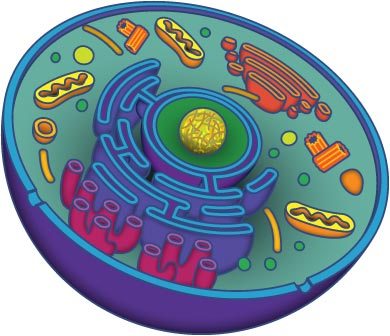
Identify the structure that is indicated by the arrow in the image.

a)

cell wall

b)

central vacuole

c)

chloroplast

d)

nucleus

13.

Identify the structure that is indicated by the arrow in the image.

a)

cell wall

b)

central vacuole

c)

chloroplast

d)

cell membrane

14.

Identify the structure that is labeled "C" in the image.

a)

central vacuole

b)

nucleus

c)

chloroplast

d)

mitochondria

e)

cell membrane

15.

Identify the structure that is labeled "H" in the image.

a)

cell wall

b)

chloroplast

c)

mitochondria

d)

nucleus

e)

cell membrane

16.
I am the outer most layer of an animal cell. What am I?
a)
cell wall
b)
nucleus
c)
cell membrane 
d)
cell skin
17.

What cell part is NOT found in all cells?

a)

Chloroplasts

b)

Cell Membrane

c)

Cytoplasm

d)

Nucleus

18.

Which of these is not found in the animal cell and is found in the plant cell? Pick more than one

a)

cell membrane

b)

cell wall

c)

chloroplast

d)

cytoplasm

19.

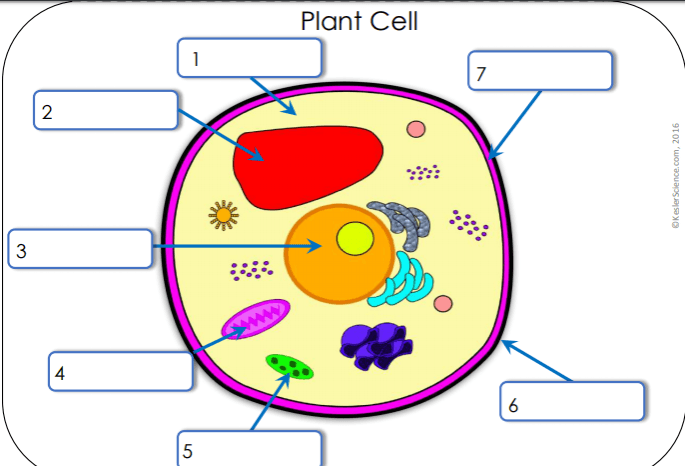
What is #3 in the diagram?

a)

vacuoles

b)

cell membrane

c)

chloroplast

d)

nucleus

20.
Breaking food down with the use of enzymes is known as:
a)
Chemical Digestion
b)
Physical Digestion
21.
Chewing food is an example of _____________.
a)
chemical digestion
b)
mechanical digestion
22.
Where digestion begins, teeth and tongue help break food into smaller pieces.
a)
mouth
b)
pharynx
c)
esophagus
d)
salivary glands
23.
Physical changes size and shape of something?
a)
False
b)
True
24.
When something new is created or a substance is broken down into diffrent chemicals, you have a chemical change.
a)
True
b)
False
25.
A copper penny turning greenish after a few years is an example of ...
a)
Chemical Change
b)
Physical Change
26.
The main purpose of the ____________ system is to break food particles into pieces that can be used.
a)
circulatory
b)
respiratory
c)
digestive
d)
skeletal
27.
What is responsible for delivering oxygen and removing carbon dioxide from the body?
a)
cell nucleus
b)
excretory system
c)
nervous tissue
d)
respiratory system
28.
Which of the following body systems work together for support, protection, and movement?
a)
respiratory and cardiovascular
b)
skeletal and muscular
c)
skeletal and integumentary
d)
digestive and respiratory
29.

What is the function of the endocrine system?

a)

produce hormones that control body processes

b)

get rid of waste

c)

break down food into nutrients

d)

provide movement

30.
Geotropism is a force that affects certain organisms.  Which of the following is an example of a plant responding to the external stimulus of gravity?
a)
A seedling growing towards a sunny window.
b)
Plant roots growing down into the soil.
c)
Flowers producing nectar to attract bees.
d)
A potted plant wilting when it dries out.
31.
When a seedling emerges upright from the soil, which force is it overcoming?
a)
Gravity
b)
Magnetism
c)
Repulsion
d)
Heat
32.
A cheetah's water levels are becoming too high, and its thirst is quenched. In response to this, the cheetah's body will send internal signals...
a)
Of hunger, since the cheetah needs food
b)
Of thirst, since all living things need water
c)
To sweat, so the organism can shed some of the water
d)
Of quenched thirst, so the organism will stop drinking water
33.
Which of the following is an example of an external Stimuli?
a)
Becoming dehydrated and then taking a drink of water
b)
Getting a headache and then taking Excedrin
c)
Having hunger pains and then eating a sandwich
d)
Smelling Pizza and then eating a piece
34.
Which type of tropism?
a)
hydrotropism
b)
thigmotropism
c)
phototropism
d)
geotropism (Gravitropism)
35.
What is a tropism
a)
A stimulus that affects plants. 
b)
The way a plant responds to a stimulus. 
c)
The way a plant grows.
d)
The way a plant dies. 
36.
The process of plants creating their own food is called?
a)
Germinate 
b)
Nutrients 
c)
Photosynthesis
d)
Plant Life 
37.

Which part of the plant shows positive geotropism?

a)

Stem

b)

Leaves

c)

Roots

d)

Seed

38.

Which part of the plant shows negative geotropism?

a)

The roots

b)

The leaves and stem

39.

Which part of the plant shows positive phototropism?

a)

The roots

b)

Stems and leaves

40.

Which part of the plant shows negative phototropism?

a)

Leaves and stems

b)

Roots

41.
What type of tropism response to water? 
a)
Hydrotropism
b)
Gravitropism
c)
Thigmotropism
d)
Phototropism
42.

What does Negative Tropism mean?

a)

Not growing at all

b)

Growth toward the stimulus

c)

Growth away from the stimulus

43.

When a seedling grows, it exerts what type of force on the soil?

a)

upward force

b)

downward force

c)

diagonal force

d)

horizontal force

44.

When a response is positive it

a)

grows away from the stimulus

b)

grows towards the stimulus

45.

The roots have negative

a)

phtotropism

b)

Thigmotropism

c)

Gravitropism

d)

Hormones

46.

what type of tropism is occurring here?

a)

phototropism

b)

thigmotropism

c)

geotropism

d)

tropictropism

47.
What three things do plants need?
a)
Water, air, and sunlight.
b)
Water, soil, and sunlight.
c)
Water, soil, and air.
d)
Love, family, and Cheetos.
48.
What does chlorophyll capture?
a)
Chlorophyll captures water from the air.
b)
Chlorophyll captures carbon dioxide from the air.
c)
Chlorophyll captures the energy of sunlight.
d)
Chlorophyll captures baseballs.
49.

What part of the plant absorbs water?

a)

shoot (stem and leaves)

b)

roots

50.

Which of the following is an example of an organism?

a)

plant

b)

animal

c)

one-celled amoeba

d)

all of the above