
 Worksheets
Cellular Transport Honors Bio Practice
Total questions: 52
Worksheet time: 44mins
Which is NOT found in the cell membrane?
carbohydrates
proteins
lipids
nucleic acids

In the diagram B represents ______________ which are _____________
phosphate heads, hydrophilic
phosphate heads, hydrophobic
fatty acid tails, hydrophilic
fatty acid tails, hydrophobic
How do materials pass through the membrane in simple diffusion vs. facilitated diffusion?
in simple diffusion they use the protein channels and in facilitated diffusion they use the protein pump
in simple diffusion they fit between gaps in the phospholipid bilayer and in facilitated diffusion they use the protein channels
in simple diffusion they use the protein pumps and in facilitated diffusion fit between gaps in the phospholipid bilayer
none of these are correct

Which types of molecules would have the most difficult time crossing the lipid bilayer?
large, charged molecules
small, uncharged molecules
What are protein channels and protein pumps?
proteins acting as enzymes which aid in digestion
proteins acting as enzymes which aid in the building or larger molecules
transport proteins in the cell membrane
proteins involved in cell to cell recognition
If cells containing 10% sodium are placed in a solution with 20% sodium. What type of solution is this and what would happen?
hypertonic, water would enter the cell
hypotonic, water would enter the cell
hypertonic, water would leave the cell
hypotonic, water would leave the cell
If a cell containing 5% NaCl is placed in an environment that is 5% NaCl. That environment would be described as
isotonic
hypertonic
hypotonic
hydroponic

How to cells release waste by fusing a vesicle with the cell membrane?
exocytosis
endocytosis
Which is the only type of transport that moves particles from an area of low concentration to an area of higher concentration (against the concentration gradient)
simple diffusion
facilitated diffusion
spontaneous transport
active transport
Which is true about the cell membrane?
It has a hard surface
It is semipermeable
It contains digestive enzymes
All of the above
Molecules moves from high to low concentration in ______.
down hill racing
up hill racing
passive transport
active transport
In diffusion, molecules move from _________ concentration?
high to low
low to high
low to low
high to high
Osmosis describes movement of ___________ across the semipermeable membrane.
gas
sugar
water
people
Diffusion occurs because molecules __________.
are in homeostasis
are happy and playful
are always moving
are always sad
Movement of oxygen and carbon dioxide across the plasma membrane with the concentration gradient would be and example of ________
Endocytosis
Exocytosis
facilitated diffusion
simple diffusion
Which is an example of an active transport?
Endocytosis
Diffusion
Osmosis
Passive transport
Movement of gasses and uncharged molecules through the phospholipid bilayer occurs in ______.
simple diffusion
facilitated diffusion
super diffusion
none of the above
Facilitated diffusion is the movement of molecules that_____
does not require energy
move with concentration gradient
move through the membrane protein
All of the above


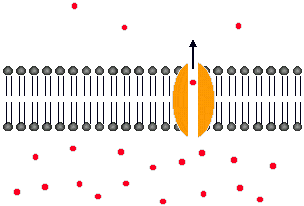
Particles, like macromolecules, are too large to enter the membrane.
Need help from channel proteins. No energy required.
active transport
passive transport
facilitated diffusion
osmosis

Uses energy.
If kool-aid powder made of sugar, flavor, and food dye is the solute, then water added is the _________ and kool-aid (the drink once made) is the _________
solution; solvent
solvent; solution
solvent; concentration
concentration; solvent
If an animal cell were placed in a solution of water taken from the ocean, what would happen to the cell?
The cell would swell because the solution is hypertonic
The cell would swell because the solution is hypotonic
The cell would shrink because the solution is hypertonic
The cell would shrink because the solution is hypotonic


Check all of the factors that can speed up the diffusion rate of molecules?
increase temperature
greater concentration differences
smaller particles
increased surface area

What type of transport is pictured here?
endocytosis
exocytosis
diffusion
osmosis
A test tube of water containing 0.8 mg of salts, holding a cell whose cytoplasm has a concentration of 0.02 mg salts. The "cell" is considered ______________________ relative to the solution in the test tube.
hypertonic
hypotonic
isotonic
What is the polarity of the different parts of the cell membrane?
the heads are nonpolar; the tails are polar
the heads are polar; the tails are nonpolar
the heads and tails are nonpolar
the heads and tails are polar
Give three examples of passive transport.
diffusion, osmosis, phagocytosis
facilitated diffusion, molecular pumps, osmosis
osmosis, facilitated diffusion, diffusion
exocytosis, molecular pumps, pinocytosis
Which form of cellular transport requires the use of energy?
active transport
passive transport
Decreased temperature will lead to faster osmosis
True
False


If the dots represent sugar what direction will the water flow?
Into the cell
Out of the cell
Both equally (equilibrium)

After examining this diagram showing the concentration of water inside and outside of the cell, identify the tonicity of the solution.
hypertonic
hypotonic
isotonic
difference in the concentration of a substance from one location to another
Concentration gradient
Protein Pump
Active Transport
Passive Transport
solution that has a higher concentration of dissolved particles compared with another solution
isotonic
hypertonic
hypotonic
tonicity
diffusion of molecules assisted by protein channels that pierce a cell membrane
facilitated diffusion
diffusion
osmosis
hydrophilic
molecules move from low concentration to high concentration
passive transport
active transport
diffusion
with the concentration gradient
cell is in a ___________solution when water moves out of the cell
isotonic
hypertonic
hypotonic
The solution has more water than the cell , it is a ___________ solution
isotonic
hypertonic
hypotonic

Which part of this phospholipid is hydrophobic (fears water) "runs away with the "tails" between their legs"?
fatty lipid tails
head
all of it is hydrophobic
none of it is hydrophobic

