Wayground logo

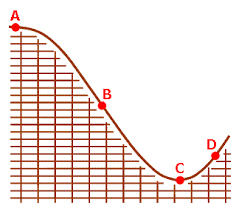
Free Printable Worksheets

Font size

S
M
L
XL
Worksheets

Physical Science Exam Review

Total questions: 190

Worksheet time: 4hrs 42mins

Name
Class
Date
1.
The International System of Units only includes _____ base units
a)
five
b)
six
c)
seven
d)
eight
2.

She thought that ants used the filtered light that penetrated the upper layers of earth and would dig more tunnels during the daytime.

a)

describe independent variable

b)

describes constants

c)

describes conclusion

d)

describes the hypothesis

3.

Every other day for three weeks the length of the tunnels was measured in millimeters using a string and a ruler. Averages for the light and dark groups for each measured were then computed. The averages are listed in the following chart.

a)

describes the dependent (outcome) variable.

b)

describes hypothesis

c)

describes conclusion

d)

describes independent variable

4.
Determine the number of Significant Figures in 101.00 mL.
a)
5
b)
4
c)
3
d)
2
5.
Determine the number of Significant Figures in 101320 Pa.
a)
5
b)
4
c)
3
d)
6
6.
Determine the number of Significant Figures in 10.0 g
a)
1
b)
4
c)
3
d)
2
7.
Which is the correct measurement of the red line?  
a)
9 cm
b)
8.5 cm
c)
8.50 cm
d)
8.1 cm
8.
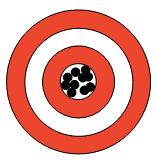
?
a)
High Accuracy & High Precision
b)
High Accuracy & Low Precision
c)
Low Accuracy & High Precision
d)
Low Accuracy & Low Precision
9.
729 cm = _____ hm
a)
7290
b)
72.9
c)
.729
d)
.0729
10.
.0791 km = _____ m
a)
7.91
b)
79.1
c)
791
d)
7910
11.
209 g = _________kg
a)
0.209
b)
2.09
c)
20,900
d)
2,090
12.

Which of the following are pure substances?

a)

Carbon dioxide (CO2)

b)

Milk

c)

Salt water

d)

Nitrogen (N2)

13.

Which of the following are mixtures?

a)

Sodium bicarbonate (NaHCO3)

b)

Steel (Fe + C)

c)

Salt water (NaCl + H2O)

d)

Gold (Au)

14.

Which of the following are compounds?

a)

Silver nitrate (AgNO3)

b)

Bronze (Cu + Sn)

c)

Sugar (C12H22O11)

d)

Blood

15.

What type of matter is this?

a)

Compound

b)

Element

c)

Mixture of elements

d)

Mixture of compounds

16.

What type of matter is this?

a)

Element

b)

Compound

c)

Mixture of elements

d)

Mixture of compounds

17.

Which of the following are evidences of a chemical change?

a)

Change of color (unintended)

b)

Change of shape

c)

Change of size

d)

Change of odor

18.

Which of the following are evidences of a physical change?

a)

Change of size

b)

Change of color (unintended)

c)

Change of state of matter

d)

Change of odor (Unintended)

19.

You can identify this mixture because you can only see one phase

a)

Mixture of elements and compounds

b)

Mixture of compounds

c)

Homogeneous

d)

Heterogeneous

20.

Which of the following are examples of chemical changes?

a)

Burning paper

b)

Cutting paper

c)

Iron rusting

d)

Wrinkling paper

21.

Which of the following are physical changes?

a)

Cutting your hair

b)

Fruit rotting

c)

Water boiling

d)

Dropping an alka-seltzer in water

22.

How do you identify an element?

a)

It is made of only one type of atoms

b)

It is made of different type of atoms

c)

It can be found on the Periodic Table

d)

It is represented by a chemical symbol

23.
This picture represents which of the following?
a)
element
b)
compound
c)
mixture
24.
What is matter?
a)
Any subtance that doesn't take up space or have mass.
b)
Any substance that takes up space or have mass.
c)
Any substance that exists on Earth.
d)
Any substance that exists in space.
25.

Phase change going from Liquid to Solid...

a)

Melting

b)

Freezing

c)

Condensation

d)

Sublimation

26.

Phase change going from a Solid to a Liquid...

a)

Freezing

b)

Condensation

c)

Melting

d)

Sublimation

27.

Phase change going from a Solid to a Gas...

a)

Deposition

b)

Sublimation

c)

Condensation

d)

Recombination

28.

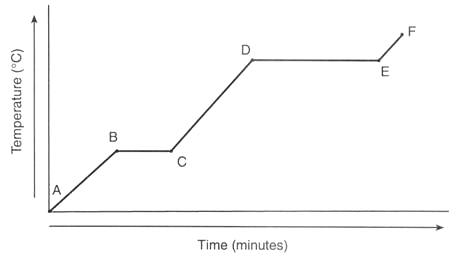
Is the substance gaining or losing energy?

a)

Gaining

b)

Losing

29.

What state/phase is the object likely from points A to B?

a)

Solid

b)

Liquid

c)

Gas

d)

Plasma

30.

Are the particles moving faster or slower as time goes on?

a)

Faster

b)

Slower

31.

Is the substance gaining or losing energy?

a)

Gaining

b)

Losing

32.

Where on the graph are phase changes taking place?

a)

1

b)

2

c)

3

d)

4

e)

5

33.
What happens to particle movement/speed when energy is added to a phase?
a)
Particles slow down
b)
Particles go faster
c)
Particles don't move
d)
Particles stay the same speed
34.
What happens to particle spacing when energy is added to a phase? 
a)
Particles move farther apart
b)
Particles move closer together
c)
Particles stay the same
35.
In an exothermic reaction, heat is ...
a)
taken in or absorbed
b)
given out or released
36.
In an endothermic reaction, heat is ...
a)
taken in or absorbed
b)
given out or released 
37.
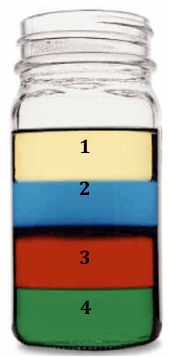
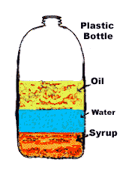
Put the liquids in order from most dense to least dense?
a)
4, 3, 2, 1
b)
1, 2, 3, 4
c)
3, 4, 2, 1, 
d)
4, 3, 1, 2
38.
What do we know about the density of lamp oil, rubbing alcohol, and vegetable oil?  
a)
The density is greater than 1.0 g/mL
b)
The density is less than 1.0 g/mL
c)
The density is equal to 1.0 g/mL
d)
The density can not be determined
39.
Which liquid is the least dense?
a)
oil
b)
water
c)
syrup 
d)
plastic bottle
40.
In general what is the most dense form of matter?
a)
solid
b)
liquid
c)
gas
d)
plasmas
41.
Jack has a rock. The rock has a mass of 14 g and a volume of 2 cm3. What is the density of the rock?
a)
7 mL
b)
7 g/cm3
c)
28 g/cm3
d)
1/7 g/cm3
42.
What is the formula for density?
a)
density = mass x volume
b)
density = mass / volume
c)
density = mass + volume
d)
density = mass - volume
43.
Which substance is the MOST dense?  ** Use the key
a)
A
b)
B
c)
C
d)
Cannot be determined by the data provided.
44.
Which box has a higher density?  
a)
Box A
b)
Box B
c)
cannot be determined
d)
they are the same
45.
What is the volume of 150 grams of lead if it has a density of 11.3 g/cm3?
a)
13.3 g
b)
13.3 cm3
c)
.075 g
d)
1695 cm3
46.
Density is...
a)
the amount of mass in an object
b)
the amount of space an object takes up
c)
the amount of mass in a given space
d)
the weight of an object
47.
Italian Salad Dressing
a)
heterogeneous mixture
b)
homogeneous mixture
48.
An example of ...
a)
A mixture
b)
A compound
c)
An element 
49.

Diagram(s) representing a single element

a)

A

b)

B

c)

C

d)

D

50.

What kind of matter is this?

a)

Element

b)

Compound

c)

Mixture

51.

Subatomic particles with a negative charge

a)

Electrons

b)

Neutrons

c)

Protons

d)

Quarks

52.
subatomic particles found on the outermost shell & responsible for the atom's reactivity
a)
neutrons
b)
valence electrons
c)
isotopes
d)
ions
53.
Subatomic particles with a positive charge
a)
neutrons
b)
atomic mass
c)
protons
d)
isotopes
54.
Value representing the number of protons in an element
a)
Atomic Mass
b)
Mass Number
c)
Valence Electrons
d)
Atomic Number
55.
Where electrons are likely to be found as they travel around the nucleus
a)
Nucleus
b)
Electron Cloud
c)
Within a Proton
d)
Within a Neutron
56.

A horizontal row of elements in the periodic table

a)

Molecule

b)

Period

c)

Family

d)

Atom

57.

What is one way Neutrons are different from electrons?

a)

they both are negative

b)

neutrons have no charge, while electrons have a negative charge

c)

Both are in the nucleus( center of atom)

d)

Electrons are inside nucleus and neutrons are outside the nucleus.

58.

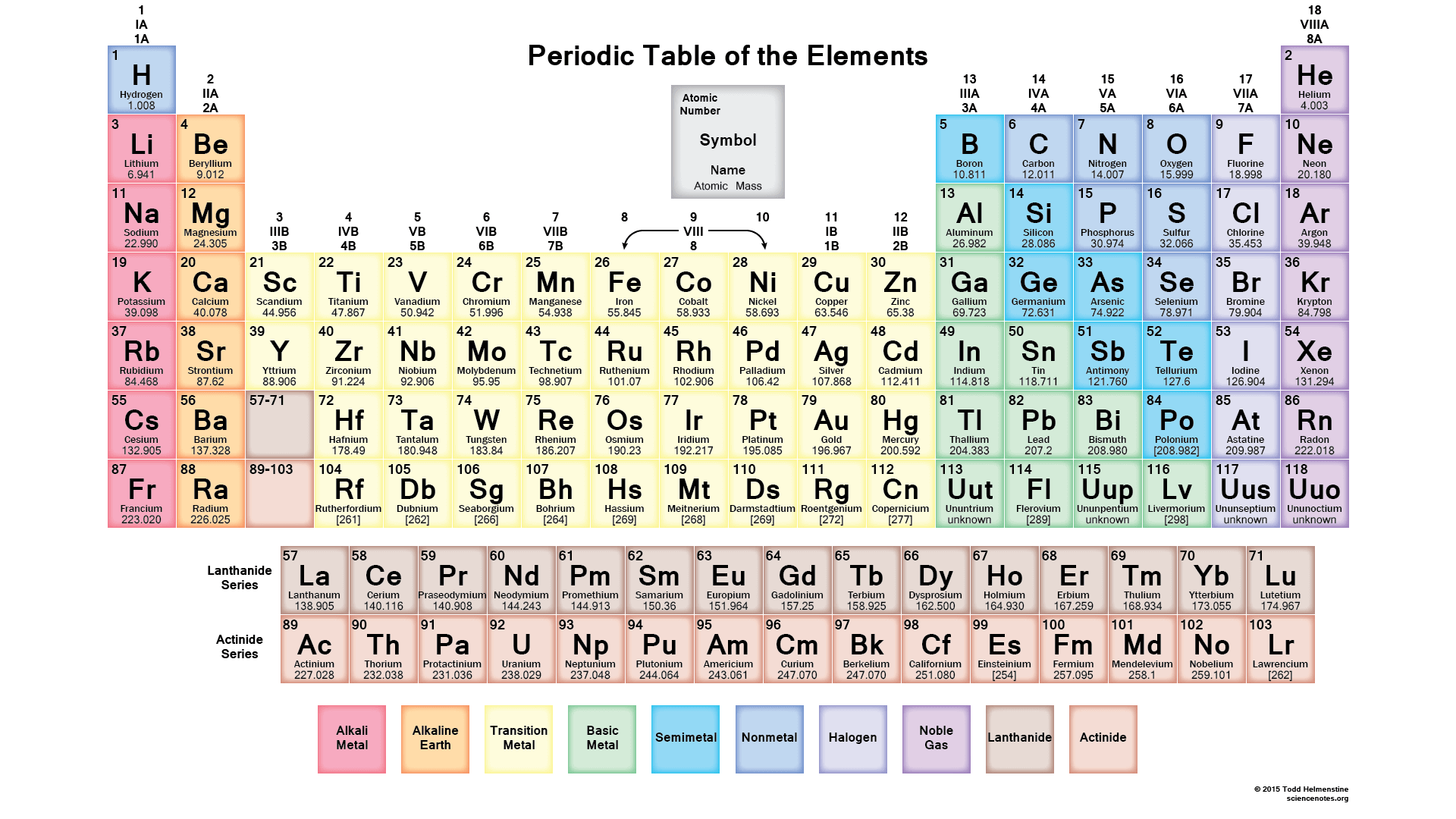
What is the atomic number?

a)

35

b)

18

c)

17

d)

52

59.

The vertical (up and down) columns in the Periodic Table are called

a)

groups

b)

towers

c)

periods

d)

atomic numbers

60.
Which is an electron?
a)
A
b)
B
c)
C
61.
An element's identity is determined by the number of
a)
electrons.
b)
protons.
c)
neutrons.
d)
valence.
62.

Elements in the same group have the same

a)

Properties

b)

Number of electrons

c)

Number of protons

d)

Nucleus

63.
Sodium (Na) is found in period 
a)
3
b)
2
c)
4
d)
1
64.
Sodium (Na) is found in group 
a)
1
b)
2
c)
3
d)
4
65.
What is an isotope? 
a)
A charged atom
b)
An atom with different amounts of neutrons
c)
An atom with different amounts of protons
d)
A neutral atom
66.
How many neutrons does a Sodium 24 isotope have?
a)
12
b)
13
c)
14
d)
15
67.

76 protons and 114 neutrons

a)

Osmium-114

b)

Osmium-76

c)

Osmium-190

d)

Osmium-190.23

68.

9 protons and 9 neutrons

a)

Fluorine-18

b)

Fluorine-9

c)

Fluorine-16

d)

Fluorine-18.998

69.
What quantities vary between isotopes of an element?
a)
protons, electrons, and atomic mass
b)
protons, electrons, and atomic number
c)
neutrons and electrons
d)
neutrons and atomic mass
70.
Which of the following is the atomic number of an alkali metal?
a)
31
b)
20
c)
18
d)
19
71.
What group on the Periodic Table contains the elements of the alkaline earth family?
a)
1
b)
2
c)
17
d)
18
72.
Gold (Au)
a)
Transition Metal
b)
Alkali Metal
c)
Alkaline Earth Metal
d)
Heavy Metal
73.
Argon (Ar)
a)
alkali metal
b)
alkaline earth metal
c)
halogen
d)
noble gas
74.
How many valence electrons does an alkaline earth metal have? 
a)
1
b)
2
c)
7
d)
8
75.

This type of element is dull, brittle solids and gases, insulators, poor conductors of heat and electricity, as well as having low melting points.

a)

metals

b)

metalloids

c)

nonmetals

76.
Which is a metal?
a)
Rhodium (Rh)
b)
Arsenic (As)
c)
Hydrogen
d)
Argon (Ar)
77.
Matter can not be created nor destroyed: it can only be
a)
Destroyed a little bit
b)
Invisible
c)
Transformed, changed
d)
None of the above
78.
The number in front of a compound or element is a 
a)
Subscript
b)
Coefficient
c)
Superscript
d)
Charge
79.
A chemical reaction is balanced when
a)
both sides have the same elements
b)
Both sides have the same  number of atoms
c)
Same subscripts
d)
Same coefficients
80.
In a synthesis reaction
a)
A compound breaks apart into two or more compounds
b)
Two or more compounds make one single product
c)
CO2 and H2O must be products
d)
O2 must be a reactant
81.
In a reaction A + B ----> C,  reactant A has 5g and product  C has 9g. How many grams does reactant B should have? 
a)
4g
b)
5g
c)
9g
d)
14g
82.
What will weigh more when a chemical change is complete?  The reactants before the chemical reaction, or the product after the reaction is complete?
a)
They both will weigh the same
b)
The product always weighs more than the reactant
c)
The reactant will weigh more than the product
d)
They both will loose mass after the reaction
83.
What is the Law of Conservation of mass?
a)
Mass is created in a chemical reaction
b)
Mass is created in a physical change
c)
New chemicals formed from a chemical reaction have a larger overall mass than the original reactants
d)
Mass is never created or destroyed
84.
What is the part of the chemical equation in green called? 
Fe + S --> FeS
a)
products
b)
reactants
c)
yield
d)
chemical formula
85.
How many elements are in C6H12O6?
a)
1
b)
2
c)
3
d)
4
86.
How many HCl molecules do you need to balance this equation? 
Mg +  __HCl --->  MgCl2 + H2
a)
1
b)
2
c)
3
d)
4
87.

Balance this equation

_Al +_HCl --> _H2 +_AlCl3

a)

2,6,3,2

b)

it's already balanced

c)

4,12,3,4

d)

2,1,4,5

88.
What is the right part of a chemical equation called...
2H2 + O2 --> 2H2O
a)
Reactants
b)
Products 
c)
Yields 
d)
Chemical Equation 
89.
What is the total number of atoms present in 5Na3PO4
a)
5
b)
40
c)
55
d)
8
90.

Balance the following equation:

___ H2+ ___ O2→___ H2O

a)

1, 1, 3

b)

2, 2, 2

c)

1, 2, 1

d)

2,1, 2

91.
2HI --> H2 + I2
a)
synthesis
b)
decomposition
c)
single replacement
d)
double replacement
92.
Zn + H2S --> ZnS + H2
a)
synthesis
b)
combustion
c)
single replacement
d)
double replacement
93.
FeS + HCl --> H2S + FeCl2
a)
synthesis
b)
combustion
c)
single replacement
d)
double replacement
94.
Bob puts 200 grams of ice into a pitcher with 900 grams of water. He gets distracted and comes back later to find that the ice has melted in the water. How many grams of water does Bob now have in the pitcher?
a)
200 g
b)
700 g
c)
1,100 g
95.
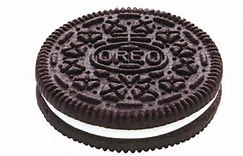
An oreo cookie weighs 20 grams.  It gets crushed into crumbs for a recipe.  How much do its crumbs weigh?
a)
15 grams
b)
25 grams
c)
20 grams
96.

Water

a)

Element

b)

Ion

c)

Compound

97.

Chloride

a)

Element

b)

Ion

c)

Compound

98.

rhodium

a)

Element

b)

Ion

c)

Compound

99.

Manganese (II)

a)

Element

b)

Ion

c)

Compound

100.


 CO2CO_2^{ }  

a)

Element

b)

Ion

c)

Compound

101.

ammonium nitrate

a)

Element

b)

Ion

c)

Compound

102.

 HNO3HNO_3 

a)

Element

b)

Ion

c)

Compound

103.
What is the correct formula for the compound, lithium oxide?
a)
LiO
b)
Li2O
c)
LiO2
d)
Li2O2
104.
What is the formula for manganese(III) oxide?
a)
MgO
b)
Mg2O3
c)
MnO
d)
Mn2O3
105.
The formula of calcium phosphate is 
a)
CaPO4
b)
Ca2(PO4)3
c)
Ca3PO4
d)
Ca3(PO4)2
106.
What is the chemical formula for Tetrasulfur pentoxide?
a)
SO
b)
S4O
c)
S4O5
d)
S5O4
107.
Roman numerals tell you the ____ of the metal cation(s) in an ionic compound.
a)
number
b)
mass
c)
type
d)
charge
108.
True or false: When naming ionic compounds, use prefixes to indicate subscripts
a)
True
b)
False
109.
Ionic compounds are written with
a)
cation (+ ion) first then anion (- ion)
b)
anion (- ion) first then cation (+ ion)
c)
either way is fine
d)
polyatomic ions first
110.
ammonium phosphate
a)
(NH4)3PO4
b)
NPO4
c)
NH4PO4
d)
NH4(PO4)3
111.
The chemical formula for tin (IV) oxide is written
a)
Sn2O4
b)
Ti2O4
c)
SnO2
d)
TiO2
112.
You can measure _____ by dividing distance over time.
a)
motion
b)
position
c)
speed
d)
velocity
113.
When runners are running around a track, they are constantly changing their _____.
a)
motion
b)
speed
c)
velocity
d)
force
114.
An object's location is its _____.
a)
force
b)
motion
c)
velocity
d)
position
115.
What is the total displacement of the object represented in this motion graph?
a)
5 meters
b)
4 meters
c)
2 meters
d)
0 meters
116.
What is the total distance of the object represented in this motion graph?
a)
5 meters
b)
4 meters
c)
2 meters
d)
0 meters
117.
What is the total distance of the object represented in this motion graph?
a)
0 meters
b)
10 meters
c)
11 meters
d)
20 meters
118.
What is the total distance of the object represented in this motion graph?
a)
0 meters
b)
140 meters
c)
150 meters
d)
300 meters
119.
A runner races in the 100 meter dash.  It takes her 10 seconds to finish.  What is her average speed?
a)
10 m/s
b)
1000 m/s
c)
100 seconds
d)
10 seconds
120.
Which runner won the race?
a)
A
b)
B
c)
C
d)
It was a tie
121.
Velocity is both ____ and _____. 
a)
speed , direction 
b)
direction, mass
c)
volume, density 
d)
direction, magnitude 
122.
You walk 10 meters to math class in 20 seconds. Your average speed is
a)
2 m/s
b)
0.5 m/s
c)
200 m/s
d)
5 m/s
123.
A roller coasters accelerates from an initial velocity of of 6.0 m/s to a final velocity of 70 m/s over 4 seconds.  What's the acceleration?
a)
24 m/s2
b)
18 m/s2
c)
16 m/s2
d)
16 m/s
124.
A dog runs with an initial speed of 7.5 m/s on a waxed floor.  It slides to a stop in 15 seconds.  What is the acceleration?
a)
-7.5 m/s
b)
-7.5 m/s2
c)
-0.5 m/s2
d)
7.5 mi//hr
125.
The picture of the position vs. time graph shows an object that is...
a)
accelerating/speeding up
b)
moving at a constant speed 
c)
not moving 
d)
accelerating/slowing down. 
126.
Why does a car accelerate as it round a corner at a constant speed?
a)
Its direction changes
b)
It doesn't
c)
It slows down
d)
Its speeds up  
127.
In each of the following cases, determine where the car has no acceleration ?
a)
A car shortly after a stoplight turns green.
b)
A car approaching a red light
c)
A car with the cruise control set at 80 km/h
d)
A car turning a curve at a constant speed
128.
Which of the following is a unit for acceleration?
a)
km/s
b)
m/s2
c)
mi/hr
d)
ft
129.
How can acceleration be zero?
a)
a car runs out of gas and slowly rolls to a stop
b)
a car decreases speed at a constant rate until it comes to rest
c)
car has constant speed and is traveling on a straight path
d)
the car travels round trip and is back at the starting point
130.

A quantity that needs both magnitude and direction to be fully described.

a)

Vector

b)

Scalar

131.

A quantity described by magnitude and does not need direction

a)

Vector

b)

Scalar

132.
What is the net force?
a)
20 N 
b)
0 N 
c)
400 N 
d)
40 N 
133.

What is the unit to MEASURE force?

a)

Kilogram

b)

Meter

c)

Pounds

d)

Newton

134.

A ____________ is a push or a pull on an object.

a)

friction

b)

force

c)

magnet

d)

gravity

135.
Balanced or unbalanced?
a)
balanced
b)
unbalanced
136.
The sum of all forces acting on an object.
a)
Contact Force
b)
Balanced Force
c)
Unbalanced Force
d)
Net Force
137.
What will cause an object to move?
a)
Applied forces
b)
Balanced forces
c)
Unbalanced forces
138.
You and your dad are moving the couch from one side to another. Your dad pushes with a force of 35 N to the right and you push with a force of 25 N right. What is the net force on the couch?
a)
60 N right
b)
10 N left
c)
60 n right
d)
50 N left
139.

Which example would be a balanced force?

a)

Train moving at a constant speed in the same direction.

b)

A skier going down a hill.

c)

A basketball being passed to a teammate.

d)

An apple falling to the floor.

140.
A 20 kg bike accelerates at 10 m/s2.  what was the force?
a)
25 Newtons
b)
20 Newtons
c)
200 Newtons
d)
10 Newtons
141.
What is Newton's First Law known as? The Law of
a)
Friction
b)
Mass
c)
Inertia
d)
Gravity
142.
What is Newton's First Law
a)
F=ma
b)
Every action has an equal and opposite reaction
c)
An object at rest stays at rest, an object in motion stays in motion. 
d)
Friction 
143.
Newton's third law states that any action will have a(n) _______ and ______ reaction
a)
Equal and similar
b)
Equal and opposite
c)
Equal and different
d)
Greater and opposite
144.
This equation goes with which law?
a)
Newton's first law of motion
b)
Newton's second law of motion
c)
Newton's third law of motion
d)
None of these
145.
When a cannon fires a cannonball we observe Newton's third law. Which force is the reaction force?
a)
The cannon moving forward
b)
The cannonball moving forward
c)
The cannon moving backward
d)
The cannonball moving backward
146.
A bike accelerates at 10 m/s2 when a force of 50N is applied.  What is the mass of the bike and its rider?
a)
25 kg
b)
200 kg
c)
20 kg
d)
5 kg
147.
Which of Newton's laws are illustrated with a rocket launch?
a)
1st Law, the Law of Inertia. 
b)
2nd Law, the Law of Acceleration.
c)
3rd Law, the Law of Action Reaction
d)
The Law of Conservation of Mass
148.
Objects with more mass or heavier have LESS inertia.
a)
True
b)
False
149.
Friction can make a moving object slow down or stop.
a)
True
b)
False
150.
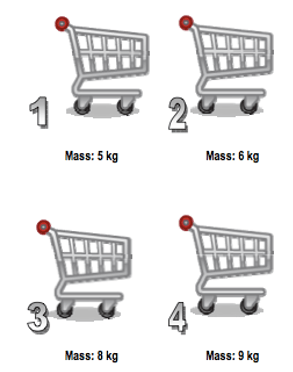
A force of 90N is applied to each cart below, which one will accelerate the fastest?
a)
Cart 1
b)
Cart 2
c)
Cart 3 
d)
Cart 4
151.

If two people with the same mass collide, they experience the same amount of force.

a)

True

b)

False

152.

Force always come in________

a)

waves

b)

triplets

c)

pairs

153.

When a heavy football player and a light one run into each other, who exerts more force

a)

The light one

b)

Their force are equal

c)

The heavy one

154.
The force that pulls things toward earth.
a)
Speed
b)
Gravity
155.
What is the definition of "weight"?
a)
measure of the force of gravity on your body
b)
the time it takes to get on a ride 
c)
the amount of matter in an object
d)
the size of an object
156.
In physics, weight is measured in _____.
a)
grams
b)
newtons
c)
kilograms
d)
pounds
157.
In physics, the weight equation is _____________.
a)
Weight=Mass×Gravity
b)
Mass=Weight×Gravity
c)
Gravity=Mass×Weight
158.

What is the weight of a 15 kg object on earth? (Use g= 9.8 m/s2)

a)

147 N

b)

.65 N

c)

1.53 N

d)

207 N

159.
If a net force is acting on an object, 
a)
its velocity must be constant
b)
its velocity must be changing
c)
its mass must be changing
d)
its acceleration = 0 
160.
Most modern vehicles have padded dashboards. This reduces collision injuries by...
a)
reducing the driver's change in momentum
b)
increasing the driver's change in momentum
c)
increasing the force of impact
d)
increasing the time of impact
161.

In an elastic collision, ______ is conserved.

a)

Momentum only

b)

Kinetic Energy only

c)

Both momentum and energy

162.
In a perfectly inelastic collision, ______ is conserved. 
a)
Momentum only
b)
Kinetic Energy only
c)
Both momentum and kinetic energy
163.
The recoil speed of a rifle is much less than the exit velocity of a bullet because...
a)
the rifle experiences a smaller force
b)
the rifle experiences a smaller change in momentum
c)
the rifle has a much greater mass
d)
the rifle does not obey the laws of physics
164.
A 50 kg ball rolls down the street at 5 m/s. Calculate the momentum of the ball. 
a)
55 kg*m/s
b)
100 kg*m/s
c)
250 kg*m/s
d)
500 kg*m/s
165.
Parkour Peter bends his knees upon landing in order to ____
a)
reduce his change in momentum
b)
increase his change in momentum
c)
increasing his landing time
d)
increasing his landing force
166.
The momentum of an object depends upon the object's ___________&_____________.  
a)
size and shape
b)
mass and speed
c)
mass and veloctiy
d)
mass and energy
167.
The definition of momentum is
a)
Mass in Motion
b)
The size of an object
c)
The velocity of an object
d)
A comparison between two objects
168.
In any collision (crash) the ______ is ALWAYS constant
a)
Total Momentum
b)
total speed
c)
total Velocity
d)
Energy
169.
When the speed of an object is doubled, its momentum
a)
remains unchanged in accord with the conservation of momentum.
b)
doubles
c)
quadruples
d)
decreases
170.
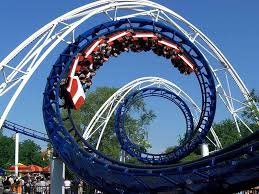
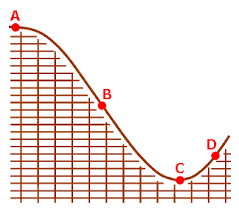
At which point(s) on the roller coaster is the gravitational potential energy at its maximum?
a)
A
b)
B
c)
C
d)
D
171.
At which point(s) on the roller coaster is the kinetic energy at its maximum?
a)
A
b)
B
c)
C
d)
D
172.

1. A ball has a 17 J of kinetic energy and its mechanical energy is 25 J. If the ball has a mass of 3.2 kg, what is its height above the ground?

a)

0.26 m

b)

0.52 m

c)

5.2 m

d)

25 m

173.
What does the Law of Conservation of Energy state?
a)
Energy cannot be created or destroyed
b)
Nothing can exchange energy
c)
Energy will increase over time.
d)
Energy will decrease over time.
174.
Energy of motion is which type of energy?
a)
Potential
b)
Kinetic
c)
Sound
d)
Gravitational
175.

the capacity necessary to do work; controls the amount of change that can occur within a system

a)

speed

b)

joule

c)

momentum

d)

energy

176.

the standard international unit for energy

a)

newton

b)

joule

c)

kilogram

d)

m/s/s

177.
The faster an object moves, the ________ kinetic energy it has. 
a)
more
b)
less
c)
none of the above
d)
all of the above 
178.
As mass increases, KE ...
a)
increases
b)
decreases
c)
stays the same
179.
A moving 10 kilogram object has 20 Joules of kinetic energy. What is its velocity?
a)
2 m/s
b)
4 m/s
c)
200 m/s
d)
10 m/s
180.
What is the mass of a moving object that has 100 Joules of kinetic energy and moves at a velocity of 2 m/s?
a)
50 kg
b)
200 kg
c)
25 kg
d)
100 kg
181.

The highest inhabited town in the world has an elevation of 5334 m above sea level. What would be the gravitational potential energy of a 64 kg person in this town?

a)

341,376 J

b)

83.3 J

c)

3,345,484.8 J

d)

34,834.3 J

182.

The world record for pole vaulting is 6.15 m. I the pole vaulter’s gravitational potential energy is 4942 J, what is his mass?

a)

803.6 kg

b)

504.3 kg

c)

30,393.3 kg

d)

82 kg

183.
What is the form of energy that is created using heat?  This form of energy makes particles of matter move faster.
a)
light energy
b)
thermal energy
c)
chemical energy
d)
kinetic energy
184.
What is the form of energy that is created using heat?  This form of energy makes particles of matter move faster.
a)
light energy
b)
thermal energy
c)
chemical energy
d)
kinetic energy
185.
What is a form of energy that is the result of chemicals reacting to each other or to some action?
a)
light energy
b)
thermal energy
c)
chemical energy
d)
kinetic energy
186.
What is the energy something has because of its position?
a)
electrical energy
b)
solar energy
c)
mechanical energy
d)
potential energy
187.

What is the GPE at point E?

a)

500,000 J

b)

250,000 J

c)

300,000 J

d)

100,000 J

188.

What is the Kinetic Energy at point D?

a)

500,000 J

b)

250,000 J

c)

300,000 J

d)

50,000 J

189.

What is the Kinetic Energy at point C?

a)

500,000 J

b)

400,000 J

c)

300,000 J

d)

50,000 J

190.

What is the GPE at point F?

a)

500,000 J

b)

250,000 J

c)

300,000 J

d)

0 J