wayground logo

Free Printable Worksheets

Font size

S
M
L
XL
Worksheets

Physical Science Midterm

Total questions: 150

Worksheet time: 2hrs 26mins

Name
Class
Date
1.
What type of graph is represented by figure 1-1?
a)
bar graph
b)
line graph
c)
circle graph
d)
non of the above
2.
What is a system of knowledge and the methods used to find that knowledge?
a)
science
b)
technology
c)
measurement
d)
curiosity
3.
How are science and technology related?
a)
Technology is a branch of natural science.
b)
Science is a branch of technology.
c)
Advances in science may lead to advances in technology and vice versa.
d)
Science and technology are not related.
4.
In which step of the scientific method is information obtained through the senses?
a)
drawing conclusions
b)
making observations
c)
analyzing data
d)
revising a hypothesis
5.
What happens when the data in an investigation do not support the original hypothesis?
a)
The scientist gives up and starts an investigation on a new topic.
b)
The data must be incorrect and are thrown out.
c)
The hypothesis is revised.
d)
The data are altered so that they support the original hypothesis.
6.
What is a statement that summarizes a pattern found in nature?
a)
a scientific law
b)
a fact
c)
a scientific theory
d)
a hypothesis
7.
What is the most important safety rule?
a)
Never work with chemicals.
b)
Always use unbreakable glassware.
c)
Always follow your teacher's instructions and textbook directions exactly.
d)
Never do experiments that involve flames or hot objects.
8.
How is 0.00069 written in scientific notation?
a)
69 x 10-5
b)
6.9 x 10⁴
c)
0.69 x 10⁻³
d)
6.9 x 10⁻⁴
9.
What are 6 centimeters equal to?
a)
600 meters
b)
6/10 of a millimeter
c)
60 millimeters
d)
600 millimeters
10.
Timers at a swim meet used four different clocks to time an event. Which recorded time is the most precise?
a)
55 s
b)
55.2 s
c)
55.25 s
d)
55.254 s
11.
On the Celsius scale, at what temperature does water boil?
a)
b)
212°
c)
100°
d)
32°
12.
The type of graph used to show how a part of something relates to the whole is which of the following?
a)
circle graph
b)
bar graph
c)
line graph
d)
direct proportion
13.
How do scientists communicate the results of investigations?
a)
by publishing articles in scientific journals
b)
by giving talks at scientific conferences
c)
by exchanging e-mails
d)
all of the above
14.
How do scientists who speak different languages make their data understandable to one another?
a)
They all use different systems of measurement.
b)
They all use SI.
c)
They communicate through a universal translator.
d)
They all must speak French.
15.
What is a peer review?
a)
a process in which only close friends of a scientist review the scientist's work
b)
a process in which scientists examine other scientists' work
c)
a process in which scientists copy other scientists' work
d)
a process in which scientists keep their work secret
16.
A measurement must include both a number and a(an) ____________________.
a)
letter
b)
unit
c)
phrase
d)
number
17.
Computers are an example of a(an) ____________________ that helps people solve problems.
a)
technology
b)
model
c)
scientific method
d)
tool
18.
____________________ is the closeness of a measurement to the actual value being measured.
a)
precision
b)
model
c)
accuracy
d)
science
19.
Which of the following is NOT a pure substance?
a)
milk
b)
oxygen
c)
sugar
d)
water
20.
Which subatomic particle has a negative charge?
a)
electron
b)
positron
c)
neutron
d)
proton
21.
What you change in the experiment is known as the _______ variable.
a)
Controlled
b)
Dependent
c)
Independent
d)
Constant
22.
What you measure in the experiment is known as the ______ variable.
a)
Dependent
b)
Independent
c)
Controlled
d)
Constant
23.
What you keep the same during the experiment is known as the ____ variable.
a)
Dependent
b)
Independent
c)
Controlled
24.
During an experiment, you must always have a _____ group to compare to your experimental group.
a)
Variable
b)
Problem
c)
Hypothesis
d)
Control
25.
A testable answer to a scientific question written in if then form
a)
Question
b)
Observation
c)
Hypothesis
d)
Experiment
26.
How many variables can be tested in a controlled experiment?
a)
one
b)
two
c)
three
d)
as many as possible
27.
Why do we want to test one variable at a time?
a)
Because it is hard to setup a data table with more
b)
To know what is causing the changes
c)
It is what has always been done
d)
No one really knows
28.
A series of steps used by scientists to solve a problem or answer a question. 
a)
scientific method
b)
recipe
c)
data collection
d)
metric system
29.
A broad and comprehensive statement of what is thought to be true; it is supported by much evidence.
a)
hypothesis
b)
theory
c)
guess
d)
fact
30.
Which statement below correctly identifies the difference between laws and theories?
a)
Laws describe phenomena, while theories explain why phenomena exist.
b)
Laws are a statement of fact, while theories are a statement of opinion.
c)
Laws are a prediction of phenomena, while theories are an explanation
31.

____________ is the change in velocity divided by the time needed for the change to occur.

a)

average velocity

b)

speed

c)

acceleration

d)

displacement

32.

Average speed is found by ________

a)

multiplying total distance traveled by total time

b)

multiplying the displacement by the total time spent

c)

dividing the displacement by the total time spent

d)

dividing total distance traveled by the total time

33.

__________ is the speed of an object at any instant of time.

a)

acceleration

b)

average speed

c)

instantaneous speed

d)

velocity

34.

The distance between your starting position and your final position is called _________

a)

acceleration

b)

differential

c)

displacement

d)

velocity

35.

At 8 AM you leave home and walk 0.5 km to a friend's house. At 11:30 AM you return home, then travel by car to the mall, which is 10 km away, and arrive at 11:45 AM. What is the total distance traveled?

a)

10 km

b)

11 km

c)

10.5 km

d)

2.8 km/h

36.

A net force of 2500 N acts on an African male elephant with a mass of 7000 kg. How large is the acceleration of the African male elephant?

a)

0.22 m/s2

b)

0.25 m/s2

c)

0.30 m/s2

d)

0.36 m/s2

37.

A bowling ball with a mass of 7.3 kg has a net force of 1.5 N acting on it. How large is the bowling ball's acceleration?

a)

0.21 m/s2

b)

0.25 m/s2

c)

0.55 m/s2

d)

1.25 m/s2

38.

Calculate the momentum of a 16 kg bicycle traveling north at 3 m/s.

a)

24 kg m/s

b)

36 kg m/s

c)

42 kg m/s

d)

48 kg m/s

39.

What is the momentum of a train with a mass of 18,000 kg traveling at 13 m/s?

a)

233,400 kg m/s

b)

234,000 kg m/s

c)

234,500 kg m/s

d)

240,000 kg m/s

40.

A jogger whose mass is 65 kg is moving at a speed of 4.0 m/s. What is the jogger's approximate kinetic energy?

a)

240 J

b)

1040 J

c)

520 J

d)

400 J

41.

What is the approximate kinetic energy from a baseball's forward motion, if the baseball is moving at a speed of 50.0 m/s and has a mass of 0.15 kg?

a)

187.5 J

b)

380 J

c)

90.25 J

d)

400 J

42.

An average golfer hits a golf ball with a force of 3800 N. If the club contacts the ball through a distance of 0.01 m, how much work does the golfer do on the ball?

a)

22 J

b)

30 J

c)

50 J

d)

38 J

43.

Find the approximate GPE for a coffee mug with a mass of 0.4 kg on a 1.2 m high counter top.

a)

3 J

b)

4.7 J

c)

7.4 J

d)

10 J

44.

A battery converts 147 J of energy in 3.5 s. What is the battery's power?

a)

42 W

b)

45 W

c)

40 W

d)

48 W

45.

_____________ is a measure of the average kinetic energy of all particles in an object.

a)

radiation

b)

temperature

c)

density

d)

conduction

46.

Which of these make the best conductor?

a)

plastic

b)

wood

c)

air

d)

metal

47.

Which material would be the worst insulator?

a)

aluminum

b)

wood

c)

plastic

d)

rubber

48.

Which unit is used for energy?

a)

J

b)

kg

c)

W

d)

N

49.

In which type of circuit does charge have only one path to flow through?

a)

open

b)

parallel

c)

uniform

d)

series

50.

Electric current in a circuit is measured in _________

a)

amperes

b)

ohms

c)

volts

d)

watts

51.

__________ is the tendency for a material to oppose the flow of electrons.

a)

conduction

b)

resistance

c)

induction

d)

transistance

52.

__________ is the tendency for a material to oppose the flow of electrons.

a)

conduction

b)

resistance

c)

induction

d)

transistance

53.

What is the current in a circuit if the voltage difference is 15 V and the resistance is 15 ohms?

a)

0.0 A

b)

1.0 A

c)

30 A

d)

225 A

54.

What is the lowest point of a wave called?

a)

trough

b)

crest

c)

valley

d)

depressions

55.

Which type of electromagnetic wave can be used to determine how energy efficient a house is?

a)

X-rays

b)

gamma rays

c)

infrared waves

d)

radio waves

56.

Which of the following electromagnetic waves enables your body to make vitamin D?

a)

visible light

b)

ultraviolet waves

c)

gamma rays

d)

infrared waves

57.

Which of the following electromagnetic waves are used for medical treatment?

a)

radio waves

b)

infrared waves

c)

microwaves

d)

gamma rays

58.
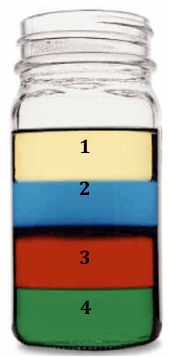
Put the liquids in order from most dense to least dense?
a)
4, 3, 2, 1
b)
1, 2, 3, 4
c)
3, 4, 2, 1, 
d)
4, 3, 1, 2
59.
What is the final velocity of a tennis ball that is dropped from a roof top after 5 seconds?(acceleration = final velocity - initial velocity / time)
a)
1.96 m/s2
b)
1.96 m/s
c)
49 m/s2 
d)
49 m/s
60.
When two or more simple machines work together a _?_ is formed.
a)
complex machine
b)
compound machine
c)
block and tackle
d)
none of these
61.
Brian uses 8,400 J of work to push a box 28 meters.  How much force did he use  to move the box? (Work = Force x distance)
a)
300 N
b)
300 J
c)
235, 200 J
d)
235, 200 N
62.
What is the mechanical efficiency of a block and tackle system if you put in 9, 000 J of work and the machine puts out 3, 800 J of work? (M.E. = work output / work input  x 100)
a)
2.4%
b)
cannot be determined
c)
237%
d)
42.2 %
63.
An object in freefall seems to be _?_.
a)
warped.
b)
weightless.
c)
decreased in size.
d)
increased in size.
64.
Cold air sinks because, compared to hot air, _?_.  
a)
it is more dense.
b)
it is less dense.
c)
it has more molecules.
d)
it has less molecules.
65.
Through which of the following will convection most likely occur?
a)
solids and liquids
b)
solids and gases
c)
liquid and gases
d)
liquids only
66.
What color(s) are being reflected from this shirt?
a)
red, orange, yellow, blue, indigo, violet
b)
green
c)
red, orange, and violet
d)
yellow and orange
67.
Suppose two waves collide and the temporary combined wave that results is larger than the original waves. What term best describes this interaction?
a)
constructive interference
b)
destructive interference
c)
standing wave formation
d)
resonance
68.
Energy travels from the Sun as _?_ energy.
a)
solar
b)
light
c)
electromagnetic
d)
thermal
69.
The picture is showing what type of thermal energy transfer?
a)
radiation
b)
conduction
c)
convection
70.
The man is sitting in front of an electric heater. The man is getting thermal energy by _?_.
a)
convection
b)
conduction
c)
radiation
71.
The pans are getting thermal energy by _?_.
a)
convection
b)
conduction
c)
radiation
72.
According to the law of conservation of energy, the total amount of energy in the universe ____.
a)
is increasing.
b)
is decreasing.
c)
remains constant.
73.
All objects have inertia defines ___.
a)
Charles' law
b)
Newton's 1st law
c)
Newton's 2nd law
d)
Newton's 3rd law
74.
In which state of matter are the forces of attraction among the particles is so that they can only vibrate?
a)
liquid
b)
gas
c)
solid
d)
plasma
75.
In which state of matter are the forces of attraction so weak among the particles that the force is negligible?
a)
liquid
b)
gas
c)
plasma
d)
solid
76.
A place or object used for comparison to determine if another object is in motion is called a
a)
comparison point
b)
reference point
c)
point of view
d)
motion detector
77.
Calculate the distance if a cheetah runs 12 m/s in 10 seconds. 
a)
1.2 s
b)
1.2 m
c)
120 s
d)
120 m
78.
A roller coasters accelerates from an initial velocity of 6.0 m/s to a final velocity of 70 m/s over 4 seconds.  What's the acceleration?
a)
19 m/s2
b)
19 m/s
c)
16 m/s2
d)
16 m/s
79.
When a car goes around a corner at 20 mph, why do we say it  accelerates?
a)
The car is accelerating because of the velocity is constant
b)
The car accelerates because it's going 20 mph
c)
Cars always accelerate when they are in motion
d)
The car is accelerating because it's changing direction
80.
If the mass of an object is 1000 kg on Earth, what is it's mass on the moon?
a)
10kg
b)
100kg
c)
1000kg
d)
10,000kg
81.
What is the definition of "weight"?
a)
the force in which gravity pulls on an object
b)
the time it takes to get on a ride 
c)
the amount of matter in an object
d)
the size of an object
82.
The unit of weight is
a)
Kg
b)
N
c)
metre/sec
d)
Kgm/s
83.
If an object mass is 30 kg on the Earth, what would be it's weight on Earth? (F=ma)
a)
3.1 kg
b)
294 kg
c)
294 N
d)
3.1 N
84.
What does it mean to reflect?
a)
bounce off
b)
bend
c)
refract
d)
energy
85.
What does it mean to refract?
a)
bounce off
b)
to bend
c)
curve outward
d)
reflect
86.
What property of light waves can be observed as light waves pass from one medium to another and change speed?
a)
Diffraction
b)
Refraction
c)
Reflection
d)
Separation
87.
What kind of wave can travel through space?
a)
electromagnetic waves
b)
compressional waves
c)
transverse waves
d)
longitudinal waves
88.
A wave carries...?
a)
energy only
b)
matter only
c)
the matter carries the energy
d)
neither
89.
The lowest part of the wave is?
a)
trough
b)
crest
c)
point of origin
d)
compression point
90.
Amplitude reflects the amount of ____________________ in a wave.
a)
energy
b)
compression
c)
rarefaction
d)
speed
91.
Which wave has a greater frequency?
a)
A
b)
B
92.
_______ carry the greatest amount of energy. 
a)
x-rays
b)
gamma rays
c)
infrared rays
d)
visible light
93.
Cell phones use_____________waves.
a)
Microwaves
b)
Gamma
c)
XRays
d)
Radio 
94.
Sound will travel slowest through which of the following forms of matter?
a)
milk
b)
desk
c)
air
d)
door
95.
Sound travels FASTEST through which of these materials?
a)
Air
b)
Empty space
c)
Metal
d)
Water
96.
Why is sound able to travel faster through a solid than a gas?
a)
Gas molecules are packed tightly.
b)
Sound does not travel faster through a solid than a gas.
c)
Solid molecules are packed tightly.
d)
Gas molecules move slowly.
97.
A wave that requires a medium through wave which to travel
a)
A. electromagnetic  wave
b)
B. longitudinal wave
c)
C. mechanical wave
d)
D. transverse wave
98.
A wave in which the particles of the medium move perpendicularly to the direction the wave is traveling
a)
A. surface wave
b)
B. transverse wave
c)
C. electromagnetic  wave
d)
D. longitudinal wave
99.
A wave in which the particles of the medium vibrate parallel to the direction of the wave motion
a)
A. mechanical wave
b)
B. surface wave
c)
C. longitudinal wave
d)
D. wave
100.
What two points represent one full wavelength?
a)
Point A to E
b)
Point B to D
c)
Point A to G
d)
Point F to G
101.
Which wave has the lowest frequency?
a)
red
b)
orange
c)
green
d)
blue
102.
What part of the electromagnetic spectrum can be seen by humans? 
a)
visible light
b)
microwaves
c)
ultraviolet rays
d)
infrared rays
103.
Which of the following is NOT in the visible light spectrum?
a)
violet light
b)
red light
c)
ultraviolet light
d)
blue light
104.
At which point is the substance a solid?
a)
b)
C
c)
E
d)
D
105.
At which point is this substance a liquid?
a)
A
b)
C
c)
E
d)
D
106.
What is the objects average speed from 0-20 seconds?
a)
0.5m/s
b)
10m/s
c)
2m/s
d)
10m
107.
When a pendulum swings, at which point is potential energy at its greatest
a)
1
b)
2
c)
3
d)
4
108.
Which of the following is an example of work being done?
a)
Teacher sitting in a chair
b)
Book resting on desk
c)
Keys hanging from a key chain
d)
A ball being rolled on the floor
109.
Calculate the kinetic energy of a runner that has a mass of 80 kg and is running at a velocity of 8 m/s. (KE= 1/2mv2)
a)
5120 J
b)
320 J
c)
640 J
d)
2560 J
110.
Which energy transformation occurs in a toaster?
a)
chemical to electric
b)
electric to thermal
c)
kinetic to chemical
d)
thermal to potential
111.
A lamp that plugs into a wall socket draws energy which flows through a thin wire in the bulb causing it to glow. What energy transformations are taking place?
a)
Chemical to light to electrical
b)
Mechanical to sound to light
c)
Thermal to solar to electrical
d)
Electrical to thermal to light
112.
Which of the following best describes the energy transformations that occur when a flashlight that runs on batteries is turned on?
a)
Chemical to light to electrical
b)
Electrical to light to chemical
c)
Light to electrical to chemical
d)
Chemical to electrical to light
113.

Which of the following is a device designed to open an overloaded circuit and prevent overheating?

a)

Circuit breaker

b)

Magnet

c)

Resistor

d)

Transformer

114.

The function of an electric motor is to change ____.

a)

chemical energy to electrical energy

b)

electrical energy to chemical energy

c)

electrical energy to mechanical energy

d)

mechanical energy to electrical energy

115.

How could the strength of an electromagnet be increased?

a)

By reducing the length of the core of the electromagnet

b)

By using rubber material as the core for the electromagnet

c)

By decreasing the amount of current in the electromagnet

d)

By increasing the number of coils in the wires of the electromagnet

116.

Newton’s First Law of Motion is defined as ____.

a)

For every action, there is an equal and opposite reaction

b)

A net force acting on an object causes the object to accelerate in the direction of the force

c)

An object at rest stays at rest, while an object in motion stays in motion

d)

The force the opposes the motion of two objects

117.

Newton’s Second Law of Motion is defined as ____.

a)

For every action, there is an equal and opposite reaction

b)

A net force acting on an object causes the object to accelerate in the direction of the force

c)

An object at rest stays at rest, while an object in motion stays in motion

d)

The force the opposes the motion of two objects

118.

Newton’s Third Law of Motion is defined as ____.

a)

For every action, there is an equal and opposite reaction

b)

A net force acting on an object causes the object to accelerate in the direction of the force

c)

An object at rest stays at rest, while an object in motion stays in motion

d)

The force the opposes the motion of two objects

119.

____________ is the change in velocity divided by the time needed for the change to occur.

a)

average velocity

b)

speed

c)

acceleration

d)

displacement

120.

Average speed is found by ________

a)

multiplying total distance traveled by total time

b)

multiplying the displacement by the total time spent

c)

dividing the displacement by the total time spent

d)

dividing total distance traveled by the total time

121.

_____________ is a measure of the average kinetic energy of all particles in an object.

a)

radiation

b)

temperature

c)

density

d)

conduction

122.
a)
Series circuit
b)
Incomplete circuit
c)
Parallel circuit
d)
Power source
123.
What is an insulator?
a)
The area of a conductor through which a current is able to move
b)
A material which does not allow electricity to go through it
c)
The amount of devices which are in a circuit
d)
A battery or other device which provides energy for a circuit
124.
When there are several path for the current to follow
a)
Pathway
b)
Conductor
c)
Series circuit
d)
Parallel circuit
125.
The flow of electricity through a conductor
a)
Battery
b)
Current
c)
Static electricity
d)
Switch
126.
A small device that stores energy in a chemical form
a)
Complete circuit
b)
Switch
c)
Power source
d)
Battery
127.
What is a conductor?
a)
A material that allows electricity to go through it
b)
The area of a conductor through which a current is able to move
c)
A battery or other device which provides energy for a curcuit
d)
When there is only one path for the electricity to flow
128.
An electrical force which occurs as electrons are built up in an object
a)
Complete circuit
b)
Static electricity
c)
Power source
d)
Load
129.
Series circuit
a)
A material that allows electricity to go through it
b)
Only one pathway for the electricity to flow
c)
A device which provides energy for a circuit
d)
More than one path for the electricity to flow
130.
what is conduction?
a)
direct touch
b)
air or liquids
c)
heat waves/ light waves
d)
drinking hot coffee
131.
what is convection
a)
direct touch
b)
air or liquids
c)
heat waves or light waves
d)
sunbathing outside
132.
what is radiation?
a)
direct touch
b)
air or liquids
c)
heat waves/ light waves
d)
touching the cookies out of the oven
133.
How does air travel?
a)
they don't travel
b)
hot to cold
c)
cold to hot
d)
All of the above
134.
How do molecules at warm temperatures differ from molecules at cool temperatures? 
a)
a.  At warm temperatures, molecules move around more
b)
b.  At warm temperatures, molecules grow in siz
c)
c.  At warm temperatures, molecules exchange electrons more easil
d)
d.  At warm temperatures, molecules combine with each other more easil
135.

The Kinetic Theory of matter says that all particles of matter are constantly in _____________.

a)

Motion

b)

state of matter

c)

convection

d)

radiation

136.

Particles in motion have ___________ energy.

a)

thermal

b)

kinetic

c)

potential

d)

sound

137.

How do you increase the kinetic energy of molecules?

a)

Decrease the temp

b)

change the energy input

c)

increase the thermal energy

d)

expand the molecules and increase the density

138.

Uneven heating and cooling of the Earth's surface forces the air to circulate in an attempt to find equilibrium or balance. This type of heat transfer is an example of ______.

a)

Convection

b)

Conduction

c)

Radiation

d)

Solar energy

139.

Thermal energy always moves from areas of ______ heat to areas of ______ heat.

a)

low -- high

b)

high -- low

c)

high -- high

d)

low -- low

140.

When matter moved from a solid to a liquid the molecules ____________.

a)

Expand and slow down

b)

Expand and become more dense

c)

Expand and speed up

d)

Contract and become more dense

141.
Magnetism is generated by moving
a)
protons.
b)
electrons.
c)
neutrons.
d)
elements.
142.
What do the lines around this magnet represent?
a)
North Pole
b)
South Pole
c)
Magnetic Declination
d)
Magnetic Field
143.
As the distance between two magnets increases (they get farther apart), the force between them:
a)
Increases
b)
Decreases
c)
Stays the Same
144.
What kind of magnet can be turned on and off?
a)
refridgerator magnet
b)
electromagnet
c)
magnetite
d)
iron
145.
The strongest part of a magnet is...
a)
the bars.
b)
the force field.
c)
the poles. 
d)
the middle.
146.

You have been injured in the laboratory (cut, burn, etc.). First you should

a)

visit the school nurse after class

b)

see the doctor after school

c)

tell the science instructor at once

d)

apply first aid yourself

147.

Horseplay or practical jokes in the laboratory are

a)

always against the rules

b)

okay

c)

not dangerous

d)

okay if you are working alone

148.

When you finish working with chemicals, biological specimens, and other lab substances, always

a)

treat your hands with skin lotion

b)

wash your hands thoroughly with soap and water

c)

wipe your hands on a towel

d)

wipe your hands on your clothes

149.

True or False: Never remove chemicals or other equipment from the laboratory.

a)

True

b)

False

150.

True or False: Work areas should be kept clean and tidy.

a)

True

b)

False