
 Worksheets
End of Q2 practice
Total questions: 110
Worksheet time: 2hrs 52mins
Another piece of evidence in the theory of Continental Drift is __________ evidence of a giant fern named Glossopteris.
geologic
fit/shape
glacial
fossil/climate
Because Glossopteris seeds cannot travel across the ocean and grow in warm, swampy climates, these fossils are evidence of ...
Pangea existing
Continental Drift
changing climates
all of the above
Wegner used the following as pieces of evidence...
fit/shape of continents
geologic and fossil
climate
all of the above
What is the Theory of Continental Drift?
Earth's continents do not move.
Earth's continents moved in the past and continue moving today.
Earth's continents will eventually fall off the planet.
What piece of evidence for Continental Drift states that the continents fit together like puzzle pieces?
Continent Shape
Fossil/Climate Evidence
Landform/Rock Evidence
Glacial Evidence
What piece of evidence for Continental Drift states that similar types and ages of rocks are found on different continents?
Continent Shape
Fossil/Climate Evidence
Landform/Rock Evidence
Glacial Evidence
What is the process of magma pushing up through a mid-ocean ridge, forming new crust, and pushing continents apart called?
seafloor spreading
seafloor growing
volcanic volleyball
What is the process of magma in the mantle rising and cooling and sinking and warming that causes the continents to move?
a tiny mouse running on a wheel
magma wheel
convection currents
In what layer of Earth do convection currents happen?
crust
mantle
outer core
inner core

TRUE or FALSE
North America and Europe are moving closer together.
TRUE
FALSE

Where do convection cycles happen?
core
mantle
crust

Which material is more dense?
solid
liquid
gas
Convection cycles move in the mantle. How does this affect the crust?
crust has no motion
crust moves in random direction
crust moves in same direction convection cycle moves

What layer of earth changes because of the convection cycle?
Crust
Core
Mantle
If magma increases in temperature (get hot) what will happen?
It moves down (sinks)
It moves up (rises)
If magma decreases in temperature (cooler) what will happen to the magma?
It will move down (sink)
It will rise up (float)

Why does hot mantle rise (go/move up)?
hot = less dense
hot = no change
hot = more dense
Rocky or rigid outer part of Earth consisting of the brittle crust and the top part of the upper mantle
Lithosphere
Oceanic Crust
Continental Crust
Asthenosphere
Mantle convection is the very slow creeping motion of Earth’s solid silicate mantle caused by convection currents carrying heat from the interior to the planet's surface.
Lithosphere
Earthquake
Convection Currents
Core
In the region where two continental plates collide, what geological feature MOST often forms?
an ocean
a volcano
a river valley
a mountain chain
Crustal plates that pull apart from one another MOST likely form
volcanic island arcs
strike-slip faults
oceanic trenches
rift zones
Which of these tectonic plate boundaries is most likely to form a volcano.
a continental plate colliding with a continental plate
an oceanic plate sliding past a continental plate
a continental plate sliding past a continental plate
an oceanic plate colliding into a continental plate
What causes the tectonic plates to continually to move?
Convection currents
Volcanic and seismic activity
Strong winds and storms
Rotation of the solid core
Which statement best describes why fossils of the same land-dwelling species have been discovered in both South America and Africa?
The organism migrated to two continents
The organisms were separated by the formation of new mountain ranges
The organisms became extinct due to climate change on these continents
These organisms once lived on one large landmass that later split into two continents


What type of fossils were noticed by Wegener to be found on two different continents?

When plates collide we get ________.
crumbles
volcanos
trenches
mountain ranges


Subduction means.....
one plate goes under another plate
two plates slide past each other
two plate collide and form folded mountains

Sea-floor spreading explains how.....
new crust is created at a divergent boundary
volcanoes are formed on continents
deep sea trenches are formed
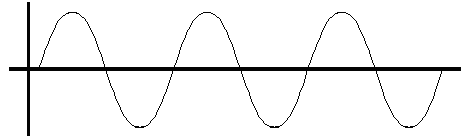
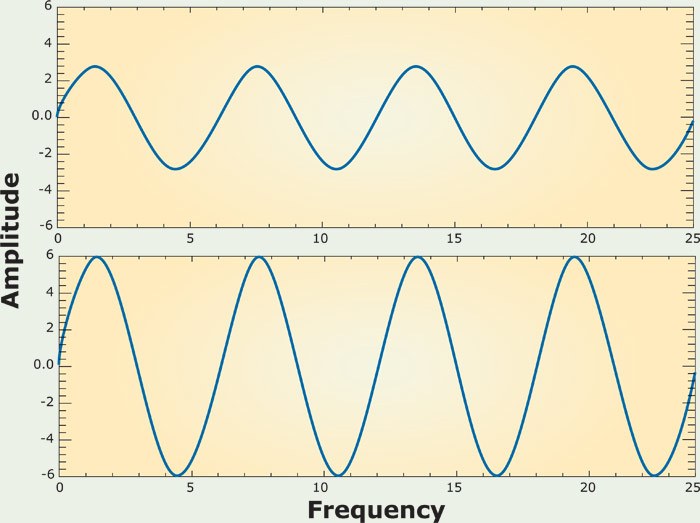


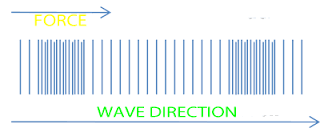
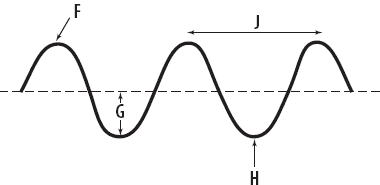
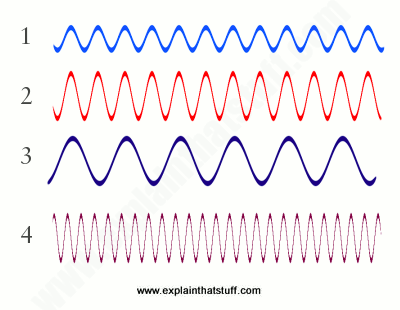
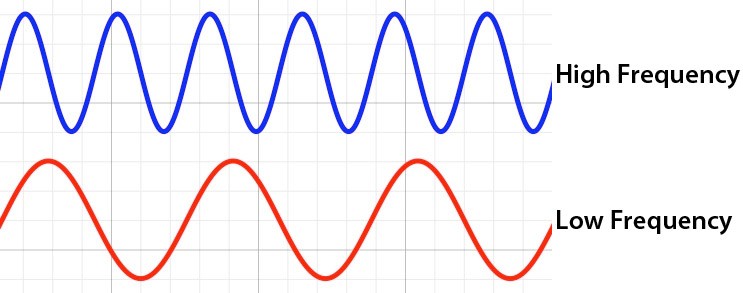


This illustration best depicts which of the following behaviors?
Reflection
Refraction
Diffraction
Resonance

This image best depicts which of the following wave behaviors?
Reflection
Refraction
Diffraction
Resonance
The two categories of waves are
Mechanical
Physical
Electromagnetic
Love

Which of the pictured is responsible for black pavement being hot?
Transmission
Reflection
Refraction
Scattering
Absorption
What makes electromagnetic waves different from mechanical waves?
no medium required
medium needed
light -catalyzed
space exclusive
Which of the following is true for sound waves?
They require a medium.
They are unrelated to vibrations.
They cannot travel through liquids
They can travel in a vacuum
How do electromagnetic and mechanical waves compare?
Mechanical waves can only travel through a vacuum, but electromagnetic waves can travel through a solid, liquid, or gas.
Mechanical waves can travel through a solid, liquid, or gas, but electromagnetic waves can only travel through a gas.
Mechanical waves can only travel through a solid, liquid, or gas, but electromagnetic waves can travel through a vacuum.
Mechanical waves can travel through a solid, liquid, or gas, but electromagnetic waves can only travel through a solid.

Which distance represents the amplitude?
W
X
Y
Z


Visible light emitted from a star or galaxy can be separated into a band of colors, called a ________.
Spectrum (or spectral lines)
Microwave
Radiation
Cosmic Microwave Background Radiation is a form of _________.
Matter
Energy
Visible Light
Water
As galaxies move away from our galaxy
a shift on the electromagnetic spectrum is noticed. This phenomena is
called _____________.
redshift
blueshift
How does Cosmic Microwave Background Radiation support the Big Bang Theory?
Microwaves are found everywhere in the universe.
Microwaves occurred at the time of the Big Bang
Microwaves are useful in our everyday lives
The Big Bang Theory explains the formation of the...
Earth
Sun
Universe
Solar System
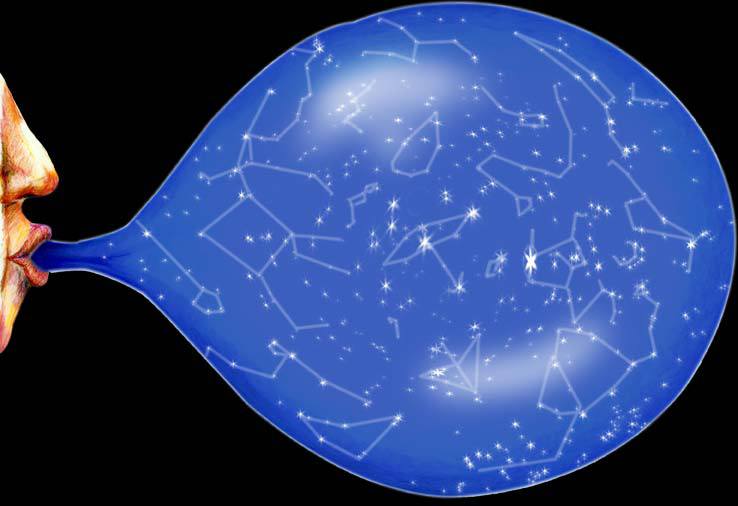
Why is the light from distant galaxies red-shifted?
They produce more red light than nearby galaxies
They are moving away from us
The longer wavelengths are filtered out more by dust
They are moving toward us
The "afterglow" of the energy from the origin of the universe that we see today.
Cosmic microwave radiation
sunlight
Doppler effect
Cosmic explosions
How is the "Big Bang" described?
an explosion
an expansion
a contraction
What two things determine the gravity of an object?
mass & weight
mass & distance
density & mass
volume & distance
Which statement about gravity is true?
gravity causes objects to pull towards one another
gravity causes objects to push away from each other
gravity only takes place between planets
the moon doesn't have any gravity


Which type of tide is represented in the picture?
Neap because the sun and moon are working opposite each other.
Neap because of the tidal bulges.
Spring because the sun and moon are lined up and working together.
Spring because that is where the Earth is its orbit.

What moon phases occur with neap tides?
New and full moon
First and new moon
Third and full moon
First and third quarter
What prevents planets from pulled into and crash into the Sun?
Gravity
Weight
Friction
Inertia (Forward Motion)
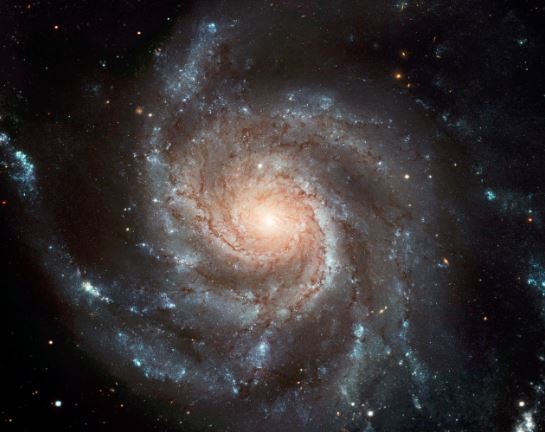
Without gravity, the stars, planets and all objects in the universe would _______.
continue to orbit each other
move in a random direction
move in a straight line
stop moving
A(n) _____ is the curved path of an object around a point/object in space.
orbit
rotation
revolution
phase
What happened first in the formation of the planets?
The Sun Forms
The Planetesimals form
The Planets form
The Solar Nebula Collapses
--------------------------- formed when dust grains stuck together, and then eventually increased in size until they were kilometers sized objects.
planetesimals
stars
planets
asteroids
What formed first?
Sun
Planets
Planetesimals
The Sun formed when the dense concentration of gas and dust at the center of a rotating disk reached a temperature and pressure high enough to fuse hydrogen into
carbon
lava
helium

What is:
An object that revolves around another object in space
Probe
Satellite
Lander
Rover

What is:
a large telescope in space. It was launched into orbit by space shuttle Discovery on April 24, 1990. It orbits about 547 kilometers (340 miles) above Earth
James Webb Telescope
Hubble
Probe
Satellite

What is:
a vehicle that carries scientific instruments to planets or other bodies in space. Information is sent through radio waves.
Rocket
Satellite
Probe
Laner

What is:
a spacecraft, observatory, and laboratory all in one.
International Space Station
Hubble
Planetarium
SpaceX

Upon closer examination, sunlight (and all stars) actually emit ___ spectra.
bright-line (or emission)
absorption (or dark-line)
continuous
multiple

A ___ is used in astronomy to break down light like a prism.
telescope
spectroscope
stethoscope
microscope
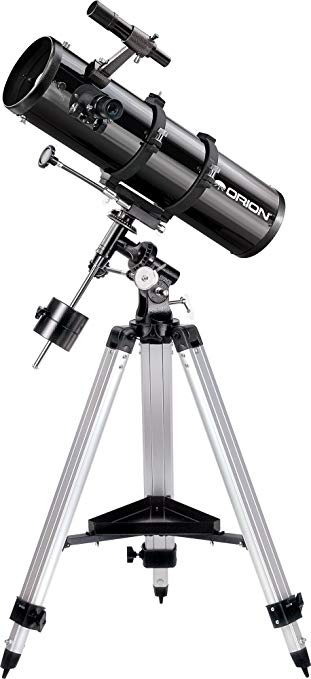
Reflecting telescopes use _______ to focus light.
Lenses
Flat mirrors
Curved Mirrors
A lens and lasers
Energy released from the focus during an earthquake
magnitude
intensity
seismic wave
tsunami
Main type of waves that can travel the earth's inner layers.
surface waves
body waves
Love waves
Rayleigh waves
This is considered as the fastest kind of seismic waves.
Love waves
Body waves
Primary waves
Secondary waves
It can travel through solids only
Love waves
Rayleigh waves
Primary waves
Secondary waves
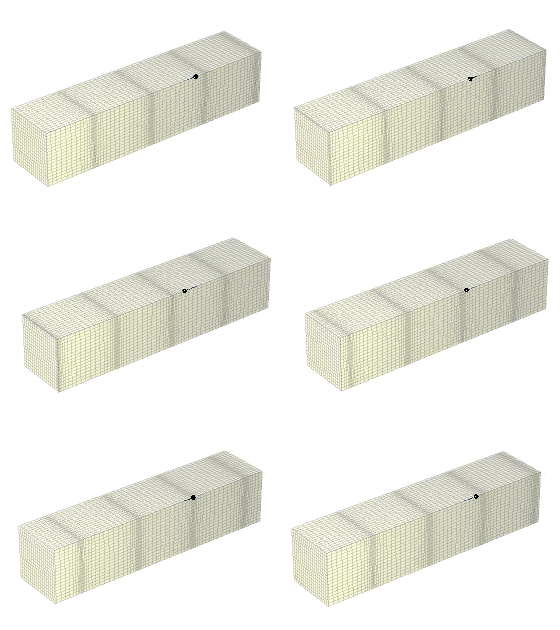
Which body wave is illustrated here?
P-Wave
S-Wave
Rayleigh Wave
Love Wave
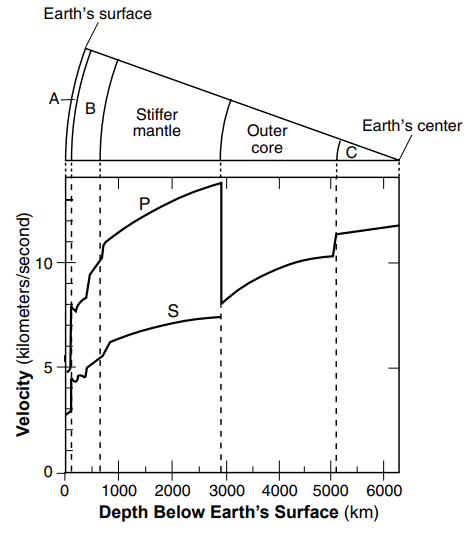
Primary (P) Waves can pass through...
solids only
liquids only
gases only
solids, liquids, and gases

