
 Worksheets
Unit 5 Circuits Review
Total questions: 41
Worksheet time: 1hrs 22mins
This type of circuit has a broken path and charges cannot flow.
open circuit
closed circuit
This type of circuit has no brakes in its path and charges can flow through.
open circuit
closed circuit
This circuit has several different paths for the charges to follow.
insulator
conductor
series circuit
parallel circuit
circuit
This circuit has only one path for electric charges to follow.
insulator
conductor
series circuit
parallel circuit
circuit
A material that resists the flow of electrical charges
insulator
conductor
series circuit
parallel circuit
circuit
A material that readily allows electric charges to pass through it
insulator
conductor
series circuit
parallel circuit
circuit
What is not needed in order to create a working circuit?
battery (power source)
lightbulb
current
closed circuit
What is voltage?
the amount of push the electrical source supplies to the circuit
how much a given device resists the flow of electric current
flow of electric charge
none of the above
What is current?
the amount of push the electrical source supplies to the circuit
how much a given device resists the flow of electric current
flow of electric charge
none of the above
What is the voltage of a circuit with 4 ohms of resistance and 3 amps of current?
12 V
21 V
4/3 V
3/4 V
The current of circuit with a voltage of 12 V and a resistance of 4 ohms is
48 A
3 A
0.3 A
none of these
The voltage of a circuit that has a resistance of 10 ohms and a current of 1.5 A is
15 V
0.15 V
6.7 V
None of these
The resistance of a circuit with 1 A of current and 30 volts of potential difference is
15 Ω
30 Ω
0.03 Ω
None of these
If a circuit had 4 D-Cell batteries (each 1.5 V) and a lightbulb with resistance of 2 ohms, what is the current that flows through the circuit?
2 A
3 A
6 A
8 A
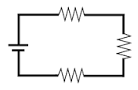

If lamp 1 is unscrewed from its holder, what will happen to lamp 2?
It will get brighter
It will stay the same brightness
It will go out
Nothing will happen

If lamp 2 is unscrewed from its holder, what will happen to lamp1?
It will stay lit
It will go out
It will get dimmer
It will dissapear


What is constant in a series circuit?
resistance (measured in ohms)
current (measured in amps)
voltage (measured in volts)
power (measured in watts)

What is constant in a parallel circuit?
resistance (measured in ohms)
current (measured in amps)
voltage (measured in volts)
power (measured in watts)
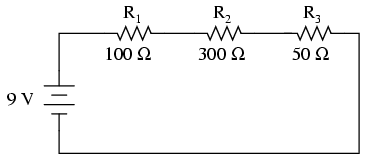
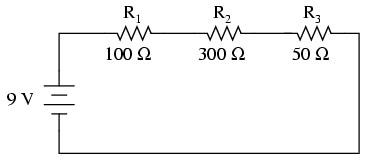
Use the current you calculated for the circuit. Then, what is the voltage drop across resistor 1 (R1)?
0.02 V
2 V
6 V
1 V
Use the current you calculated for the circuit. Then, what is the voltage drop across resistor 2 (R2)?
0.02 V
2 V
6 V
1 V
Use the current you calculated for the circuit. Then, what is the voltage drop across resistor 3 (R3)?
0.02 V
2 V
6 V
1 V

