wayground logo

Free Printable Worksheets

Font size

S
M
L
XL
Worksheets

Biology 101 Final

Total questions: 101

Worksheet time: 2hrs 31mins

Name
Class
Date
1.

1. The process of choosing parent organisms for desired characteristics is called

a)

natural selection

b)

Artificial selection

c)

random selection

d)

genetic manipulation

2.

What is an example of artificial selection?

a)

Letting dogs choose their own mate

b)

Letting plants pollinate on their own

c)

Crossing a labrador and a poodle to create a labradoodle
3.

Average phenotypes are favored in the environment, while extremes have lower survival rates.

a)

seasonal selection

b)

distruptive selection

c)

directional selection

d)

stabilizing selection

4.

The extreme population phenotypes are favored by the environment.

a)

Disruptional (Diversifying) Selection

b)

Directional Selection

c)

Stabilizing Selection

d)

All of the above

5.

individuals with alleles for an extreme type are more likely to survive and reproduce

a)

stabilizing selection

b)

directional selection

c)

disruptive selection

d)

genetic drift

6.

Which of these can change when new evidence is presented?

a)

theory

b)

law

7.
A possible explanation to a problem that has not yet been tested. 
a)
data
b)
theory
c)
hypothesis
d)
fact
8.
A broad and comprehensive statement of what is thought to be true; it is supported by much evidence.
a)
hypothesis
b)
theory
c)
guess
d)
fact
9.

What type of cell has a nucleus?

a)

eukaryotic

b)

prokaryotic

10.

Eukaryotic cells are more structurally complex than prokaryotic cells.

a)

true

b)

false

11.

True or False: Prokaryotic cells are functionally simpler than eukaryotic cells.

a)

True

b)

False

12.
What are the two parts of an ecosystem?
a)
water and sunlight
b)
all living and nonliving organisms
c)
producers and consumers
d)
soil and nutrients
13.
What is a niche?
a)
the place where a species lives
b)
what a species eats
c)
the role of a species
d)
how a species uses resources
14.

The organisms that make up a community and the nonliving parts of the environment that they interact with are a(n)

a)

Population

b)

Community

c)

Habitat

d)

Ecosystem

15.
Two or more members of a particular species living and interacting in the same area
a)
Community
b)
Population
c)
Organisms
d)
Biosphere
16.
Different populations living and interacting with each other in the same area
a)
Biome
b)
Ecosystem
c)
Community
d)
Niche
17.
Alternative forms of a gene are called
a)
Alleles
b)
Homozygous
c)
DNA
d)
Genetics
18.
The physical appearance of an organism based on traits
a)
Genotype
b)
Phenotype
c)
Meiosis
d)
Genetics
19.
This trait will always be expressed if present because it will mask the expression of others
a)
stem cells
b)
heterozygous
c)
dominant
d)
recessive
20.
In cacti, long arms (A) are dominant to short arms (a).  Suppose 2 heterozygous cacti are crossed.  What percentage of their offspring are expected to have short arms?
a)
0%
b)
25%
c)
75%
d)
100%
21.

Genetic mutations can be...

a)

beneficial, harmful, or neutral

b)

beneficial only

c)

harmful only

d)

neutral only

22.

In order for offspring to get a genetic mutation, the mutation must occur in what type of cell?

a)

Cells with no nucleus.

b)

Any body cell after birth.

c)

Cells with no cell wall or cell membrane.

d)

Cells like eggs or sperm cells that are undergoing reproduction.

23.

how much of DNA is non-coding?

a)

101%

b)

77%

c)

99%

d)

5%

24.
Fruit fly body cells have 8 chromosomes. After mitosis, you would expect a resulting fruit fly daughter cell to have ...
a)
16 chromosomes.
b)
46 chromosomes.
c)
8 chromosomes.
d)
4 chromosomes.
25.
A male shark has 40 chromosomes in each of its sex cells. How many would be present in its body cells?
a)
20
b)
40
c)
80
d)
160
26.
Compared to the number of chromosomes contained in a body cell, how many chromosomes would normally be contained in a gamete?
a)
The same number
b)
One-fourth as many
c)
Twice as many
d)
Half as many
27.

In humans, how many chromosomes are in the new cells of meiosis?

a)

46

b)

23

28.
If the number of births in a population is the same as the number of deaths in a population, what will happen to the growth of the population?
a)
It will increase.
b)
It will decrease.
c)
It will stay the same.
d)
It will fluctuate.
29.

True or False: Plants display all of the species interactions we talked about.

a)

True

b)

False

30.
What is the study of the distribution of species in geographic space and through time?
a)
Embryology
b)
Biogeography
c)
Biogeology
d)
Speciology
31.

The three species pictured do not share a common ancestor, yet have evolved to have a similar anatomy and life style. This is an example of ?

a)

Homologous Structures

b)

Divergent Evolution

c)

Vestigial Organs

d)

Convergent Evolution

32.

The three species pictured share a common ancestor and have adapted so that each lives in a different environment. This is an example of

a)

Law of Superposition

b)

Evolutionary Arms Race

c)

Divergent Evolution

d)

Convergent Evolution

33.

What is the bottom layer of the an energy pyramid?

a)

producer

b)

tertiary consumer

c)

Secondary consumer

d)

primary consumer

34.
In the energy pyramid below, which organism has the least amount of energy available?
a)
Producers
b)
Herbivores
c)
Carnivores
d)
Top Predator
35.
A secondary consumer 
a)
eats primary consumers
b)
eats producers
c)
eats plants
36.
When a protein unfolds, it is
a)
Denatured
b)
Building
c)
Adding amino acids
d)
Making food
37.
What conditions usually do not cause denaturation?
a)
Extreme heat
b)
Extreme pH
c)
Dissolving in water
38.

What is a gene

a)

A long length of DNA that codes for a chromosome

b)

A short length of DNA that codes for a chromosome

c)

A short length of DNA that codes for a protein.

39.

This organelle digests dead cell parts and contains enzymes

a)

lysosome

b)

golgi body

c)

smooth ER

d)

Rough ER

40.

Proteins are produced at this organelle.

a)

golgi body

b)

ribosome

c)

cytoskeleton

d)

cilia

41.

this organelle makes ATP.

a)

chloroplast

b)

mitochondria

c)

ribosome

d)

nucleolus

42.

This structure is found in plants and is made of cellulose.

a)

chloroplast

b)

cell membrane

c)

cell wall

d)

cytoplasm

43.

this organelle acts as a transport channel in the cell.

a)

Rough ER

b)

Smooth ER

c)

Golgi body

d)

nucleus

44.

Comparing two individuals of a species, evolutionary “fitness” would be best measured by which of the following?

a)

the length and width of the individuals

b)

the number of fertile offspring

c)

the mass of the food eaten in its life

d)

the mass of the individuals

45.
Hydrophobic region of the cell membrane?
a)
E
b)
B
c)
C
d)
46.
This image is best described as the
a)
Phospholipid Bilayer
b)
Fluid Mosaic Model
c)
Selectively Permeable Membrane
47.
What gamete possibilities could come from this parent's genotype?
a)
AB, AB, aB, aB
b)
Ab, AB, Ab, ab
c)
Ab, Ab, Ab, Ab
d)
AB, aB, ab, aB
48.
Based off this punnett square, what fraction of the offspring will have wrinkled, yellow seeds?
a)
9/16
b)
3/16
c)
1/16
d)
16/16
49.

True or False: The main function of a lipid is to store energy.

a)

True

b)

False

50.
What molecule is this
a)
sucrose
b)
protein
c)
glucose
d)
cellulose
51.
What type of carbohydrate is this?
a)
polysaccharide
b)
disaccharide
c)
monosaccharide
d)
it isn't a carbohydrate
52.

Which statement was NOT included in cell theory?

a)

All living things are composed of cells.

b)

Living cells come only from other living cells.

c)

Each cell contains a cell membrane, cytoplasm, nucleus, mitochondria, and endoplasmic reticulum.

d)

Cells are the smallest structure of living things that can perform the functions necessary for life.

53.

When one allele is not dominant over another, resulting in a blended phenotype for heterozygous offspring is considered....

a)

Incomplete Dominance

b)

Codominance

54.

When one allele is not dominant over the other, resulting in both traits expressed in a heterozygous individual.....

a)

Incomplete Dominance

b)

Codominance

55.
This is an example of ___________?
a)
Incomplete dominance
b)
Co-Dominance
56.
This is an example of ___________.
a)
 Incomplete Dominance
b)
 Codominance
57.
If two parents are heterozygous for type A blood, what is the probability that their offspring would have type O blood?
a)
100 %
b)
75%
c)
50%
d)
25%
58.
If a father is AA and a mother is AB, what is the probability for a child with AB blood? 
a)
0%
b)
25%
c)
50%
d)
75%
59.

What is a mass extinction?

a)

When all the species in a particular area on earth suddenly go extinct

b)

When many species from all over the earth suddenly go extinct

c)

When one species goes extinct due to habitat changes

d)

When all life on earth is wiped out

60.

How are greenhouse gasses harming our environment?

a)

They aren't

b)

Less heat is able to escape causing the Earth to cool down

c)

Less heat is able to escape causing the Earth to warm up

d)

More heat is able to escape

61.

What is the purpose of Mitosis?

a)

Growth of an organism and Repair of damaged tissue

b)

To help the body get rid of extra cells

c)

To increase the amount of classwork you have to do

d)

To get rid of the nucleus

62.
What do you do after you come up with your hypothesis?
a)
Conclude
b)
Test your hypothesis
c)
Do a victory dance
d)
Tell your teacher
63.
What does every scientific experiment begin with?
a)
a hypothesis
b)
a conclusion
c)
procedures
d)
a question or problem
64.
The independent variable is the ONE thing you _____.
a)
change
b)
keep the same
c)
experiment with
d)
investigate
65.
The variable that you measure is the -
a)
IV
b)
DV
c)
Constant
d)
Repeated Trial
66.
Mutated cancer causing genes are reffered to as...
a)
oncogenes
b)
oncologists
c)
optometrist
d)
oink
67.
________________________ is a process of recognizing defective cells, letting them die, and replacing with normal cells.
a)
Mitosis
b)
Apoptosis
c)
Interphase
d)
Metaphase
68.
Uncontrolled cell division is stopped by...
a)
tumor suppressor genes
b)
oncogenes
69.

Which statement below desribes the events during G2 of Interphase?

a)

The cell grows, develops, and makes new proteins

b)

The DNA replicates to form a new set of identical chromosomes

c)

The cell grows, makes new organelles, and prepares for mitosis

d)

the nucleolus disappears and the nuclear envelope disintegrates

70.

Select all stages of interphase?

a)

G1

b)

S

c)

G2

d)

Mitosis

71.
A relationship between two species where one benefits while the other is harmed.
a)
Mutualism
b)
Commensalism
c)
Parasitism
d)
Naturalism
72.
A relationship between two organisms in which one organism benefits and the other is unharmed
a)
Mutualism 
b)
Competition
c)
Parasitsm 
d)
Commensalism 
73.
A relationship between two organisms in which both organisms benefit. 
a)
Mutualism 
b)
Competition
c)
Parasitsm 
d)
Commensalism 
74.

Chromosomes that are paired by size and content are called _______ chromosomes.

a)

homeostasis

b)

homologous

c)

matching

d)

sister

75.

The individual strands on duplicated chromosomes are called_____________

a)

Centromeres

b)

daughters

c)

Sister Chromatids

d)

Karyotypes

76.
Identify the phase of mitosis.
a)
prophase
b)
metaphase
c)
anaphase
d)
telophase
77.
a)
Cytokinesis
b)
Interphase
c)
Anaphase
d)
Metaphase
78.
a)
Anaphase
b)
Cytonkinesis
c)
Interphase
d)
Prophase
79.

True or False: All living things breathe oxygen.

a)

True

b)

False

80.
A biome is......
a)
Like a snowglobe that you shake and can see different types of animals.
b)
A large region of earth with a certain type of climate
c)
An area of earth only found in the United States.
d)
A community of living things.
81.
Which of the following is heterozygous
a)
FF
b)
tt
c)
Gg
d)
RR
82.
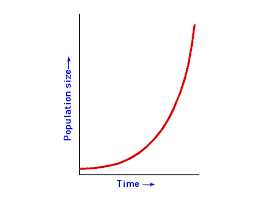
What type of growth is shown in the diagram?
a)
exponential growth
b)
logistic growth 
c)
predator-prey cycle
d)
boom-bust curve
83.
Largest number of individuals of a population that the environment can support...  
a)
carrying capacity
b)
population crash
c)
lag phase
d)
mutualism
84.
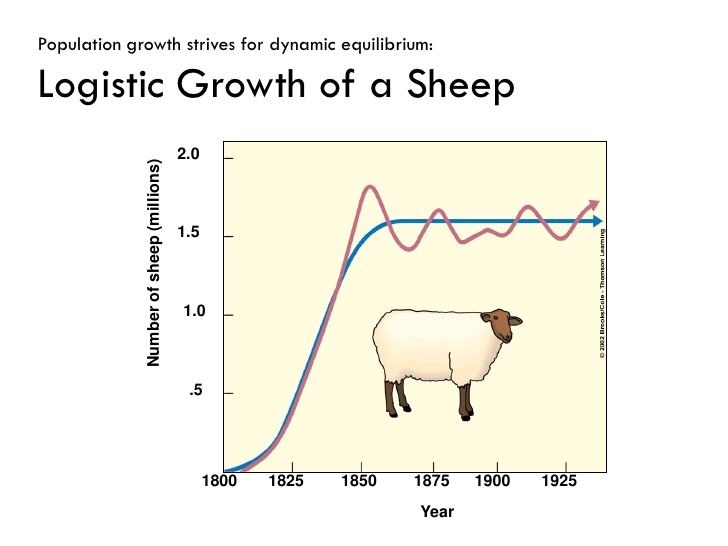
What is the carrying capacity for this sheep population?
a)
1.8 million
b)
1.25 million
c)
1.6 million
d)
1.o million
85.

Density-independent limiting factors to population growth includes

a)

stress from overcrowding

b)

parasitism

c)

competition

d)

natural disasters

86.
 Genetic Drift is more likely to happen in... 
a)
aquatic populations
b)
small populations
c)
terrestrial populations
d)
older populations
87.
Which of the following is an example of the bottle neck effect?
a)
Bald Eagles are hunted until near extinction, population recovers.
b)
Small group of iguanas floats to an island, starts a new population.
c)
Red fox pups are more likely to survive in a snowy environment if they are born white.
d)
Farmer chooses seeds from largest apples to plant next year.  This results in larger apples from year to year.
88.
A change in the genetic composition of a population as a result of descending from a small number of colonizing individuals is called:
a)
founder effect
b)
bottleneck
c)
genetic drift
d)
gene flow
89.
An organism in which foreign genes have been incorporated is called a:
a)
recombinant organism
b)
transgene recombinant
c)
polymorphism
d)
transgenic organism
90.
An organism that contains DNA from another organism is called:
a)
transatlantic
b)
recombinant
c)
binary
d)
selective species
91.
The primary sequence of a protein refers to the:
a)
Order of amino acids
b)
α-Helix or β-Pleated Sheet
c)
Interaction of subunits
d)
Hydrogen Bonding
92.

Which protein structure describes a protein's three-dimensional shape?

a)

Primary

b)

Secondary

c)

Tertiary

d)

Quaternary

93.
DNA replication results in two DNA molecules,
a)
each one with two original strands
b)
each one with two new strands
c)
each one with one new strand and one original strand
d)
one with two new strands and the other with two original strands
94.

What does tRNA "transfer"?

a)

amino acids

b)

nucleic acids

c)

nucleotides

d)

AUG

95.

How many nucleotides make up a single codon?

a)

3

b)

5

c)

4

d)

1

96.

What sequence of mRNA always begins a new polypeptide chain?

a)

UAG

b)

AUG

c)

GAU

d)

UGA

97.

An mRNA molecule is produced in which step of protein synthesis:

a)

replication

b)

transcription

c)

duplication

d)

translation

98.
Process in which amino acids are assembled into proteins at the ribosome?
a)
Translation
b)
Transcription
c)
Meiosis
d)
Replication
99.

Point mutation involves

a)

deletion

b)

insertion

c)

duplication

d)

changes in single base pair

100.
In the energy pyramid here, how much of the energy in the producers gets passed to the herbivores?
a)
10%
b)
20%
c)
80%
d)
90%
101.

Which organism in the food web shown to the right would

contain the lowest concentration of chemical pollutants?

a)

producers

b)

primary consumers

c)

secondary consumers

d)

tertiary consumers