Wayground logo

Free Printable Worksheets

Font size

S
M
L
XL
Worksheets

2nd Major Exam

Total questions: 50

Worksheet time: 37mins

Name
Class
Date
1.
A magician pulls a tablecloth out from under dishes and glasses on a table without disturbing them.
a)
Newton's 1st Law
b)
Newton's 2nd Law
c)
Newton's 3rd Law
d)
None of them
2.

A person’s body is thrown outward as a car rounds a curve on a highway.

a)

Newton's 1st Law

b)

Newton's 2nd Law

c)

Newton's 3rd Law

d)

None of them

3.
Rockets are launched into space using jet propulsion where exhaust accelerates out from the rocket and the rocket accelerates in an opposite direction.
a)
Newton's 1st Law
b)
Newton's 2nd Law
c)
Newton's 3rd Law
d)
None of them
4.
A picture is hanging on a wall and does not move.
a)
Newton's 1st Law
b)
Newton's 2nd Law
c)
Newton's 3rd Law
d)
None of them
5.
A soccer ball accelerates more than a bowling ball when thrown with the same force.
a)
Newton's 1st Law
b)
Newton's 2nd Law
c)
Newton's 3rd Law
d)
None of them
6.
What law is best described by inertia?
a)
1st
b)
2nd
c)
3rd
7.
Any push or pull on an object.
a)
force
b)
velocity 
c)
inertia
d)
momentum
8.
The force that opposes motion between two surfaces in contact with each other.
a)
inertia
b)
friction
c)
momentum
d)
gravity
9.
The combination of all the forces acting on an object is the...
a)
net force
b)
action force
c)
reaction force
d)
balance force
10.

An archer pulls the bowstring back, then releases the string and the arrow flies forward. Pulling the string back is the...

a)

action force

b)

reaction force

c)

net force

d)

inertia

11.

When an unbalanced force acts on an object, the force ______________________.

a)

changes the motion of the object

b)

is cancelled by another force

c)

does not change the motion of an object

d)

is equal to the weight of the object

12.
Which force produces a change in motion?
a)
unbalanced force
b)
balanced force
c)
gravitational force
d)
frictional force
13.

What is energy?

a)

moving energy

b)

stored energy

c)

renewable energy

d)

The ability to do work.

14.

What is potential energy?

a)

moving energy

b)

stored energy

c)

renewable energy

d)

non renewable energy

15.

What is kinetic energy?

a)

moving energy

b)

potential energy

c)

stored energy

d)

renewable energy

16.

units of force are

a)

newtons

b)

grams

c)

joules

d)

meters

17.

if you push a cart with a force of 60 N for 2 m... how much work have you done

a)

120 J

b)

30 J

c)

120 N

d)

30 N

18.

At which point of the roller coaster is potential energy the greatest?

a)

W

b)

X

c)

Y

d)

Z

19.

The faster an object moves, the ________ kinetic energy it has.

a)

more

b)

less

20.
When is the potential energy the greatest in a roller coaster?
a)
a. at the bottom of the first hill
b)
b. at the top of the first hill
c)
c. at the top of the second hill
d)
d. at the bottom of the second hill
21.

When you eat fruits and vegetables, chemical bonds are releasing stored energy, this is...

a)

a. thermal energy

b)

b. sound energy

c)

c. electrical energy

d)

d. chemical energy

22.
Any time an energy conversion takes place, some of the original energy is converted to which one of the following?
a)
a. sound energy
b)
b. potential energy
c)
c. light energy
d)
d. thermal energy
23.
After an energy conversion, you end up with the same total amount of energy as the original amount of potential energy. Which of the following laws explains this rule?
a)
a. law of energy changes
b)
b. law of conservation of energy
c)
c. law of power and energy
d)
d. law of potential energy
24.
a.  Energy stored in the nucleus of an atom.
a)
A. Sound Energy
b)
B. Potential Energy
c)
C. Nuclear Energy
d)
D. Thermal energy
25.
The energy of moving electrons
a)
A. Energy
b)
B. Energy Conversion
c)
C. Chemical Energy
d)
D. Electrical Energy
26.
Energy from light waves.
a)
Radiant Energy 
b)
Chemical Energy 
c)
Nuclear Energy 
d)
Radiation 
27.

A student is holding the end of a pendulum. The student releases the pendulum. What energy transfers are taking place?

a)

potential energy is transferred to kinetic energy

b)

chemical energy to thermal energy

c)

mechanical energy to chemical energy

d)

kinetic energy is tranferred to potential energy

28.
Heat transfers from an area of ____temperature to an area of ___ temperature.
a)
high to low
b)
low to high
c)
high to high
29.
High temperature is connected to:
a)
Low kinetic energy.
b)
High kinetic energy.
c)
Zero net energy.
d)
Equal kinetic energies.
30.
What is thermodynamics?
a)
movement of heat
b)
it's magic
c)
measurement of heat
d)
none of them
31.
Which type of energy transformation occurs when a flashlight shines?
a)
chemical → thermal → electrical
b)
chemical → electrical → light
c)
thermal → chemical → light
d)
chemical → electrical → chemical
32.
When water falls through a dam and turns a turbine connected to a generator, electricity is produced. This electricity is often used to light our homes and offices. Which of the following shows the energy transformations that occurs?
a)
electrical → light → mechanical
b)
chemical → mechanical → electrical
c)
mechanical → chemical → light
d)
mechanical → electrical → light
33.
The Theory of the Conservation of Energy states -
a)
Energy can be created, just not destroyed. It changes its form from one type to another.
b)
Energy can never be created nor destroyed. It can only change its form from one type to another.
c)
The total energy in our Universe changes, as different forms of energies can be transformed from each other under certain circumstances.
d)
Energy transformations do not passively occur in our lives, rather we actively make use of energies and transform energies.
34.
Electrical Energy is transferred to _____ Energy.
a)
Thermal
b)
Solar
c)
Electrical
d)
None
35.
Which of the following shows an energy transformation from chemical energy to electrical to light energy?
a)
A bolt of lightning lights the night sky.
b)
A candle glows brightly in the dark.
c)
A fire in a fireplace lights up a room.
d)
A battery causes a flashlight to shine.
36.
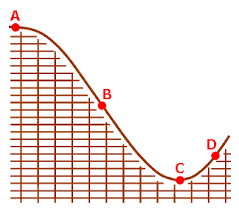
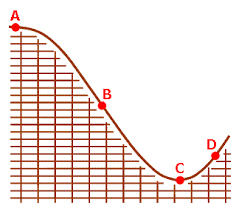
At which point(s) on the roller coaster is the gravitational potential energy at its maximum?
a)
A
b)
B
c)
C
d)
D
37.
At which point(s) on the roller coaster is the kinetic energy at its maximum?
a)
A
b)
B
c)
C
d)
D
38.
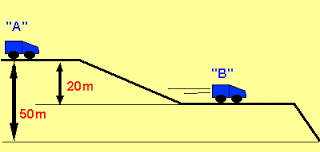
In diagram 2, if the mass of the car is 600 kg, what is the change in potential energy from point A to point B?
a)
411,600 J
b)
294,000
c)
176,400 J
d)
117,600 J
39.
Work is:
a)
A transfer of energy by a force to move and object
b)
Something you get paid for
c)
Something you take home
d)
Makes you sweat
40.
What kind(s) of energy is(are) in a person climbing a ladder?
a)
Potential
b)
Kinetic
c)
Both
41.
As a pendulum swings from its highest to lowest position, what happens to its kinetic and potential energy? 
a)
The PE and KE increase and decrease together
b)
The PE decreases while the KE increases 
c)
Impossible to know without knowing the mass  
42.
A change from one form of energy to another is called ___________.
a)
work
b)
power
c)
mechanical
d)
energy transformations
43.

What happens when the ball goes from the highest position to the lowest position

a)

PE and KE increases and decreases together

b)

Impossible to know without knowing the mass of the object

c)

the PE decreases while KE increases

44.

What kind (s) of energy is (are) in this image?

a)

Potential

b)

Kinetic

c)

Both Potential and Kinetic

45.
Which type of energy increases when you compress a spring?
a)
elastic potential energy
b)
kinetic energy
c)
radiant energy
d)
sound energy
46.

Energy stored because of gravity is called:

a)

Gravitational Potential Energy

b)

Kinetic Energy

c)

Mechanical Advantage

d)

Chemical Energy

47.

How could you increase the gravitational potential energy of an object without changing its mass and gravity?

a)

Make the object larger

b)

Lower the object towards the ground

c)

Raise the object farther off the ground

d)

Allow the object to roll on the ground

48.
When work is done, there is always a(n) _______.
a)
constant rate
b)
single movement involved
c)
transfer of energy
d)
increase in the mechanical advantage
49.

At point C, the mass in the pendulum has ________ PE, and ________ KE.

a)

maximum, maximum

b)

maximum, minimum

c)

minimum, maximum

d)

not sure

50.

What will be the PE at point C?

a)

400J

b)

100J

c)

0J

d)

40J