
 Worksheets
APES Unit 2
Total questions: 62
Worksheet time: 49mins
I. The ability of individuals to adapt to their environment
II. Changes in a population's genetic makeup over time
III. Changes in the traits of an individual
Biological evolution is based on
I only
II only
III only
I and II only
I, II, and III
I. There must be genetic variability within the population
II. The trait must be heritable
III. The trait must lead to differential reproduction
Which of the following conditions must be present for natural selection to occur in a population?
I only
II only
III only
I and II only
I, II, and III
Why is identifying and protecting keystone species a key goal of many conservation biologists?
Keystone species are economically beneficial
Keystone species are critical to human survival
Keystone species play a critical ecological roles in the community
Keystone species are endangered species
Keystone species are charismatic
Which kind of diversity allows organisms on earth to adapt to and survive many changing environmental conditions?
Genetic Diversity
Species Diversity
Community Diversity
Ecosystem Diversity
Natural Selection Diversity
Evidence has led scientists to believe that the polar bear is a relatively new species closely related to the brown bear. As some bears wandered in search of food, a population of brown bears was split off from the rest of the bears by glaciers.
What process occurred as a result of the two populations of bear being separated by the glacier?
Differential reproduction
Survival of the fittest
Mutations
Background extinction
Geographic isolation
Evidence has led scientists to believe that the polar bear is a relatively new species closely related to the brown bear. As some bears wandered in search of food, a population of brown bears was split off from the rest of the bears by glaciers.
Some of the bears in the population that split off had thick white fur adapted to the arctic conditions and were able to survive and reproduce, and leave behind more offspring than other bears leading to
Differential reproduction
Background extinctions
Specialist species
Mass extinctions
Reproductive isolation
I. Geographic isolation
II. Background extinction
III. Reproductive isolation
Speciation can occur. Through evolution, a new species can result from
I only
II only
I and III only
II and III only
I and II only
An example of current evolution by natural selection is
Skeletal remains in fossil record
Genetic resistance of some strains of bacteria to antibiotics
Human opposable thumbs
Plate tectonics
Climatic change
All are true of endemic species EXCEPT
Highly susceptible to extinction
Often generalists
Often live on islands
Can be outcompeted by non-native invasive species which share a niche
Are often indicator species
All of the following are true of climax communities EXCEPT
They are the end point of a series of competitive exclusion patterns
They are composed of a majority of K-selected species
Dominated by a few long-lived plant communities
Are considered mid-successional
Remain in a relative balance unless there is a disturbance
The gradual establishment of biotic communities in lifeless areas (such as a parking lot) where there is no soil is
Degradative succession
Primary succession
Secondary succession
Random succession
Cyclical succession
I. Rainforests have low richness
II. Rainforests have high inertia
III. Rainforests have low resilience
A tropical rainforest which has been cut down to make way for a farm is abandoned 10 years later because the soil has lost its productivity. However, the area does not experience the re-growth of trees. Which of the following explain the lack of secondary succession in the area?
I only
II only
III only
I and II only
I and III only
The whooping crane population, which once numbered only 14 individuals, has rebounded through intense captive breeding programs. However, genetic variability is greatly limited because of
The Founder Effect
Mass Extinctions
Ecological Succession
A Bottleneck
Reproductive Isolation
The number of species in an ecosystem is
Species evenness
Species diversity
Species richness
Species number
A population
Ecosystem services that give humans products and what they need to survive, like food and lumber are called
Provisioning Services
Regulating Services
Cultural Services
Supporting Services
Supply Services
Ecosystem services that provide humans beauty art and enjoyment are called
Provisioning Services
Regulating Services
Cultural Services
Supporting Services
Aesthetic Services
Ecosystem services that indirectly benefit humans , such as plants cleaning air and bees pollinating plants are called
Provisioning Services
Regulating Services
Cultural Services
Supporting Services
Anthropogenic Services
Ecosystem services that that support human life and life on Earth such as producing oxygen and water cycling are called
Provisioning Services
Regulating Services
Cultural Services
Supporting Services
Essential Services
The Theory of Island Biogeography states that
There are more species on islands that are smaller and farther from the mainland.
There are more species on islands that are smaller is
and closer to the mainland.
There are more species on islands that are larger and closer to the mainland.
There are more species on islands that are larger and farther from the mainland.
There are more species on islands that are going through primary succession.
Organisms, like koalas, that require specific habitats and food are called
specialist
generalist
indicator
keystone
invasive
Organisms, like cockroaches, that can live in many places and eat many things are called
specialist
generalist
indicator
keystone
invasive
The total range of conditions conditions (abiotic factors) that an organism can lived in is called _____________.
Succession
Environmental disturbance
Ecological tolerance
limiting factors
resilience
First members in an area after a fire, etc.
Climax Community
Pioneer Species
Indicator species
Keystone species
Invasive species
Species that suggest an environmental problem are called
Climax Community
Pioneer Species
Indicator species
Keystone species
Foundation species
This is the stable, last stage of succession after a disruptions.
Climax Community
Pioneer Species
Peak Community
Summit Community
Apex Community
Fragmenting one large park or preserve into many small parks with human habitation in between them is most likely to lead to which of the following?
Reduction in species diversity
Stabilization of microclimates
Decrease in the proportion of edge habitat
Increase in population size of carnivores
Evolution
The factor that likely poses the greatest threat of extinction of species worldwide is
black market trade in endangered species
aggressive collecting of specimens by museums and zoos
increasing loss of habitat
weakening of environmental legislation
increasing amount of invasive species
Which of the following best shows the process of evolution?
A population of mosquitoes develops resistance to a pesticide
A bear goes into hibernation
A lizard’s color becomes brown as it sits on a log
A population of foxes increases as more prey becomes available
A chimpanzee experiences a mutation in it's DNA
Characteristics that tend to increase the risk of a species becoming endangered include which of the following?
Having a very limited distribution
Being a specialist at the end of a long food chain
Having a small population size
Experiencing a bottleneck
All of these are correct
In general, which of the following is the best long-term method of preventing extinctions?
Protecting the habitats of endangered species
Paying people not to kill endangered species
Removing predators from areas that contain endangered species
Providing food to endangered species in the wild
Captive breeding programs
If mean global temperature keeps on increasing as predicted by contemporary scientists, which of the following is most likely?
There will be fewer insect pests and disease-carrying organisms
Specialist species living in fragile ecosystems will risk extinction
There will be an increase in the reproductive rate of mammals
The geographical range of many plants will move toward the equator
There will be an increase in amphibians
I. Distance from the mainland
II. Topography of the island
III. Size of the island
IV. How the island formed
The theory of island biogeography suggests that species richness is affected by which of the following factors?
I. only
II. only
III. only
I and III
All are correct
After a forest fire, a badly damaged ecosystem recovered rapidly. This ecosystem has
high resistance
low resistance
high resilience
low resilience
high fecundity
Which of the following is an example of a keystone species?
Beavers
Elephants
Kudzu vine
Lionfish
Sea otters
Which of the following is NOT an example of an invasive species?
Kudzu vine
Lionfish
Elephants
Fire ants
Gypsy moths
Which of these is an aquatic indicator species?
Shrimp
Coral
Plankton
Sea Anemone
Sharks
Why are sea otters so crucial to the Kelp ecosystem?
They aren't. They are just another member of the kelp ecosystem.
They build dams and help rivers flow
They provide us with nutrients
They feed on sea urchins which are harmful to kelp forests
Kelp wouldn't exist if sea otters didn't serve as food for predators
Pioneer species like moss and lichen are most likely to show up after
primary succession
secondary succession
a fire
a flood
climate change
Organisms that make physical changes and help create habitats are known as
Invasive species
Keystone species
Foundation species
Endangered species
Pioneer species
Which of the following is true about island biodiversity?
Small islands are more likely to have more immigrated species
Small islands have more biodiversity
Small islands have more species
Small islands have less resources
Small islands have more topography
What prediction is correct about island biogeography?
Smaller islands have more resources, and will have more biodiversity
Larger islands have more space for resources, but will have less biodiversity due to competition
Animals Islands closer to mainland will migrate successfully and there will be more diversity
Animals will fly to far away mainland and there will be more diversity
Larger islands have great topography and increase biodiversity
What is the best way to reduce stress on the ecosystem's provisioning services?
Use electric cars
Slow down population growth
Limiting human access to national parks
Recycling
Rely on solar
An optimum range is
A threat to an organism
An organism's niche
An organism's comfort zone
An organism's species richness
An organism's evolutionary goal
Jay has 3 green marbles, 4 red skittles, and 5 twix. What is the species richness?
3
12
1.5
0.50
4
Protected areas linking isolated reserves is a design called
buffer zone concept
wilderness concept
transition zone
habitat corridors
ecotones
Human waste is often dumped in the ocean. Microbial organisms in marine ecosystems can break down organic waste into less harmful components. This is an example of
a cultural service
an ecosystem provision
a regulating service
an intrinsic value
a supporting service
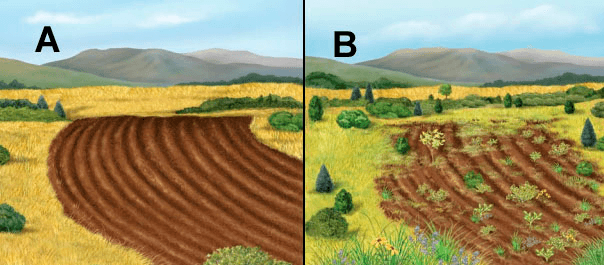
What type of succession is shown going from figure A to figure B?
primary succession
ecological succession
secondary succession
intermediate
habitat degradation
What is the role of the pioneer species in Primary Succession?
To kill the dead materials after a disaster
To rebuild soil
To add excess nutrients to the soil
To put fresh oxygen into the air
To eliminate invasive species

What type of species/community is a redwood forest?
Climax Community
Pioneer Species
Intermediate Species
Tertiary Community
Mid-successional species
Which of the following is an example of natural selection?
Bald Eagles are hunted until near extinction, population recovers.
Small group of iguanas floats to an island, starts a new population.
Red fox pups are more likely to survive in a snowy environment if they are born white.
Farmer chooses seeds from largest apples to plant next year. This results in larger apples from year to year.
An agro-geneticist selects a gene to insert into corn DNA making the kernels larger.
Zone where small numbers can survive these difficult conditions
range of tolerance
zone of intolerance
optimal range
zone of physiological stress
zone of hardship
Zone where organisms cannot survive
zone of intolerance
range of tolerance
optimal range
zone of physiological stress
zone of extinction
All of the following are considered anthropogenic disruptions EXCEPT:
Pollution
Hurricanes
Logging
Overharvesting
Addition of CO2 from power plants

Which of the natural disruption time lines is the slowest?
Episodic
Random
Semiotic
Periodic
Sporadic
The amount of glacial ice on Earth directly correlates to what?
Sea levels
Land mass
Plant distribution
Animal biodiversity
Animal distribution
Earth's climate can be affected by which of the following?
Water levels
Carbon Dioxide levels
Soil levels
Wind levels
Productivity

Which of the following is an anthropogenic disruption?
Wind Damage
Wildfires
Fragmentation
Flooding
Volcanic Eruptions
What makes an ecosystem strong/weak in the face of change?
Climate
Average rainfall
Biodiversity
Sun exposure
It's size
Species with low population numbers are more likely to be negatively impacted by fluctuations (shifts) cause by ______.
Climate change
Disease
Habitat fragmentation
Disturbances
All of the Above
What is speciation?
The creation of a new species
The blending of two species to one
The extinction of a species
Parallel evolution of two species
Co-evolution
Which traits get passed on from generation to generation in a population?
All of them
The traits least suited for the current environment
The traits best suited for the current environment
None of them
Depends upon mutation rates
Scientists are concerned about overfishing of shark populations. Sharks feed on rays and rays feed on scallops. Without sharks, rays consume all the scallop beds. This situation demonstrates that:
humans can improve an ecosystem by removing predators
humans can upset an ecosystem by removing species
reducing the shark population increases the quantity of scallops that can be taken
sharks are not important for the stability of the ecosystem
this ecosystem is resilient

