
NEW
Font size
 Worksheets
Solutions Review Quizizz
Total questions: 35
Worksheet time: 3hrs 55mins
What combination would dissolve a solid solute the fastest?
high temperature, no stirring
no heat, no stirring
sugar cube, no heat
high temperature, stirring
A substance with only London Dispersion Forces is likely to dissolve in a:
Polar solvent
Non-polar solvent
A substance with hydrogen bonding is most likely to dissolve in a:
Polar solvent
Non-polar solvent

How many grams are soluble in 100 g of water at 100 ºC?
300 grams
250 grams
100 grams
50 grams

When 40 grams of NaCl is dissolved in 100 grams of water at 90 ºC, the solution can be correctly described as:
supersaturated
saturated
unsaturated
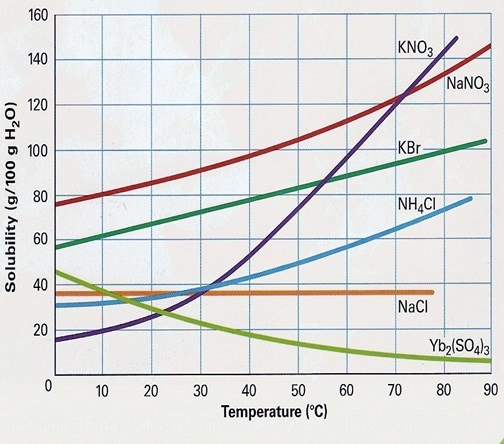
Identify how many grams of KNO3 is required to make a saturated solution at 40'C.
50 g
45 g
55 g
33 g
More ________ is soluble at higher pressure
Solid
Liquid
Gas
___________ surface area _______ rate of dissolving
increase ; decrease
increase ; increase

Which diagram best illustrates the ion-molecule attractions that occur when the ions of NaCl(s) are added to water?
1
2
3
4
A solid substance was tested in the laboratory. The test results are listed below.
• dissolves in water
• is an electrolyte
• melts at a high temperature
Based on these results, the solid substance could be
Cu
CuBr2
C
C6H12O6
Based on Reference Table F, which of these salts is the best electrolyte?
sodium nitrate
magnesium carbonate
silver chloride
barium sulfate

In an investigation, students were asked to decide the most effective method for separating a solution of sugar water. Which of the following would be their best choice?
Use a magnet to attract the sugar
Pour the solution through a paper filter
All the sugar to settle to the bottom and pour off the water
Allow the water to evaporate leaving the sugar behind
What happens to the ability of a gas to dissolve when temperature decreases?
There is no change in the solubility of the gas.
The solubility of the gas will increase.
The only factor that affects the solubility of a gas is polarity.
The solubility of most gases will decrease.
According to Reference Table F, which substance is most soluble?
AgI
CaSO4
PbCl2
K2CO3
According to Table F, which ions combine with chloride ions to form an insoluble salt?
K+ ions
Ca2+ ions
Pb2+ ions
Na+ ions
According to Reference Table F, which compound is most soluble in water?
ZnCO3
ZnSO4
BaSO4
BaCO3
Hexane and water do not form a solution. Which statement explains this phenomenon?
Water is polar and hexane is nonpolar.
Water is polar and hexane is polar.
Water is nonpolar and hexane is polar.
Water is nonpolar and hexane is nonpolar.
According to Table G, how many grams of KNO3 would be needed to saturate 50g of water at 70oC?
268 g
134 g
100 g
67 g


Which of the following statements is true?
B is a saturated solution
A is a supersaturated solution
C is an unsaturated solution
None of the above
When the solution equilibrium point is reached and no more solute will dissolve, the solution is said to be _________.
unsaturated
saturated
supersaturated
What do you call a solution that contains less than the maximum amount of solute that is capable of being dissolved?
unsaturated solution
saturated solution
supersaturated solution
insoluble solution
Dissolving ammonium nitrate
endothermic
exothermic
The initial temperature of pure water was measured to be 20oC, after dissolving a salt the final temperature was 45oC . The dissolving process was
exothermic
endothermic
The initial temperature of pure water was measured to be 20oC, after dissolving a salt the final temperature was 10oC . The dissolving process was
exothermic
endothermic
Water solutions that conduct electricity contain
catalysts
dissolved (free moving) molecules
dissolved (free moving) ions
dissolved particles

