
 Worksheets
Review for metals nonmetals metalloids and density test
Total questions: 40
Worksheet time: 3hrs 53mins
Name
Class
Date
1.
Which of these is a property of metals?
a)
It's malleable
b)
It can't conduct electricity
c)
They are used in food
d)
It's very brittle
2.
Brittle
a)
Metal
b)
Nonmetal
3.
Good conductor of heat
a)
Metal
b)
Nonmetal
4.

Which element is a metalloid?
a)
Titanium
b)
Selenium
c)
Potassium
d)
Polonium
5.
Iron is a good conductor, malleable and magnetic. What type of element is Iron?
a)
Metal
b)
Nonmetal
c)
Metalloid
d)
Pretty
6.
A student is given a sample of an unknown substance. He is asked to determine if it is classified as a metal, a metalloid, or a nonmetal. He discovered that the unknown element conducted some heat and electricity, had a shiny luster, and broke easily. This element is most likely a
a)
metal
b)
nonmetal
c)
metalloid
d)
cannot be determined
7.

Which table below correctly lists the properties of metals and nonmetals? *
a)
A
b)
B
c)
C
d)
D
8.

The table shows the properties of four elements. Which element in the table is classified as a metal?
a)
Manganese
b)
Sulfur
c)
Silicon
d)
Neon
9.
John was observing the physical properties of elements in order to classify them as either a metal, nonmetal, or metalloid. The first element was dull, brittle, and did not conduct heat. What would its classification be?
a)
metal
b)
nonmetal
c)
metalloid
10.
If a material can easily be drawn into the shape of a wire, it is
a)
Ductile
b)
Magnetic
c)
Malleable
d)
Reactive
11.
Which of the following is a good conductor of heat?
a)
Metal
b)
Nonmetal
c)
Metalloid
12.
Where are the non-metallic elements found in the periodic table?
a)
In the middle
b)
In the top rows
c)
On the left-hand side
d)
On the right-hand side
13.
Which elements are found on the left to middle of The Periodic Table?
a)
Metals
b)
Nonmetals
c)
Metalloids
d)
Candles
14.
Conductivity is ___________
a)
the way light is reflected off a surface.
b)
how well a piece of matter conducts electricity.
c)
the capability of being hammered out thin
d)
A. the capability of being drawn out into thin wires or threads.
15.
What physical properties are used to classify elements as metals, non-metals, or metalloids?
a)
Color, smell, physical state
b)
Reactivity, streak, hardness
c)
Ability to burn, mass, density
d)
Luster, conductivity, malleability
16.

The table shows the properties of three classifications of elements. What are the best headings for columns A, B, and C?
a)
(A) Metals, (B) Non-metals, and (C) Metalloids
b)
(A) Non-metals, (B) Metalloids, and (C) Metals
c)
(A) Metals, (B) Metalloids, and (C) Non-metals
d)
(A) Non-metals, (B) Metals, and (C) Metalloids
17.

Which element is least likely to conduct heat and electricity?
a)
O
b)
Si
c)
Po
d)
Ca
18.
The elements argon, krypton, and xenon are all non-metals. What property would these elements have in common?
a)
Good conductor of thermal energy
b)
Poor conductor of electricity
c)
Shiny, lustrous surface
d)
Soft and malleable
19.
Jack has a rock. The rock has a mass of 14g and a volume of 2cm3. What is the density of the rock?
a)
7 mL
b)
7 g/cm3
c)
28 g/cm3
d)
1/7 g/cm3
20.
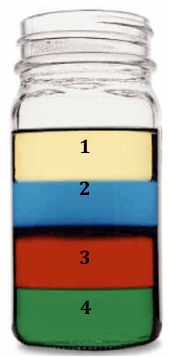
Put the liquids in order from most dense to least dense?
a)
4, 3, 2, 1
b)
1, 2, 3, 4
c)
3, 4, 2, 1,
d)
4, 3, 1, 2
21.
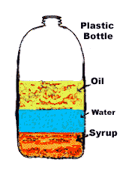
Which liquid is the least dense?
a)
oil
b)
water
c)
syrup
d)
plastic bottle
22.
In general what is the most dense form of matter?
a)
solid
b)
liquid
c)
gas
d)
plasmas
23.
What is the formula for density?
a)
density = mass x volume
b)
density = mass / volume
c)
density = mass + volume
d)
density = mass - volume
24.
What is the density of water?
a)
0 g/ml
b)
1 g/ml
c)
10 g/ml
d)
100 g/ml
25.
Why do some substances float on water?
a)
they are warmer than water
b)
they are cooler than water
c)
they are more dense than water
d)
they are less dense than water
26.
A piece of copper has a mass of 89g and a volume of 10 cm3. What would be the density of the copper?
a)
0.89 g/cm3
b)
89 g/cm3
c)
8.9 g/cm3
d)
890 g/cm3
27.
What units are used to measure Density?
a)
cm3/g
b)
g
c)
g/cm3
d)
cm3
28.
Define the term "mass".
a)
Mass/Volume
b)
Anything that has mass and takes up space
c)
The amount of space an object occupies.
d)
The amount of matter in an object.
29.
Volume is ...
a)
Mass/Volume
b)
The amount of matter in an object.
c)
The amount of space an object occupies.
d)
Anything that has mass and occupies space.
30.
Density is...
a)
the amount of mass in an object
b)
the amount of space an object takes up
c)
the amount of mass in a given space
d)
the weight of an object
31.
A crayon has a mass of 10g and volume of 5 mL. What is the density?
a)
30 g/mL
b)
15 g/mL
c)
1 g/mL
d)
2 g/mL
32.

A rock with a mass of 70g is dropped into 30 mL of water and the level rises to 35mL. What is the density of the rock in g/mL?
a)
5 g/mL
b)
35 g/mL
c)
.07 g/mL
d)
14 g/mL
33.
Which of the following is a property of metalloids?
a)
poor conductors of heat
b)
semiconductors
c)
poor conductors of electricity
d)
good conductors
34.

Find the volume of the object (HINT: use displacement)
a)
10 mL
b)
19 mL
c)
9 mL
d)
8.5 mL
35.

Describe what luster means
a)
How an object reflects light
b)
How soft an object is
c)
If an object floats
d)
If an object can be dug out of the earth.
36.
What tool do you use to measure volume of an irregular object?
a)
ruler
b)
graduated cylinder
c)
triple beam balance
d)
spring scale
37.
What tool do you use to measure volume of a regular shaped object?
a)
ruler
b)
graduated cylinder
c)
triple beam balance
d)
spring scale
38.

When an object changes shape when struck by a hammer.
a)
luster
b)
malleable
c)
brittleness
d)
ductile
39.

If I have an object with a mass of 10g and a volume of 42cm3
a)
.34 g/cm3
b)
.65 g/cm3
c)
0.24 g/cm3
d)
1.0 g/cm3
40.

If I have an object with a volume of 38 cm3 and a mass of 480g what is the density?
a)
14.22 g/cm3
b)
12.63 g/cm3
c)
10.63 g/cm3
d)
7.56 g/cm3
100 %

