wayground logo

Free Printable Worksheets

NEW

Font size

S
M
L
XL
Worksheets

Physical Science Q2 Final

Total questions: 75

Worksheet time: 2hrs 38mins

Name
Class
Date
1.
What kind of energy is in a moving skateboard?
a)
Potential
b)
Kinetic
2.
What kind of energy is in a rock at the edge of a cliff?
a)
Potential
b)
Kinetic
3.
What kind of energy is in flowerpot sitting on a windowsill?
a)
Potential
b)
Kinetic
4.
Which is the best example that something has kinetic energy?
a)
a. a car parked on a steep hill 
b)
b. a tennis ball rolling across the court
c)
c. a picture hanging on the wall 
d)
d. a piece of coal before it's burned 
5.
Which of the following is a true statement about work?
a)
It measures how quickly an object accelerates 
b)
It measures how much effort is applied over a certain distance
c)
It measures the change in an object's rate of speed
d)
It measures how much time it takes to move a massive object
6.
Which of these is a measure of force?
a)
100 newtons
b)
100 meters per second
c)
100 joules
d)
100 watts
7.
You do 90 joules of work in 30 seconds. How much power have you generated?
a)
30 watts
b)
3 watts
c)
120 watts
d)
270 watts
8.
Work is done on an object when the object moves in the SAME direction in which the force is applied.
a)
True
b)
False
9.
The FARTHER you move an object, the more work you do.
a)
True
b)
False
10.
Power is the RATE at which work is done. 
a)
True
b)
False
11.

Temperature is

a)

a constant value

b)

able to change based on surrounding energy conditions

c)

equal to heat

d)

a measurement of thermal energy

12.

Thermal energy is transferred between substances only when they have different

a)

masses.

b)

volumes.

c)

tempertures.

d)

two of the above.

13.

Heat is a form of energy.

a)

True

b)

False

14.

After hot cocoa is poured into a cold mug, thermal energy from the _______ is transferred to the _______.

a)

hot cocoa; cold mug

b)

cold mug; hot cocoa

c)

air; hot cocoa

d)

Thermal energy does not get transferred.

15.

The thermal energy of matter depends on its

a)

mass.

b)

temperature.

c)

number of particles (mass).

d)

all of the above.

16.

Which most often occurs when a pot of water boils?

a)

Condensation

b)

freezing

c)

melting

d)

evaporation

17.

Which best explains why a wooden spoon can be used to stir hot soup on the stove?

a)

Wood is a good conductor of heat and transfers energy to the spoon.

b)

Wood is a poor conductor of heat and transfers energy to the spoon.

c)

Wood is a good conductor of heat and does not allow the transfer of energy to the spoon.

d)

Wood is a poor conductor of heat and does not allow the transfer of energy to the spoon.

18.

Which substance will conduct the least amount of heat?

a)

glass

b)

copper

c)

plastic

d)

aluminum

19.

Which is an example of radiation?

a)

boiling a pot of noodles for dinner

b)

getting hot from lying in the sun

c)

feeling warm while taking a shower

d)

burning yourself after touching a hot plate

20.

Why does an ice cube melt when dropped into hot liquid?

a)

The liquid absorbs heat from the ice.

b)

Heat from the liquid transfers to the ice.

c)

Heat from the ice transfers to the liquid.

d)

Cold from the ice transfers into the liquid.

21.
A slower particle has a lower energy than an identical, faster particle.
a)
True
b)
False
22.
The transfer of thermal energy between objects of different temperatures is called...
a)
temperature
b)
heat
c)
internal energy
d)
none of these
23.
Thermal energy always moves:
a)
From a high temperature object to a lower temperature object.
b)
From a lower temperature object to a higher temperature object.
c)
From an object with lower kinetic energy to an object with higher kinetic energy.
d)
From an object of higher mass to an object of lower mass.
24.
The _____ Law of Thermodynamics says that heat always flows from an object with a higher temperature to an object of lower temperature naturally
a)
Zeroth
b)
First
c)
Second
d)
Third
25.
The Law of Conservation of Energy states:
a)
Energy can created or destroyed but not transformed 
b)
Energy cannot be created or destroyed, it can only transformed
c)
Energy can't be created, destroyed or transformed
26.

What is a wavelength?

a)

How many waves pass a certain point

b)

The distance from one wave crest to another

c)

The entire length of a wave

27.
When light hits the shirt in the picture, which color will bounce off?
a)
Blue
b)
Indigo
c)
Orange
d)
Violet
28.
When light hits a black object, like the one in the picture, what will happen to the different colors?
a)
All colors of light will bounce off
b)
All colors of light pass through it
c)
All colors of light will be absorbed
d)
None of the above
29.
What is the longest wavelength on the EMS (electromagnetic spectrum)?
a)
Radio Waves
b)
Micro Waves
c)
Gamma Rays
d)
X-Rays
30.
When light hits something like a raindrop or a prism, it will...
a)
Be absorbed
b)
Refract, or bend
c)
Neither 
31.
What is interference?  
a)
occurs when two or more waves overlap and combine 
b)
occurs when two or more waves combine and neutralize each other 
c)
when one waves travels alone
32.
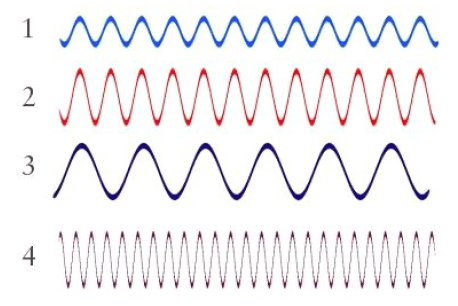
Which wave in the diagram has the greatest wavelength?
a)
1
b)
2
c)
3
d)
4
33.
The high or low pitch of a sound is related to the ___________ of the wave
a)
decibel
b)
amplitude
c)
frequency
d)
rest position
34.
How loud or soft a sound is, is related to the _____________ of the wave
a)
amplitude
b)
frequency
c)
wave length
d)
rest position
35.

Light waves bouncing off a surface is known as?

a)

Transmission

b)

Refraction

c)

Reflection

d)

Absorption

36.
Select the correct order of waves on the EMS 
a)
Radio, Micro, Infra, Visible, Ultra, X-ray, Gamma
b)
Gamma, X-ray, Ultra, Vis, Infra, Micro, Radio
c)
Vis, Micro, Infra, Ultra, X-ray, Gamma, Radio
d)
Micro, Radio, Vis, Infra, Ultra, X-ray, Gamma
37.
Which has the SHORTEST wavelength and, therefore, the highest frequency/most energy
a)
Radio waves
b)
Ultraviolet Rays
c)
Gamma Rays
d)
X-rays
38.
Which section of the spectrum is the ONLY one we can see?
a)
X-rays
b)
Visible Light
c)
Gamma Rays
d)
Ultraviolet Rays
39.
As the frequency of an electromagnetic wave increases, the amount of energy in that wave...
a)
increases.
b)
decreases.
c)
stays the same.
40.
The blue section of the wave is measuring _________________.
a)
wavelength
b)
crest
c)
trough
d)
amplitude 
41.
Bending of waves around an object (such as through a doorway)
a)
sound
b)
diffract
c)
pitch
d)
volume
42.
A disturbance that travels through a medium as a longitudinal wave
a)
sound
b)
wavelength
c)
pitch
d)
frequency
43.
This is the unit used to measure the volume of a sound. 
a)
Decibel
b)
Medium
c)
Vibration
d)
Oscilloscope
44.
The speed of a sound wave depends on
a)
the frequency
b)
the medium
c)
both air temperature and medium
d)
the air temperature
45.
travels through solids fastest because the molecules are closer together
a)
speed of sound
b)
wavelength
c)
frequency
d)
amplitude
46.

A transparent object that bends light into rainbow colors.

a)

prism

b)

mirror

c)

convex lens

d)

concave lens

47.

Light waves bounce off at many of angles because the surface is uneven.

a)

reflection

b)

refraction

c)

dispersion

d)

echo

48.
Why does a spoon look bigger in the water than it does on the top?
a)
The light refracts as it moves from air to water
b)
The light reflects as it moves from air to water
c)
The light absorbs as it moves from air to water
d)
The light is diffused as it moves from air to water
49.
when white light strikes a green wall, all of the visible wavelengths ?
a)
are absorbed
b)
are absorbed except for the green wavelength, which bounce off the wall
c)
Bounces off the wall
d)
Bounce off of the wall except the green wavelength, which is absorbed
50.

What picture shows light being absorbed by what it shines on?

a)
b)
c)
d)
51.
Two like charges:
a)
 neutralize each other.
b)
repel each other. 
c)
must be neutrons. 
d)
attract each other.
52.
The charge of an electron is:
a)
Positive. 
b)
Negative. 
c)
Electrons have no charge
53.
A metal spoon is an example of _____.
a)
a conductor
b)
an insulator
54.
What types of charges attract?
a)
Positive and Positive
b)
Positive and Neutral
c)
Negative and Neutral
d)
Positive and Negative
55.
Opposite charges
a)
attract
b)
have no force
c)
repel
56.
What is current measured in?
a)
Ω (Ohms)
b)
V (Volts)
c)
A (Amps)
d)
W (Watts)
57.
What is resistance measured in?
a)
Ω (Ohms)
b)
V (Volts)
c)
A (Amps)
d)
W (Watts)
58.
AC stands for ___.
a)
Alternating Current
b)
Attraction Connections
59.
Voltage is simply defined as...
a)
what 'pushes' electrons
b)
what 'stops' electrons
c)
moving electrons
60.
Good insulators are _______ resistors
a)
good
b)
bad
61.
Electricity that flows in a closed path is called a
a)
path
b)
current
c)
circuit
d)
light
62.
The mathematical relationship among Voltage, Current, and Resistance
a)
Faraday's Law
b)
Tesla's Law
c)
Edison's Law
d)
Ohm's Law
63.

What is the formula for Ohm's law?

a)

1+2=3

b)

RI=E

c)

V= IR

d)

E= MC2

64.

In the model, what do the arrows represent? (LT1/DOK1)

a)

The flow of current

b)

The flow of resistance

c)

The flow of voltage

d)

The flow of positrons

65.

What is the formula for voltage? (LT2/DOK1)

a)

V = (I x R) / 2

b)

V = I / R

c)

V = R / I

d)

V = I x R

66.
Magnetism is generated by moving
a)
protons.
b)
electrons.
c)
neutrons.
d)
elements.
67.
What do the lines around this magnet represent?
a)
North Pole
b)
South Pole
c)
Magnetic Declination
d)
Magnetic Field
68.
As the distance between two magnets increases (they get farther apart), the force between them:
a)
Increases
b)
Decreases
c)
Stays the Same
69.
What is responsible for the Magnetic Field around Earth?
a)
The Earth's crust
b)
The Earth's molton iron core
c)
The Earth's mantel
d)
The Sun
70.
The strongest part of a magnet is...
a)
the bars.
b)
the force field.
c)
the poles. 
d)
the middle.
71.

A magnet will pick up an object that is made of...

a)

plastic

b)

iron or steel

c)

glass

d)

copper

72.

What would happen is a north pole of a magnet came close to a north pole of another magnet?

a)

they would be attracted to each other

b)

they would be repelled from each other

73.

Every magnet has a:

a)

East and West pole

b)

North and South pole

c)

East and South pole

d)

North and West pole

e)

Chicago and Saint pole

74.
The picture is an example of an:
a)
Electric circuit
b)
Electromagnet
c)
Electric nail
d)
Electric power cell
75.
What is true about electricity and magnetic fields?
a)
Electricity is needed to create any magnet.
b)
Electricity always creates a magnetic field.
c)
Electricity is stronger than a magnetic field.
d)
Electricity prevents magnetic fields from occurring.