
 Worksheets
Physics IG 8
Total questions: 40
Worksheet time: 22mins

A sky diver is falling at terminal velocity. He has not yet opened his parachute. What is the direction of both the velocity and his acceleration?
A
B
C
D

Four objects are shown below. Each is acted on by two forces.
Which of the objects is in equilibrium ?
A
B
C
D
What is the efficiency of a solar cell if 1000 J of solar energy hits the cell and 200 J are converted into electrical energy?
10%
20%
30%
40%
What is electrical energy converted into when a drill is used?
Kinetic energy
Sound
Heat
All of the above

A
B
C
D
What is designed to change electrical energy into kinetic energy?
A. capacitor
B. generator
C. motor
D. transformer
When an object moves in a straight line, which statement is true?
When the object moves at a constant speed, the resultant force is zero
When the object accelerates, the resultant force is zero
When the object moves at a constant speed, the forward force is greater than the resistive force.
The object requires a resultant force in order to move at a constant speed.
Which of the following collections of properties contain only features which can be changed by a resultant force?
Speed, direction, mass.
Density, speed, shape
Shape, speed, direction.
Speed, direction, temperature
What is potential energy?
moving energy
stored energy
renewable energy
non renewable energy

A
B
C
D

In the image, energy is being transformed from...
chemical to electrical and then kinetic
chemical to kinetic and then potential
chemical to thermal and then kinetic
None
Complete the statement about the principal of Conservation of Energy.
Energy can be changed for one form to another but the total amount of energy
always increases
always decreases
does not change
varies according to the reaction
A Radio releases 250J of energy 10J is released as heat , How much is released as sound?
200J
220J
240J
260J
The % energy efficiency of an appliance is
total energy input/ useful energy output x 100
useful energy output /total energy input x100
total energy input x useful energy input x100
useful energy output /total energy input x50
Which energy transfer occurs when a match burns
chemical to thermal
chemical to nuclear
nuclear to chemical
thermal to chemical

A
B
C
D
A small steel ball is dropped from a low balcony. Ignoring air resistance, which statement describes its motion?
It falls with decreasing acceleration.
It falls with constant acceleration.
It falls with decreasing speed.
It falls with constant speed.

Which speed/ time graph applies to an object at rest?
A
B
C
D
Just after she jumps out of the plane (before the parachute opens). The relative forces will be
Weight force is equal to the friction force
Friction force is constant
Weight force is greater that the friction force
Friction force is greater than the weight force


The graph shows the vertical speed of a parachutist. At which point did they open the parachute?
A
B
C
D
When a parachute canopy is opened more drag is created because:
It has a large mass
It has a large surface area
It is travelling at terminal speed
The person is now vertical

This is a velocity time graph of a skydiver falling. Which point on the graph shows the point where the forces acting on him are equal?
A
B
C

A skydiver jumps from a plane. The instant she jumps, the force(s) acting on her are
Weight
Weight and air resistance
Weight and Friction
Air resistance
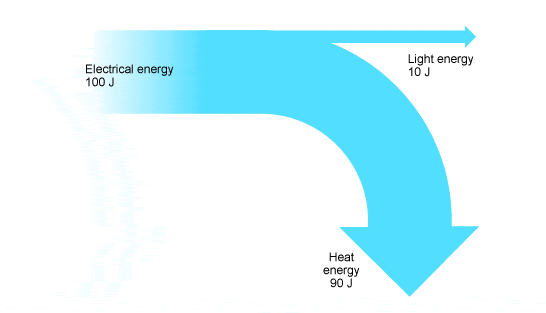


The energy efficiency shown in this diagram is:
About 10%.
About 30%.
About 60%.
Impossible to tell.

Identify the energy transfer
electrical to chemical to light
kinetic to potential
chemical to electrical to light
light to sound
A kettle uses 100J of electrical energy to produce 7J of sound energy and 93J of thermal energy. How efficient is the kettle?
100%
7%
93%
95%
A washing machine uses 250J of electrical energy to produce 125J of useful energy. How efficient is it?
5%
50%
55%
100%
A hairdryer uses 300J of energy to produce 60J of sound energy and 240J of thermal energy. Calculate it's efficiency.
80%
90%
20%
100%

Which of these equations is correct?
efficiency = total energy transferreduseful energy transferred
efficiency = useful energy transferredtotal energy transferred
energy = efficiency ×100%
efficiency = total energy tranferredwasted energy transferred
what is the unit of work?
Newton
Joule
Watt
meter
if you push a cart with a force of 60 N for 2 m... how much work have you done
120 J
30 J
120 N
30 N
Two people shove on a wall with 100 N. The wall doesn’t move. How much work is done?
100J
100N
0J
0N
There is no work done when a box is moved across the room. True or false?
True
False

